
Developing a model of rail failure
Modelling rail steel response for informed specification and selection of steel grades.
Models of rail steel response can help infrastructure managers and manufacturers make informed decisions on steel grade specification and selection. Semi-empirical ratchetting strain accumulation techniques are favoured for modelling rail failure due to their computational efficiency, being able to simulate tens of thousands of cycles in minutes. Recent developments in computational and materials characterisation methods have facilitated significant developments in the application of such techniques to modelling rail failure on a microstructural scale. These lay the foundations for future work, network scale models and the development of tools that fit into the infrastructure managers' predictive maintenance strategies for rapid evaluation of rail steel life and failure mechanism under a given traffic condition.
The UK rail network is one of the safest in Europe and is a key part of the UK’s decarbonisation strategy. Use of rail passenger transport has dramatically increased since the 1990s and a 20% increase in passenger rail usage by 2035 has been predicted by the Rail Industry Association. As a result, demand on the UK rail network is set to increase. Large scale infrastructure projects such as HS2 aim to alleviate some of the challenges faced by the industry by providing increased capacity but in order to meet requirements it is likely that more will be expected of the existing infrastructure. At the same time, the funding available for maintenance and renewals has been reduced and further efficiency savings are expected to be made. The UK infrastructure manager, Network Rail, has therefore adopted a predict and prevent maintenance strategy to achieve the required efficiency savings without compromising the record of safety in the UK. A significant priority to any rail infrastructure manager is preventing or limiting the accumulation of plastic strain in the rail as a result of the significant compressive shear loads the rail experiences as a train passes over it. Excessive accumulation of strain results in rail wear and the development of rolling contact fatigue cracks, two failure mechanisms that require intervention on the part of the infrastructure manager either to repair the rail or replace it completely.
Rail strain accumulation modelling can help to support infrastructure managers in making informed decisions when optimising the use of specific rail steels so that when a renewal does occur, the most appropriate grade of steel, that will require the least intervention with the longest working life for a given operating condition, is implemented.
Representing a failure mechanism that was previously overlooked has transformed the capabilities of the rail steel life prediction model. This has got the attention of the rail manufacturers as well as project sponsor Network Rail, with work now planned to look at microstructural response to thermal and impact loads.Prof. David Fletcher
University of Sheffield
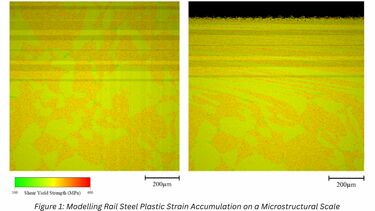
The semi-empirical ratchetting strain accumulation modelling technique was reimplemented in a GPU accelerated agent-based modelling environment. The new modelling framework and speed increases achieved facilitated the implementation of a previously unrepresented failure mechanism inspired by Peridynamics which captures mild wear. Microstructures that are geometrically representative of real rail steel microstructures, with mechanical properties derived directly from nanoindentation, have also been implemented. This has enabled the simulation of the wear and rolling contact fatigue response of modern harder rail steels under contact conditions that are reflective of those a full-scale rail might experience in service including long durations with lower loads and partial slip (in contrast to previous simulations which focused on accelerated failure under severe conditions). These additions to the model have also introduced the potential for future applications to other rail wheel contact phenomena and further developments of the modelling technique within the MERail research group at Sheffield. There is now the opportunity for the simulation of other wheel rail contact phenomena such as thermal conduction or corrosion and the future development into full scale applications.
Equipment used
UKRRIN (UK Rail Research and Innovation Network) funded equipment facilitated the application of novel characterisation methods to rail steels, enabling the development of a new model of rail failure. This equipment includes but is not limited to: SUROS2 (Sheffield University ROlling Sliding 2) twin-disc machine, Bruker Hysitron TS77 select nanoindenter, and Alicona PortableRF infinite focus microscope.
FLAMEGPU (Flexible Large-scale Agent Modelling Environment for GPUs) by Prof. Paul Richmond who is part of the Research Software Engineering (RSE) group at the University of Sheffield was used as the basis of the new model.

Biography
Philomenah is a postgraduate researcher at the University of Sheffield. Having originally graduated from the same institution with a BEng in Mechanical Engineering, she is now pursuing an EngD under the supervision of Professor David Fletcher. Her project, sponsored by Network Rail, is focused on how the metallurgy of modern rail steels affect wear and rolling contact fatigue behaviour.