
Assessing Short Range Order through the application of total scattering
Investigating Short Range Order of Ni₄Mo through total scattering to validate and expand on prior microscopy findings
Short range order (SRO) is an ordering phenomenon that occurs on an atomic scale and has been linked to both increases and decreases in mechanical performance. Currently, the formation of SRO, how to selectively engineer it into alloys and any direct connection to mechanical performance remain elusive, necessitating further research and technique development so that one day it may be used as a tool for alloy design and optimization.
SRO is generally split into two sub-types, namely homogeneous and heterogeneous SRO. Heterogenous SRO exists in the form of nanoscale ordered domains, within which elements are completely ordered and adopt a different structure from the surrounding matrix (Figure 1). While these ordered domains remain nanoscale in size, ordering may remain continuous out to several unit cells. Due to its nature and size, heterogeneous SRO is generally best observed and characterized through transmission electron microscopy (TEM) due to its high sensitivity to domain formation.
SRO of the homogeneous type does not result in the formation of ordered domains and instead manifests as a statistical preference in atomic neighbours (Figure 1). It is akin to letting people decide their own seating arrangement. People will generally prefer sitting next to people they like; having preferred neighbours though, does not mean that all people are sitting next to only their preferred neighbour. Due to its statistical nature, SRO of this type is best captured and described through total scattering, a bulk characterization technique that makes use of both Bragg and diffuse X-ray/neutron scattering.
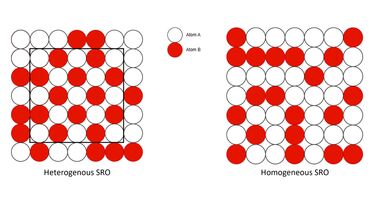
Figure 1: A model depiction of Homo- and Heterogeneous SRO. The heterogeneous SRO model, seen on the left, showcases continuous ordering of atoms within a domain (illustrated by the black square). However, outside of the domain, the structure returns to being “random” and is no longer continuous. Homogeneous SRO, depicted on the right, showcases that there exists no continuous ordering but that preferential neighbours exist, with atoms of type B preferring B atoms over A atoms, though it is not strictly enforced all throughout.
An example of why SRO is important is the use of Mo as a solid solution strengthener in nickel-based superalloys. It is well known that adding small quantities of Mo to superalloys result in a disproportionally large increase in mechanical performance. While the strengthening mechanism of Mo is largely attributed to the introduction of lattice distortions, it is also well known that Mo readily forms SRO in the much simpler Ni-Mo system, calling into question whether lattice distortions are the sole reason for observed increases in mechanical performance. However, studies assessing the SRO within Ni-Mo alloys generally rely on TEM, focusing largely on heterogenous SRO. Niels focuses on assessing the Ni4Mo alloy system through application of total scattering to capture the formation and evolution of SRO from a homogenous SRO perspective.
Carrying out a total scattering experiment starts with collecting high resolution diffraction data. Diffraction data used in my experiments was collected at Diamond Lightsource (X-ray) and ISIS neutron and muon source (neutron). Collected data were processed and refined to yield accurate average lattice parameters via the standard Rietveld approach. Raw diffraction data were also processed to yield pair distribution functions, a real space function indicating atomic pair distances. Lattice parameters obtained during Rietveld processing were used to build a large box, with pair distribution functions being used to drive large box refinement towards a statistically real representation of the sample. Once refined, large box models were interrogated for statistical enhancement in specific atomic configurations to assess SRO within Ni4Mo. Results are largely in good agreement with findings presented in TEM studies.
By assessing Ni4Mo through total scattering and combining findings with previous results obtained from TEM studies, we can paint a holistic picture of atomic scale ordering within the Ni-Mo system. By building a robust holistic picture, future research may be focused on how these SRO types of impact mechanical performance and how to optimize them for alloy design.
Equipment Used
Diamond Lightsource, ISIS Neutron and Muon source, GSAS-II, TOPAS, rmcProfile, GudrunX, GudrunN

Biography
Niels Schreiner, a joint PhD researcher based at The University of Sheffield and Diamond Lightsource has been investigating binary solid solutions to further validate the total scattering approach and gain insight into the propensity of common solid solution strengtheners' affinity for SRO formation. Prior to his PhD position at Sheffield University, Niels was studying chemistry at the University of Maastricht with a focus on solid state chemistry.