
Korea Futures: Society, Sustainability, and Transformation- Conference
On 26–27 March 2026, The Centre for Korean Studies (CKS) welcomed 13 speakers from nine countries to our annual conference, which this year was on the theme Korea Futures: Society, Sustainability and Transformation.

Across two days, the conference brought together a wide range of perspectives through six panels exploring Korea’s past, present, and future.
We opened the event with remarks from Professor Kate Taylor-Jones, Director of Research in the School of Languages, Arts and Societies.
Our keynote speaker, James Grayson (Emeritus Professor, University of Sheffield), went on to set the tone for the conference with a thought-provoking talk titled From “Tradition” to “Transformation”. He explored how Korean society has evolved through a combination of historical continuity, cultural adaptation, and religious change. Drawing on ideas influenced by Franz Boas, he introduced the concept of “emplantation” to describe how belief systems such as Christianity are integrated by working alongside existing traditions. His central message was that Korean modernity is not a break from the past, but an ongoing process of blending and transformation.
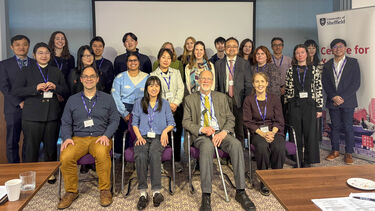
Day One focused on panels titled Ageing Society, Family, Home and the Everyday, and Korea’s International Relations.
We began by exploring ageing in South Korea, with speakers highlighting how policy, inequality, and social norms shape people’s experiences of later life. This was followed by a panel looking at how changing social structures are reshaping everyday life, from family dynamics to urban living and migrant experiences. The final panel of the day turned to Korea’s place in the world, examining issues such as security, nuclear policy, and diaspora politics, and reflecting on the peninsula’s shifting global role.
Day Two moved into panels on Popular Culture, AI, Digital Technology and Society, and Martial Law, Democracy and Governance.
The day opened with a panel on Korean popular culture, considering it as a global industry shaped by labour, technology, and power, alongside important questions around gender and representation. We then turned to the impact of digital technologies, particularly AI, with discussions highlighting both opportunities and challenges around innovation, risk, and inclusion. The final panel explored governance in Korea, looking at historical legacies, political crises, and evolving forms of civic participation, and raising important questions about authority, citizenship, and democratic change.
Once again our annual CKS conference created space for rich cross-disciplinary discussion and meaningful international exchange. Feedback from both speakers and attendees was very positive, with many highlighting the engaging programme and the quality of conversations throughout.