
School of Education researchers at Haute École Pédagogique in Lausanne
How can we identify and reduce ableist barriers to learning for students with disabilities in schools?

How can we identify and reduce ableist barriers to learning for students with disabilities in schools? This was the question animating a two-day symposium at Haute École Pédagogique Vaud (HEP) in Lausanne, Switzerland, which was attended by academics from the School of Education at The University of Sheffield.
HEP Vaud is the main training institution for teachers and school professionals in the French-speaking region of Switzerland. From 29 October to 30 October, the institution hosted a symposium addressing the topic of Ableism: An Invisible Wall At School? The symposium explored how ableism impacts students with disabilities in schools and research.
Prof Katherine Runswick-Cole and Dr David Ben Shannon, two academics from The School of Education at the University of Sheffield, were invited to deliver a public keynote at the symposium alongside Prof Patty Douglas from Queens University, Ontario, Canada. The opening keynote explored the key differences between the medical model and the social model of disability, as well as the kinds of disability affirmative practices that might reduce barriers to learning in schools. The keynote was attended by academics at HEP, as well as teachers from special and integrated schools, and two Members of the Ministry of Education. The keynote was delivered hybrid and attended by around 60 people.
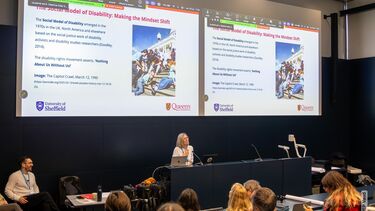
During their presentation, Katherine discussed the meanings of ableism in the context of education, drawing on recent research with colleagues in the School of Education on the WAARC: Wellcome Anti-Ableist Research Culture project. She shared anti-ableist resources with colleagues as well as artwork from the recently completed Tired of Spinning Plates project by the artist and parent carer, Becky Whinnerah.
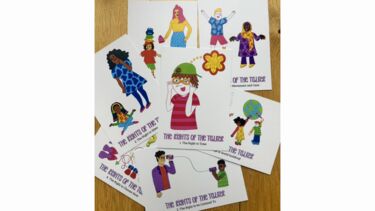
David shared research from the Rights of the Talker project to discuss how educators can challenge ableist assumptions in their own practice. Developed for the book Language, Place and the Body in Childhood Literacies and illustrated by artist Lo Tierney, the Rights of the Talker is a disability-affirmative practitioner resource that recognises and values the diversity of children’s communication practices. It was developed by a group of researchers and practitioners, including David, Abigail Hackett, Vishnu KK Nair, Warda Farah, and Khawla Badwan. You can learn more about Rights of the Talker at the project’s website: RightsOfTheTalker.shu.ac.uk
Presenting at HEP Vaud continued to develop a relationship with HEP Vaud first established at the European Congress of Qualitative Inquiry in 2024. It also builds on the strong collaborations already existing between the University of Sheffield and Queens University.

iHuman
How we understand being ‘human’ differs between disciplines and has changed radically over time. We are living in an age marked by rapid growth in knowledge about the human body and brain, and new technologies with the potential to change them.