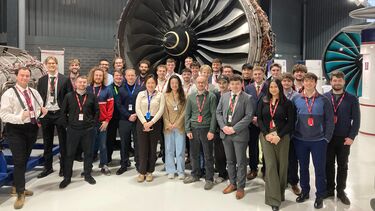
Jet engine innovation earns Aerospace students top prize
Aerospace engineering undergraduate students take first place for their work on understanding the effects of advanced manufacturing processes on the performance of safety critical titanium alloy parts as part of the Industrial Training Programme.

Aerospace engineering undergraduate students from the School of Mechanical, Aerospace and Civil Engineering, working on real-life engineering problems set by industry partner Rolls-Royce, came first for their work to understand the effects of advanced manufacturing processes on the performance of safety critical titanium alloy parts as part of the School of Chemical, Materials and Biological Engineering’s (CMBE) Industrial Training Programme (ITP) in Aerospace Materials and Manufacturing.
The winners investigated how machining affects the surface quality integrity of a critical rotating titanium alloy part. Competing against very tough competition, every group delivered professional results and served as great ambassadors for the university.
The ITP is a 12-week module delivered to Aerospace Engineering MEng undergraduates by staff from CMBE, Henry Royce Institute alongside Rolls-Royce engineers. The module challenges small groups to solve current and pressing technical materials and manufacturing issues - from developing new AI techniques to rapidly assess changes in part performance through to developing bespoke testing to accelerate the impact of process changes on part structural integrity. The projects are defined by Rolls-Royce and students need to be pro-active and apply their materials science and engineering knowledge to solve open-ended industrial problems.
Over the last five years the CMBE module has been boosted by a generous annual donation from the Armourers and Brasiers’ Gauntlet Trust which has enabled the students to undertake more industrial visits and tap into a larger consumable budget. This year, students were lucky enough to witness steel engine shafts - arguably the most critical component - being hot forged at Special Melted Products in Sheffield through to the high speed machining of the same parts in Derby, prior to inspection and engine assembly.
Martin Jackson, Professor of Advanced Metals Processing, said: “The ITP has been running for over 12 years, delivered 74 project technical reports and provided unique training to over 400 aerospace engineering students. The programme has become an integral part of what we do at Sheffield and we look forward to the next 12 years of technical challenges with Rolls-Royce and training the next generation of aerospace engineers in the discipline of materials and manufacturing.”