Focus on Linguistics with Visiting Scholar Dr Truus De Wilde
Dr Truus De Wilde (Freie Universität Berlin), a sociolinguist and expert in language variation, language ideology, and language attitudes, delivered specialist sessions and a public reading as part of our Focus on Linguistics week in Dutch Studies.

No beef reepjes and Zeesticks: New Names for Vega(n) Food
"Two hours with Dr De Wilde made me entirely rethink the marketing techniques used to sell vegetarian and vegan food.
Erin Molyneux
BA English and Modern Languages
“Linguistics is everywhere,” says De Wilde. In March 2026, EU Lawmakers outlawed the use of 31 meat-related names for vegetarian and vegan products as part of efforts to help livestock farmers in food supply markets. In De Wilde’s linguistics sessions, our students explored the language strategies and patterns at work in the Dutch names and descriptions of ‘no meat products’, analysing visual food-related documents such as advertisements, packaging, etc.
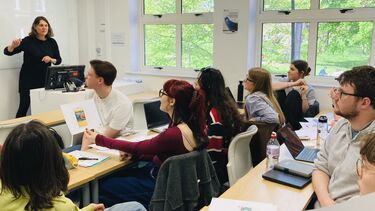
"Two hours with Dr De Wilde made me entirely rethink the marketing techniques used to sell vegetarian and vegan food", Erin Molyneux (BA Dual English with Dutch and German) observed. "I wasn't aware that the names we give to these foods can be so controversial, or that there are so many rules to adhere to. I loved learning about Dutch and Belgian perspectives and language strategies, specifically how they compare to those of the British. Now I can't shop without studying the packaging!”
"Own Words for Own Worlds": On Surinamese-Dutch
We know that the legacy of colonialism lasts much beyond the official ending of national relations. This can be through the language a nation speaks, or adopts, upon independence. In Suriname, the role of Dutch remains a point of deep reflection and debate, a topic explored in Truus De Wilde’s public seminar on 22 April 2026.
We know that the legacy of colonialism lasts much beyond the official ending of national relations. This can be through the language a nation speaks, or adopts, upon independence. In Suriname, the role of Dutch remains a point of deep reflection and debate, a topic explored in Truus De Wilde’s public talk during our Focus on Linguistics week.
The tension between history and identity was perhaps best captured in 2008 by Paul Middellijn, who suggested in the New York Times: “We shook off the chains of Dutch colonialism in the 1970s but our consciousness remains colonised by the Dutch language.” This sentiment underscores a complex reality where the language of the former oppressor remains the official tongue long after the end of colonial rule.
While Suriname is a vibrant melting pot of many languages, Dutch maintains its position as the prestige language of the state. It is the mandatory professional requirement and serves as the primary language of instruction at the country's only university, Anton de Kom. This status is reinforced by the enduring social and familial links between Suriname and the Netherlands, which many Surinamers call home either temporarily or permanently. However, while Dutch is the official voice of the government, Sranan Tongo remains the true lingua franca of the streets, spoken by 90% of the population despite having no official status.
Pluricentric Language
A significant shift is occurring in how this linguistic relationship is defined. Dr De Wilde argues that because Dutch is now recognised as a pluricentric language—one language with multiple standardised and codified variations—there is a growing opportunity to validate Surinamese-Dutch as a legitimate variety in its own right. Rather than being seen as a secondary version of the European standard, Surinamese-Dutch is emerging as a language with its own unique vocabulary and distinct pronunciation. By embracing "own words for own worlds," the people of Suriname are reflecting a growing self-awareness, transforming a colonial inheritance into a tool for national identity.
Growing Collaboration
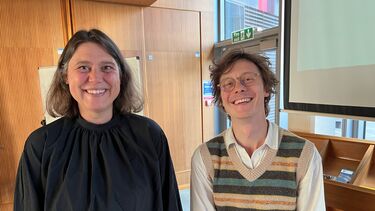
Dr De Wilde’s visit was part of a growing partnership between Dutch at Sheffield and Dutch at the Freie Universität Berlin. Dr Filip De Ceuster visited Berlin in November 2025 and Dr Henriette Louwerse in January 2026. Dr De Wilde's visit was generously sponsored by the Dutch Language Union (Taalunie).

Visit us
Discover what sets Sheffield apart at our next undergraduate open day in November.