
APT Programme
Aphasia Partnership Training Programme:
Developing training to help improve communication between people with aphasia and their partners.

APT launch meeting
We held a launch meeting on Tuesday 20th January 2026, where the Chief Investigators introduced the APT programme to an audience of over 50 healthcare professionals over Microsoft Teams. To watch the recording of the launch meeting, visit the following link:
APT launch meeting recording
We also have opportunities to get involved with APT further down on this page, particularly for NHS trusts wishing to participate in the trial.
APT
The Aphasia Partnership Training programme (APT) is funded by an NIHR Programme Development Grant, and sponsored by Sheffield Teaching Hospitals NHS Foundation Trust. It is jointly led by Professor Rebecca Palmer from the University of Sheffield and Professor Madeline Cruice from City St George’s, University of London.
APT is co-designing and evaluating a novel Communication Partner Training programme for people with aphasia and their communication partners. The Sheffield CTRU will lead a randomised controlled trial in approximately 30 NHS speech and language therapy services.
Background
Approximately 40% of stroke survivors have the communication disorder ‘aphasia’ making it difficult to talk, understand what others say, read, and write. People with aphasia and their communication partners (family, friends, paid carers) cannot understand and support each other, leading to communication breakdown, frustration, distress, isolation and unhappiness for both people.
Communication Partner Training aims to improve communication between individuals with aphasia and their communication partners. Several small studies suggest that this can help, although better evidence is needed to confirm its effectiveness. Additionally, it has not been described in enough detail for speech and language therapists to provide it. Existing research and patient group discussions highlight that not many NHS patients and partners are offered this training.
Research aims
Develop a new Communication Partner Training programme and manual for NHS delivery to people with aphasia and their communication partners living in the community, in a programme called Aphasia Partnership Training (APT)
Evaluate APT and its value for money
Understand and develop resources to support the UK-wide NHS delivery of APT
Design and methods
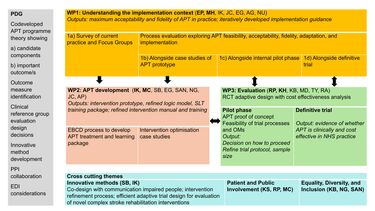
Work Package 1 investigates the UK implementation context of CPT delivery with a survey of current practice; iteratively tests feasibility, acceptability and fidelity of a novel CPT using process evaluation methods alongside case studies, pilot, and definitive phases of an adaptive trial; and designs implementation guidelines.
Work Package 2 develops the novel CPT and NHS speech and language therapist learning package through Experience-Based Co-Design with key stakeholders. The CPT and learning package will be refined following initial case studies. Further minor refinements may be made based on findings of the pilot phase of the trial.
Work Package 3 delivers a randomised controlled trial using an adaptive design to evaluate clinical and cost effectiveness of our novel CPT in ~28 UK NHS services randomising 336 dyads to CPT plus usual care versus usual care alone. The first 50 dyads will contribute to an internal pilot informing progression with the definitive trial.
The following diagram illustrates how the 3 work packages link together:
Get Involved: NHS Trusts
To evaluate the clinical and cost effectiveness of APT, developed in WP2 as described above, we will conduct a randomised controlled trial.
Our overall objectives are to establish whether:
- APT improves communication of PWA and communication partners.
- Communication improvement is maintained long term.
- Delivering APT is cost-effective.
The trial also seeks to investigate the impact of APT on:
Thoughts and feelings of PWA and their partners.
The relationship between the PWA and their partner.
The ability of the PWA to use more language in conversation.
We are looking for NHS Trusts who are interested in being involved in evaluating the new APT programme. As the intervention is still being designed, the trial is expected to start around November 2027. We are looking for expressions of interest for sites who may want to recruit to the APT trial.
If you are interested, please complete the following Google Form:
If you would like to discuss further before completing the form, please contact:
If you have recently expressed interest by emailing us, thank you. This has been recorded and there is no need to do so again.
What we will need from participating trusts
- To recruit 1 person with aphasia/communication partner dyad per month for 12 months (i.e. total of 12 dyads).
- Dedicated SLT time (approx. 1/2 day) for research tasks (paid directly to the Trust from the research trial), additional time paid from Service Support Costs.
- Dedicated SLT time for APT delivery (will be paid for in arrears from excess treatment costs).
- SLTs who can do ad hoc outcome measure assessments (approx. 24 outcome measures required each taking half a day) (to be paid from the research budget for each assessment completed).
Benefits of taking part
- We hope to reimburse time costs at band 7 (this could provide opportunities for band 6 staff to step up into a band 7 role).
- Other financial support arrangements, including budget site set-up and archiving fees, and accruals.
- Training in a new therapy and research methods (free CPD).
- We will provide new assessments and video cameras (that can be kept after the trial!).
- Patient benefits related to being in a trial.
Contact Us
If you have any questions or if you are interested in taking part, please email:
apt-programme@sheffield.ac.uk.
Patient and public involvement
A PPI group of 11 diverse individuals, made up of people with aphasia and communication partners, will be involved throughout the programme. The group, led by Kate Sudworth will provide support and guidance to the study team on all aspects of the research.
- PPI Group
Name Stroke Survivor or Communication Partner Time Post Stroke (at start of programme) Kate Sudworth (PPI lead) Family (wife) 15 years Colin Lyall Stroke Survivor 12 years Meneka Sandhu Family (daughter) 4 years Karen Fawley Family (wife) 3.5 years Zoë Mitton Stroke Survivor 3 years Johnnie Mitton Family (partner to Zoë) 3 years Phil Skelson Stroke Survivor 20+ years Gita Ladher Stroke Survivor 3 years Neville Sankey Stroke Survivor 1.5 years Samya Whaites Family (daughter to Neville) 1.5 years Chris McKevitt Stroke Survivor 6 years
Programme Management Group
- PMG
Name Role Organisation Email Prof Rebecca Palmer Chief Investigator
PPI Lead
Co-Lead of WP3
Professor of Communication and Stroke Rehabilitation
Speech and Language Therapist
University of Sheffield r.l.palmer@sheffield.ac.uk Prof Madeline Cruice Co-Chief Investigator
PPI Lead
Co-Lead of WP2
Professor of Aphasia Rehabilitation and Recovery
Speech and Language Therapist
City St George's, University of London m.cruice@citystgeorges.ac.uk Prof Suzanne Beeke Co-Investigator
Innovative Methods Lead
University College London s.beeke@ucl.ac.uk Prof Ian Kellar Co-Investigator
WP2 Lead
Innovative Methods Lead, Professor of Health Psychology
University of Sheffield i.kellar@sheffield.ac.uk Emma Gibbs Co-Investigator Sheffield Teaching Hospitals NHS Foundation Trust emma.gibbs@nhs.net Dr Jo Coster Co-Investigator University of Sheffield j.e.coster@sheffield.ac.uk Prof Katerina Hilari Co-Investigator
WP3 Co-Lead
City St George's, University of London k.hilari@citystgeorges.ac.uk Dr Munya Dimairo Co-Investigator
Senior Statistician
CTRU, University of Sheffield m.dimairo@sheffield.ac.uk Prof Emma Power Co-Investigator
Joint-Lead of WP1
Professor of Speech Pathology, Speech and Language Therapist
University of Technology, Sydney emma.power@uts.edu.au Dr Madeleine Harrison Co-Investigator
Joint-Lead of WP1
University of Sheffield madeleine.harrison@sheffield.ac.uk Prof Nan Greenwood Co-Investigator
EDI Lead
City St George's, University of London Nan.Greenwood@citystgeorges.ac.uk Dr Sharon Adjei-Nicol Co-Investigator
EDI Lead
Canterbury Christ
Church
University
sharon.adjei-nicol@canterbury.ac.uk Katie Biggs Co-Investigator
CTRU Lead
EDI Lead
CTRU, University of Sheffield c.e.biggs@sheffield.ac.uk Prof Tracey Young Co-Investigator
Health Economist
University of Sheffield t.a.young@sheffield.ac.uk Kate Sudworth Co-Investigator
PPI Representative
N/A cathrin.sudworth@sky.com Elaine Scott Programme Manager Support CTRU, University of Sheffield elaine.scott@sheffield.ac.uk Sarah Wilkinson Sponsor Representative Sheffield Teaching Hospitals NHS Foundation Trust sarah.wilkinson71@nhs.net Dr Analisa Pais Research Fellow – WP2
Speech and Language Therapist
City St George's, University of London analisa.pais@citystgeorges.ac.uk Natascha Ullrich Speech and Language Therapist University of Sheffield cm4nu@sheffield.ac.uk Sienna Hamer-Kiwacz Programme Manager CTRU, University of Sheffield s.a.hamer-kiwacz@sheffield.ac.uk Dr Ann George Research Associate – WP1 University of Sheffield a.m.george@sheffield.ac.uk George Cleaver Programme Support Officer CTRU, University of Sheffield g.j.cleaver@sheffield.ac.uk
Funding and sponsor
This project is funded by the Stroke Association and the National Institute for Health and Care Research (NIHR) PGfAR NIHR208121. The views expressed are those of the author(s) and not necessarily those of the NIHR or the Department of Health and Social Care.
APT is sponsored by Sheffield Teaching Hospitals NHS Foundation Trust.
Contact
You can email the team at:
apt-programme@sheffield.ac.uk