
General Engineering BEng (Hons)
Gain both academic knowledge and practical experience on this unique interdisciplinary degree, taught by world-leading academics across seven departments. Develop a strong understanding across engineering disciplines and how they all fit together, before specialising in your area of interest.
-
A Levels
A*AA -
UCAS code
H103 -
Duration
3 years -
Start date
September -
Attendance
Full-time
- Course fee
- Funding available
- Optional placement year
- Study abroad option
Explore this course:
Course description
Why study this course?
Top five for general engineering
Sheffield is one of the top five UK universities for the subject, according to The Guardian University Guide 2025.
Customise your degree
Study here and you have the option to specialise in six streams across the Faculty of Engineering – from aerospace to software engineering.
Access expert teaching
Get support from across the faculty and sample engineering from many different angles to help you decide your future engineering discipline.
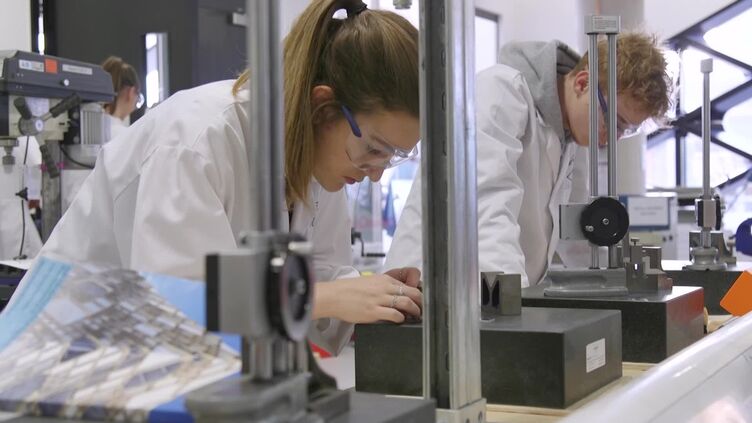
Practical, hands-on experience
Benefit from state-of-the-art laboratories across the University, including everything The Diamond has to offer.

Build the strongest foundations for your career by becoming a truly interdisciplinary engineer.
With a selection of modules from four engineering schools and a choice of six specialisms, you'll immerse yourself in the varied fields of engineering.
In an increasingly complex and challenging world, knowledge and expertise beyond a single discipline is invaluable for 21st century engineers.
Taught by world-leading experts from our four outstanding engineering schools, this three-year course will ensure you develop the broadest possible understanding of the field.
During years one and two, you'll study modules across all disciplines, after which you’ll choose one of six possible specialisms - or continue studying a variety of subjects.
You'll spend year three studying your chosen stream. The interdisciplinary ethos of your degree will be continued in the industry led final-year project.
Placements and study abroad
Placement
Study abroad
Modules
A selection of modules are available each year - some examples are below. There may be changes before you begin your studies. As you progress through your course, we’ll confirm additional details for the core and optional modules available to you.
Choose a year to see modules for a level of study:
UCAS code: H103
Years: 2026, 2027
In year one you will be taught a range of fundamental engineering principles that will equip you with a strong foundation of engineering knowledge.
Core modules:
Core modules:
- Mathematics for Engineers
-
This module aims to reinforce your previous knowledge and to develop new basic mathematical techniques needed to support the engineering subjects taken at Years 1 and 2. It also provides a foundation for your Year 2 study of mathematics in engineering. The module is delivered via online lectures, reinforced with weekly interactive problem classes.
20 credits - Interdisciplinary Design
-
Effective interdisciplinary design lies at the heart of the engineering of complex products and systems. It is important that engineers can communicate and work effectively together and have a common language and processes to manage projects effectively. This module will introduce concepts in, and tools for, interdisciplinary engineering design important for effective project management. You will then apply your skills to design a solution, developing your critical thinking skills and taking an interdisciplinary approach to solving engineering problems. The module will be based around interdisciplinary design exercises conducted in multidisciplinary teams. We will help you reinforce your group-working skills and appreciation of wider issues and regulations.
20 credits
In parallel to your interdisciplinary studies, you will undertake workshops on computer-aided design, drawing and manufacturing.
As part of this module, you will also undertake a focussed, week-long, cross-faculty interdisciplinary design activity aimed at equipping students with essential teamwork, design, problem-solving, and communication skills. Particular attention is paid to employability, sustainability, and inclusivity. Through real-life engineering projects, you will be introduced to tackling complex challenges. - Programming for Engineers
-
The first part of this module introduces basic concepts of computer programming, through an introduction to problem solving and the development of simple algorithms using the programming language Python. The module will stress the importance of good programming style and good code design and will introduce how an object-oriented approach can help to achieve these aims. The second part of this module introduces some of the fundamental principles of object oriented programming and software engineering using the Java Programming Language. It introduces models of real-world systems. Techniques for developing sound programming techniques are introduced and applied.
20 credits - Structural Mechanics
-
This module is delivered in both the Autumn and Spring Semesters. Teaching in the first semester is designed to provide a basis of knowledge and understanding of elastic structural analysis and will be applied to two key structural forms - trusses and beams. The focus of the second semester is on the analysis of stress, strain and elastic deformation of beams.
20 credits - Materials and Process Engineering
-
This module provides an overview of the materials available to engineers, and how they can be processed. Different types of materials and how they are selected will be introduced, along with the manufacturing methods that are used with them, and how these affect the materials performance. Then the module continues by developing and applying the process synthesis method to design a process. This is then extended to the development of material balances, which are a fundamental tool of process engineering, and are presented in the context of industry. Later this module expands the process engineering design toolkit to include the development of energy balances. The concept is applied to a wide range of process units such as chemical reactors, heaters/coolers, mixers, distillation columns, evaporators, cooling towers, crystallisation, distillation columns, and boilers. Such processes make up the bulk of the unit operations seen in both existing and emerging process industries. A firm grounding in sustainability is included in the context of separation processes such as distillation by ensuring the energy requirements for processes are minimised and hence the processes are as sustainable as possible.
20 credits - Electrical Engineering
-
You will be introduced to electrical engineering. You will learn about the core elements of circuits and how these are analogues of many other physical processes. You will become adept at analysing fundamental passive and active circuits using a number of techniques. The fundamentals of engineering magnetics and large-scale power are also introduced. Electrical engineering is presented in the wider context of interdisciplinary engineering by identifying a number of crucial synergies. You are encouraged to appreciate both the depth and fascination of electrical engineering as a distinct subject, and its broad application across the entire engineering discipline.
20 credits
You'll spend your second year further developing these foundations and improving your project design skills, before specialising in your third year.
Core modules:
Core modules:
- Fluid Mechanics
-
Fluids are everywhere in engineering. They shape how water is supplied and managed, how energy is generated and transported, how vehicles move through air and water, and how natural and built environments respond to change. This module provides an engaging first introduction to fluid mechanics, giving you the tools to understand and analyse how fluids behave in real engineering systems.
20 credits
You will develop a physical feel for fluid flow and learn how engineers describe, predict and control it using fundamental principles. The module emphasises problem-solving, interpretation of results, and understanding the assumptions behind common engineering models. Along the way, you will see how fluid mechanics connects to a wide range of applications across mechanical, aerospace, civil, environmental and energy engineering.
The module also introduces modern computational approaches used by engineers to study fluid flow. Rather than focusing on software alone, you will learn how to critically interpret computational results and relate them back to real physical behaviour.
Module aims:
To introduce the core principles that govern fluid behaviour in engineering systems.
To develop confidence in analysing and interpreting fluid flow problems using established methods.
To build physical intuition about how real fluids behave, and why simplifying assumptions matter.
To provide a strong foundation for more advanced study in fluid mechanics and related engineering topics.
Teaching is delivered through a combination of lectures, interactive problem-solving activities and applied examples designed to link theory with real-world engineering practice. - Design and Mathematics
-
This module will develop your interdisciplinary design skills through a team-based project focused on designing and building a product-scale solution. You will apply technical knowledge, systems thinking and project management approaches, working with increasing independence and creativity. The project encourages consideration of ethical, social, environmental and regulatory factors, reinforcing professional practice and sustainable design.
20 credits
The module also reinforces mathematical ideas met in year 1 and develops further mathematical concepts applicable across the full range of engineering disciplines. You will gain an understanding of a range of mathematical techniques and confidence in applying them to solve problems, including within the design and build element of this module.
As part of this module, you will also undertake a focussed, week-long, cross-faculty interdisciplinary design activity, aimed at equipping you with essential teamwork, design, problem-solving, and communication skills. In addition to a focus on employability, sustainability and inclusivity, you will apply more advanced engineering technical knowledge to industry-relevant, complex and interdisciplinary problems. - Thermodynamics and heat transfer
-
Unlock some core principles of chemical engineering and materials processing exploring thermodynamics and heat transfer. This foundational knowledge is crucial for designing and operating sustainable chemical processes and for determining the composition and microstructure and thus properties of materials.
20 credits
You'll delve into thermodynamics, understanding energy utilization, efficiency, and the vital role of thermodynamic equilibrium. You will extend this to cover phase diagrams and how materials mix, highlighting how different processing can lead to different phases of materials. You'll explore the first and second laws of thermodynamics, analyzing power and refrigeration cycles.
Finally, we'll consider the processes of heat and matter transfer, including conduction, convection, radiation as well diffusion. This will prepare you to a) design efficient heat transfer equipment and to the stability and formation of materials. - Mechatronics and Electrical Power
-
The conversion of energy from one form to another, is a core aspect of engineering. For example, motor vehicles take chemical energy and transform it into mechanical energy. Building on your knowledge of fundamental electrical engineering, this module provides you with an introduction to electrical power which is controlled by electrical and magnetic means. Electric machines, magnetic transformers and power electronic converters are the core topics. You will also appreciate how electromechanical energy conversion can be relevant to many traditionally non-electrical disciplines.
20 credits
In the mechatronics part of the module, you will receive a comprehensive foundation in the design, intelligence and integration of modern robotic systems. Beginning with the physical aspects of robotics, we will examine diverse locomotion techniques and the fundamental components (actuators, mechanisms and sensors) that dictate robot function. You will cover essential concepts in mechanical design and system integration necessary for robot fabrication and assembly. You will also investigate broader societal and ethical implications of robotic technology.
Optional modules:
Optional modules:
- Structural Analysis and Design
-
This module focuses on detailed concepts of elastic and plastic structural analysis methods for statically determinate and indeterminate structures and covers fundamental principles and theoretical background of structural design concepts. Computational structural analysis is introduced as well as giving hands-on experience with laboratory sessions.
20 credits
The module will also provide a comprehensive introduction to the design of key structural elements. You will transition from basic structural analysis to the practical application of design codes. Emphasis is placed on our responsibility to ensure structural safety through rigorous calculation and minimize environmental impact through sustainable material specification and simple structural optimisation. - Energy Materials and Sustainable Manufacturing Processes
-
You will explore sustainable technologies including examining the processes required to make them. Specific attention will be paid to the electrical and magnetic properties of materials. Electrical conductors, insulators, field gradient, resistivity. Insulators, semi-conductors, metals, mixed conductors and solid electrolytes and their roles in energy generation and storage will be examined. The basics of magnetism and the effect of magnetic fields on materials and the classification of magnetic materials and their role will also be covered. The selection and design of process equipment found in materials production plants, including aspects of control, scale-up methods and short cut design procedures. You will be introduced to product design including various techniques necessary for the selection of ideas and screening of alternatives, as well as the details of manufacturing and economic considerations. Process safety and loss prevention from industrial processes will also be introduced.
20 credits - Control and Analogue Electronics
-
Understanding the dynamics of systems and how to control their behaviour to meet stability and performance criteria is critical to a wide range of engineering disciplines. This module will show you how the dynamics of many engineering systems can be modelled, analysed and controlled in a unified way. This will include some basic mechatronic systems.
20 credits
Using examples from across engineering, you will gain an understanding of how to unify these strategies in both continuous and discrete time. You will learn how to design controllers to meet performance and stability criteria while appreciating the practical limitations and implications of these controllers.
The analogue electronics section of the module brings together the underlying physical principles of transistors to show how structural decisions in device design affect performance as a circuit element. Basic circuit topologies such as long-tailed pairs, Darlington transistors and current mirrors are described as a precursor to exploring the internal design of a typical op-amp.
In your third year, you'll have the opportunity to choose a specialism, allowing you to specialise in areas that align with your interests while continuing to build a broad technical foundation.
For Biomedical specialism, you'll need to choose both modules under either route A or B for your optional modules; you cannot mix and match between the two routes.
Third year core modules:
Third year core modules:
- Individual Project
-
This module is an important project where you will demonstrate your engineering competence at bachelor level. Working individually under the supervision of a member of academic staff, you will undertake an individual project to further develop your skills and gain new project-specific knowledge through independent learning and experimentation. To do this, you will need to draw on all the skills, knowledge and experience you have acquired during your studies.
40 credits
As part of the project, you will undertake a critical evaluation of technical literature, plan and manage time and resources in your project and convey the results to an audience using a combination of written and non-written techniques appropriate to the background of the audience.
Alongside your project, you will learn the fundamentals of engineering management, finance, law and the commercial context in which industrial projects sit. - Biomedical Engineering Research, Careers and Employability Topics
-
In this module, a diverse range of industrial speakers are invited to deliver seminars on their career and professional experience. Many will be former course alumni, and all are recognised experts and leaders in their respective fields. They work across start-ups to multinational companies and span many stages of career progression, from recent graduates to board level roles. Students will hear about potential career pathways and related career decisions taken by the speakers, alongside practical application advice from active employers. Opportunities for networking, interaction, discussion and debate with speakers are expected and encouraged. From this module students gain important insights that will allow them to enhance their own employability and present themselves effectively in the global job market.
20 credits - Design of Medical Devices and Implants
-
The purpose of this module is for students to gain knowledge and experience in designing medical and assistive devices and implants, which underlines the role played by a Biomedical Engineer/Bioengineer. Topics include a survey of world health and clinical problems, the need for solutions in the developed, developing and underdeveloped countries; the principles of medical device and implant design; design parameters and specifications; design for an assistive product, engineering analysis; preclinical testing for safety and efficacy, risk/benefit ratio assessment, evaluation of clinical performance and design of clinical trials, ethics in human and animal research, business model analysis. Case studies and topical discussions are used to aid further understanding of specific topics.
15 credits - Innovation and Commercialisation in Medical Devices and Implants
-
The purpose of this module is for students to gain knowledge and experience in designing and commercialising medical and assistive devices and implants, highlighting the role of Biomedical Engineers/Bioengineers in innovation, entrepreneurship, and responsible, financially informed design across the full translation pathway.Students will learn the principles of medical device and implant design, including identifying clinical needs, stakeholder engagement, market analysis, and concept generation and selection. The module covers key aspects of commercialisation such as intellectual property (IP) strategy, regulatory pathways, business models, costing and pricing strategies, reimbursement considerations, funding routes, and early-stage investment. Students will also examine security and data protection requirements, particularly for software-enabled, connected, or AI-based medical devices, alongside sustainability considerations including lifecycle analysis, material selection, manufacturability, and environmental impact.In addition, the module explores design parameters and specifications, risk/benefit ratio assessment, preclinical safety and efficacy testing, evaluation of clinical performance, and the design of clinical trials. Emphasis is placed on RandD strategy, ethical considerations in animal and human testing, and the entrepreneurial process of bringing a medical device from concept to market, including balancing technical performance with financial viability, regulatory compliance, security, and sustainability constraints. Case studies and topical discussions are used throughout to support understanding of real-world industry challenges and to develop the skills required to translate innovative medical technologies into practical and scalable healthcare solutions.
20 credits
Third year optional modules - route A (Medical Devices):
Third year optional modules - route A (Medical Devices):
- Control Systems Design
-
In this module, we will show you how to design, implement and evaluate modern control systems from start to finish. You will explore how to model and analyse dynamic systems using both first-principles and data-driven approaches, and how to identify system behaviour when models are imperfect. We'll introduce state feedback, observers, and Kalman filtering to help you estimate system states in the presence of noise and uncertainty. You will then learn to design advanced controllers, including linear quadratic regulators and linear model predictive control, and test them in both simulation and on a real system using hardware-in-the-loop setups.
20 credits
Throughout, we will emphasise responsible engineering practice, including considerations of safety, efficiency, resource use and environmental impact. By the end of the module, you will have the skills and confidence to take a control concept from theory through to real-world implementation and evaluation, considering both technical performance and sustainability. - Robotic Systems
-
A central challenge in modern robotics is the requirement to operate effectively outside of highly controlled factory environments. Advanced robotic systems must move across complex terrain, interact with delicate objects, or operate at extreme scales. This shift necessitates the development of highly adaptable systems that integrate advanced mechanical designs with sophisticated sensing and control.
20 credits
In this module, you will learn advanced design principles across four distinct robotic domains, including:-Locomotion, studying the kinematics and dynamics of limbed, underwater, and aerial systems.-Grasping and manipulation, where you will investigate robot gripper/hand design and the mechanics of contact.-Soft and biomimetic robotics, focusing on novel materials and bio-inspired movement, -Modular and micro-robotic systems, studying integration and scaling challenges in this advanced domain.
The module will be taught through a combination of lectures, computational laboratories, and systems design projects. Through these activities, you will develop the design principles and practical skills needed to model, design, integrate, control and evaluate complex mechatronic systems using industry-standard platforms.
Third year optional modules - route B (Biomedical):
Third year optional modules - route B (Biomedical):
- Anatomy, Physiology and Medical Imaging
-
This module introduces core concepts in human anatomy, physiology, and medical imaging technology. It covers the structure and function of major body systems, with a focus on systemic anatomy and the physiology of the musculoskeletal, cardiovascular, and respiratory systems. You will learn the fundamental principles of medical imaging and explore how technologies using both ionising and non-ionising electromagnetic radiation - such as X-ray and magnetic resonance imaging (MRI) - support diagnosis and patient care. Emphasis is also placed on understanding human physiological function and developing problem-solving skills relevant to biomedical engineering.
20 credits - Clinical Engineering and Computational Mechanics
-
The complexity of the geometry and boundary conditions of structures within the body are such that the physical governing equations rarely have closed-form analytical solutions. This module describes some of the numerical techniques that can be used to explore physical systems, with illustrations from biomechanics, biofluid mechanics, disease treatment and imaging processes. This includes discussion of the finite difference and finite element methods and a comparison of the approaches. Formal teaching elements are supported by more practical sessions in which the student will apply both hand-written and commercial codes to investigate problems in the medical sphere.
20 credits
In your third year, yoou'll have the opportunity to choose a specialism, allowing you to specialise in areas that align with your interests while continuing to build a broad technical foundation.
Third year core modules:
Third year core modules:
- Individual Project
-
This module is an important project where you will demonstrate your engineering competence at bachelor level. Working individually under the supervision of a member of academic staff, you will undertake an individual project to further develop your skills and gain new project-specific knowledge through independent learning and experimentation. To do this, you will need to draw on all the skills, knowledge and experience you have acquired during your studies.
40 credits
As part of the project, you will undertake a critical evaluation of technical literature, plan and manage time and resources in your project and convey the results to an audience using a combination of written and non-written techniques appropriate to the background of the audience.
Alongside your project, you will learn the fundamentals of engineering management, finance, law and the commercial context in which industrial projects sit.
Third year optional modules:
Third year optional modules:
- Soil Mechanics
-
This module is an introductory module to the use of soils in engineering practice. As soils are a naturally varying material, the creation of different soil types is first discussed, giving you a background in why soils differ. This then progresses into the engineering classification of soils. The module then focuses on applying a fundamental understanding of mechanics to geotechnical problem-solving, with an emphasis on fluid-soil and structure-soil interaction.
20 credits
The approach is designed to link soil mechanics theory (e.g. seepage, consolidation, shear strength, settlement) to practical application (e.g. deformation and failure of foundations and slopes) through the use of physical models, numerical models and case studies.
The module will encompass lectures, tutorials, group work, including laboratories, and directed and independent reading. - Advanced Buildings and Bridges
-
In this module you'll build on the structural analysis and design skills you've developed in your first two years and apply these to the design of bridges and building structures, within the context of the climate emergency.
20 credits
Bridges provide vital links in our transport networks. They are among the largest structures we build, typically crossing challenging terrain and often have long lifespans which may include significant maintenance or alterations.
You'll be introduced to the key aspects of bridge engineering, including both design of new structures and management of existing assets. The focus of the module will be on areas where design or analysis considerations are different or in addition to those considered in design of other structure types e.g. buildings.
Buildings are ubiquitous, engineers need to be able to design structures that are appropriate, safe and sustainable is a key skill structural engineers need to You'll develop your building design skills through a case study of real building, looking at how the structural solution develops from identifying the site and building constraints, through concept design to detailed design, before applying these to your own design in the group coursework. - Design Project 5: Management of Resilient Infrastructure
-
Build on your technical expertise as you confront the professional realities of designing, constructing, and managing large-scale infrastructure. You will address long-term maintenance, economic viability, and the strategic decisions that define modern infrastructure development and management.
20 credits
You will participate in two interactive projects. First, you'll design and plan the construction sequence for a major piece of infrastructure, testing your strategy through hands-on workshops. You will then expand your horizon to grapple with the entire project lifecycle, from initial feasibility through adaptation and eventual decommissioning, developing a robust asset management strategy that ensures safety, reliability and sustainability for the long term.
By integrating technical and ethical insights, you will learn to balance commercial, social, and environmental needs. You'll develop the strategic insight and decision-making skills required to manage high-value infrastructure in a rapidly changing world. - Urban Water Systems
-
The module introduces students to water quality assessment and sustainable water management in engineering practice, with a focus on the design and delivery of drinking water supply, urban drainage systems and wastewater treatment services. It addresses public health issues and the challenges posed by climate change. Students will develop practical skills in water quality measurement, critical interpretation of data, and the design of water infrastructure systems. The module also explores Sustainable Development Goal 6 (Clean Water and Sanitation), including the challenges of providing essential water services in the UK and in developing countries. Sustainable water engineering approaches, such as water reuse, nature-based solutions, and stormwater harvesting, are also considered.
20 credits
In your third year, yoou'll have the opportunity to choose a specialism, allowing you to specialise in areas that align with your interests while continuing to build a broad technical foundation.
For Electrical and Software specialism, you'll need to choose all modules under either route A or B for your optional modules; you cannot mix and match between the two routes.
Third year core modules:
Third year core modules:
- Individual Project
-
This module is an important project where you will demonstrate your engineering competence at bachelor level. Working individually under the supervision of a member of academic staff, you will undertake an individual project to further develop your skills and gain new project-specific knowledge through independent learning and experimentation. To do this, you will need to draw on all the skills, knowledge and experience you have acquired during your studies.
40 credits
As part of the project, you will undertake a critical evaluation of technical literature, plan and manage time and resources in your project and convey the results to an audience using a combination of written and non-written techniques appropriate to the background of the audience.
Alongside your project, you will learn the fundamentals of engineering management, finance, law and the commercial context in which industrial projects sit. - Control Systems Design
-
In this module, we will show you how to design, implement and evaluate modern control systems from start to finish. You will explore how to model and analyse dynamic systems using both first-principles and data-driven approaches, and how to identify system behaviour when models are imperfect. We'll introduce state feedback, observers, and Kalman filtering to help you estimate system states in the presence of noise and uncertainty. You will then learn to design advanced controllers, including linear quadratic regulators and linear model predictive control, and test them in both simulation and on a real system using hardware-in-the-loop setups.
20 credits
Throughout, we will emphasise responsible engineering practice, including considerations of safety, efficiency, resource use and environmental impact. By the end of the module, you will have the skills and confidence to take a control concept from theory through to real-world implementation and evaluation, considering both technical performance and sustainability.
Third year optional modules - route A (Electrical):
Third year optional modules - route A (Electrical):
- Energy Systems and Power Electronics
-
In this module, you will be introduced to the concepts on electrical energy supply networks and the power electronics which are revolutionising electrical power delivery systems.
20 credits
In autumn, you will study the design and applications of power electronics - the use of electric switches and diodes to efficiently manipulate power flow - in more depth than in your second year. Focusing primarily on DC-DC and DC-AC conversion, we introduce you to several circuits and analysis techniques and discuss practical implementation issues such as gate drives and snubber circuits. You will also have the opportunity to apply the theory you learn in lectures in the laboratory.
In spring, you will study the structure of the power grid and the power flows in both synchronous generators and transmission systems, before performing stability analysis under load-change or fault conditions. The per-unit system will then be introduced to facilitate fault current calculations when short-circuit faults occur in electrical power systems. You will also learn about protection and switchgear used to limit fault currents and ensure safe system operation. - Electromagnetic Fields and Devices
-
This module introduces the fundamentals of electromagnetic fields and their application to the design of electrical machines used in renewable energy, electric vehicles, and aerospace systems.
20 credits
In Semester 1, you will develop an understanding of the physical behaviour of electric and magnetic fields and build a strong mathematical foundation for analysing these fields using Maxwell's equations. Analytical methods will be applied to solve practical engineering problems, with an emphasis on electrical power applications. You will also learn numerical techniques for field computation and gain hands-on experience using open-source finite element analysis (FEA) software.
In Semester 2, the focus shifts to the fundamentals of electrical machine design, covering both radial-field and axial-field topologies. You will explore the key principles, configurations, and industrial applications of these machines. The module develops general torque equations based on electrical and magnetic loadings, linking machine geometry, material properties, and performance. It also examines magnetic materials, including the characteristics and limitations of permanent magnets (hard) and laminated steels (soft). Additionally, you will study winding structures, winding factors, and methods to reduce electromotive force (EMF) and magnetomotive force (MMF) harmonics, as well as control winding reactances, providing you with the analytical and design skills essential for modern electrical machines. - Integrated Electronic and Semiconductor Systems
-
This module focuses on the design and implementation of complete electronic and semiconductor system hardware, connecting system-level design to practical realisation.
20 credits
You will study digital, analogue, and how to integrate embedded software. Analogue electronics skills will be delivered with a strong emphasis on power electronics, including DC-DC and DC-AC converters. This will also serve as background to support engineering of high-voltage high-current energy, generations and motor systems. The module combines circuit analysis, practical implementation techniques, and laboratory experience.
For microelectronics and sensor systems you will examine power delivery, energy management alongside sensor integration, data conversion and communication required to build complete embedded communication control or sensing platforms. Implementation strategies for microelectronic and integrated semiconductor systems will be covered, including grounding, power distribution and EMI control. You will evaluate trade-offs between efficiency, accuracy, cost, reliability, and security, while considering safety standards and system lifetime requirements.Overall, this module develops the skills needed to design secure, reliable, and efficient electronic systems, preparing you for advanced study or professional engineering practice.
Third year optional modules - route B (Software):
Third year optional modules - route B (Software):
- Machine Learning and Optimisation
-
Machine learning is a component of artificial intelligence that enables a computer to learn how to perform a task from data or simulations rather than being explicitly programmed for every possible scenario. Machine learning is currently being applied in a wide array of technology sectors, including robotics and autonomous systems, healthcare, bioinformatics and finance, and has experienced a huge growth in industry in recent years.
20 credits
In the first semester, the focus is on the theory and geometry of convex optimisation. You will study objective function properties, constrained and unconstrained search, and techniques for transforming complex constraints into manageable mathematical forms. In the second semester, the focus moves to the machine learning pipeline, where you will study optimisation-driven model identification and the problem of achieving good generalisation on unseen data. You will conclude the module with an analysis of the ethical issues and mitigation strategies arising from training and deploying machine learning systems.
You will study through a combination of lectures, computational laboratories, and project work, implementing optimisation and machine learning algorithms using industry-standard software, and developing practical skills needed for research and industrial environments. - Digital Signal Processing
-
Digital signal processing (DSP) is a fundamental discipline at the intersection of mathematics, engineering and computer science that deals with the manipulation, analysis, and interpretation of signals represented in digital form. These signals can be derived from various sources such as audio, video, images, sensor data, and communication systems. At its core, DSP involves the transformation of analog signals into digital representations through a process called sampling. Once in digital form, signals can be processed, analysed, and modified using a variety of algorithms and techniques. DSP plays a crucial role in a wide range of applications including telecommunications, audio and video processing, medical imaging, radar systems and control systems.
20 credits
In this module you will learn the principles of discrete-time sampled systems, including difference equations and stability. You will learn to describe digital signals and systems in different domains (e.g. time, frequency and z domains) and use a range of methods to determine the output of a digital system for a given digital input. The concept of transforms, including the fast Fourier transform (FFT), will be introduced to you. Building on these core principles, digital filter design for finite and infinite impulse response (i.e., FIR and IIR) filters and their applications are addressed, before moving on to practical implementation and testing of DSP systems. You will learn both software and hardware based implementations and their limitations. The module concludes with a look at the extension of the core principles to 2D digital signals, i.e. image processing. - Advanced Software Engineering
-
This module aims to advance students' software engineering skills by focusing on specific aspects of the software engineering lifecycle, including (but not limited to) analysis, testing, maintenance, and re-engineering of software systems.
20 credits
In your third year, yoou'll have the opportunity to choose a specialism, allowing you to specialise in areas that align with your interests while continuing to build a broad technical foundation.
For Energy and Sustainability specialism, you'll need to choose modules under either route A or B for your optional modules; you cannot mix and match between the two routes.
Third year core modules:
Third year core modules:
- Individual Project
-
This module is an important project where you will demonstrate your engineering competence at bachelor level. Working individually under the supervision of a member of academic staff, you will undertake an individual project to further develop your skills and gain new project-specific knowledge through independent learning and experimentation. To do this, you will need to draw on all the skills, knowledge and experience you have acquired during your studies.
40 credits
As part of the project, you will undertake a critical evaluation of technical literature, plan and manage time and resources in your project and convey the results to an audience using a combination of written and non-written techniques appropriate to the background of the audience.
Alongside your project, you will learn the fundamentals of engineering management, finance, law and the commercial context in which industrial projects sit. - Systems for Sustainability
-
This module introduces sustainability relevant to the environmental impact of chemical processes and industry. The module covers the concepts of systems analysis by introducing systems-level thinking. Tools to examine process sustainability will be included such as life cycle analysis and circular economy.
20 credits - Energy Engineering
-
The module covers topics including the sources, history, classifications and units of energy, an introduction to coal, oil and natural gas. It then goes on to cover energy conversions such as combustion processes to generate power for electrical systems. Other energy carriers are also considered such as nuclear as well as the use of energy for transport and energy futures.
20 credits
Third year optional modules - route A (Renewable Energy):
Third year optional modules - route A (Renewable Energy):
- Energy Systems and Power Electronics
-
In this module, you will be introduced to the concepts on electrical energy supply networks and the power electronics which are revolutionising electrical power delivery systems.
20 credits
In autumn, you will study the design and applications of power electronics - the use of electric switches and diodes to efficiently manipulate power flow - in more depth than in your second year. Focusing primarily on DC-DC and DC-AC conversion, we introduce you to several circuits and analysis techniques and discuss practical implementation issues such as gate drives and snubber circuits. You will also have the opportunity to apply the theory you learn in lectures in the laboratory.
In spring, you will study the structure of the power grid and the power flows in both synchronous generators and transmission systems, before performing stability analysis under load-change or fault conditions. The per-unit system will then be introduced to facilitate fault current calculations when short-circuit faults occur in electrical power systems. You will also learn about protection and switchgear used to limit fault currents and ensure safe system operation. - Electromagnetic Fields and Devices
-
This module introduces the fundamentals of electromagnetic fields and their application to the design of electrical machines used in renewable energy, electric vehicles, and aerospace systems.
20 credits
In Semester 1, you will develop an understanding of the physical behaviour of electric and magnetic fields and build a strong mathematical foundation for analysing these fields using Maxwell's equations. Analytical methods will be applied to solve practical engineering problems, with an emphasis on electrical power applications. You will also learn numerical techniques for field computation and gain hands-on experience using open-source finite element analysis (FEA) software.
In Semester 2, the focus shifts to the fundamentals of electrical machine design, covering both radial-field and axial-field topologies. You will explore the key principles, configurations, and industrial applications of these machines. The module develops general torque equations based on electrical and magnetic loadings, linking machine geometry, material properties, and performance. It also examines magnetic materials, including the characteristics and limitations of permanent magnets (hard) and laminated steels (soft). Additionally, you will study winding structures, winding factors, and methods to reduce electromotive force (EMF) and magnetomotive force (MMF) harmonics, as well as control winding reactances, providing you with the analytical and design skills essential for modern electrical machines.
Third year optional modules - route B (Sustainable Development):
You must choose Building Performance Simulation and Analysis as one of your optional modules and choose another one from the remianing two.
Third year optional modules - route B (Sustainable Development):
You must choose Building Performance Simulation and Analysis as one of your optional modules and choose another one from the remianing two.
- Building Performance Simulation and Analysis
-
This module builds on your knowledge and understanding of heat transfer and fluid flow to quantify the energy and well being performance of buildings. You will apply the fundamental principles in the context of buildings, particularly focussing on design decision making and the performance of active systems. For instance approaches to quantify the relative benefit of a natural or mechanical ventilation approach, quantifying energy requirements for air conditioning and heating, and evaluating more energy efficient approaches. During the module you will cover both the use of hand calculations for early design decisions, and the application of computer simulation to evaluate annual performance.
20 credits
The module will provide the foundations in analysis for you to apply to in your later design projects. - Environmental Engineering
-
The course will have three main focus areas: air pollution, water pollution and soil pollution. The module will prepare students to tackle pollution problems, both in terms of methods to prevent pollution from occurring and methods for remediation of polluted sites.
20 credits - Design Project 5: Management of Resilient Infrastructure
-
Build on your technical expertise as you confront the professional realities of designing, constructing, and managing large-scale infrastructure. You will address long-term maintenance, economic viability, and the strategic decisions that define modern infrastructure development and management.
20 credits
You will participate in two interactive projects. First, you'll design and plan the construction sequence for a major piece of infrastructure, testing your strategy through hands-on workshops. You will then expand your horizon to grapple with the entire project lifecycle, from initial feasibility through adaptation and eventual decommissioning, developing a robust asset management strategy that ensures safety, reliability and sustainability for the long term.
By integrating technical and ethical insights, you will learn to balance commercial, social, and environmental needs. You'll develop the strategic insight and decision-making skills required to manage high-value infrastructure in a rapidly changing world.
In your third year, yoou'll have the opportunity to choose a specialism, allowing you to specialise in areas that align with your interests while continuing to build a broad technical foundation.
For Mechanical and Aerospace specialism, you'll need to choose all modules under either route A or B for your optional modules; you cannot mix and match between the two routes.
Third year core modules:
Third year core modules:
- Individual Project
-
This module is an important project where you will demonstrate your engineering competence at bachelor level. Working individually under the supervision of a member of academic staff, you will undertake an individual project to further develop your skills and gain new project-specific knowledge through independent learning and experimentation. To do this, you will need to draw on all the skills, knowledge and experience you have acquired during your studies.
40 credits
As part of the project, you will undertake a critical evaluation of technical literature, plan and manage time and resources in your project and convey the results to an audience using a combination of written and non-written techniques appropriate to the background of the audience.
Alongside your project, you will learn the fundamentals of engineering management, finance, law and the commercial context in which industrial projects sit.
Third year optional modules - route A (Mechanical):
Third year optional modules - route A (Mechanical):
- Fundamental and Numerical Fluid Mechanics
-
This module will introduce students to the fundamental concepts of fluid mechanics and numerical solutions. It will begin with the governing mathematical equations and concepts of turbulence and boundary layers. Students will then learn the fundamentals of computational fluid dynamics (CFD) and have the opportunity to perform simulations of fluid flows. This part of the module will cover Reynolds Averaged Navier Stokes (RANS) equations, turbulence modelling, mesh generation and numerical methods for solving complex fluid problems. Case studies will look at applications of the theory and more advanced topics. Practical CFD simulations will support the learning of the theory covered in the module.
20 credits - Dynamics, Vibration and Control
-
In this module, you will dive into the practical world of dynamics and control, mastering the tools you need to excel in industrial engineering. Building on your existing knowledge of physical mechanisms, you will learn how to translate complex machinery into precise mathematical models. Whether you are analysing discrete systems, like a chain of masses, or continuous ones, such as vibrating strings, you will develop the solutions necessary to predict exactly how these systems will behave.
20 credits
Beyond just predicting responses, you will learn how to use feedback control to achieve specific, desirable behaviours in mechanical and electromechanical systems. When first principles aren't enough, you will gain the skills to use real-world data to uncover a system's properties. By the end of this module, you will be able to bridge the gap between theory and industrial practice, applying these concepts directly to the complex challenges you'll face as a professional engineer. - Structural Integrity with Finite Element Analysis
-
In this module you will build on your prior knowledge of stress, deformation, and materials, as you are introduced to the 3D nature of stress, plastic analysis, fracture and fatigue. You will experience practical applications through case studies, labs and computer classes where you will also learn the fundamentals of the finite element method. Using industry standard software, you will use this method to generate accurate and efficient static, structural models of real engineering components and use them to assess their structural integrity, through industrial failure assessment techniques. You will be supported throughout by a series of tutorials and surgeries.
20 credits - Thermodynamics and Propulsion
-
In this module you will consolidate and expand upon Thermofluids engineering developed during first and second year courses. This is achieved through the study of more realistic systems, machines, devices as well as their application (from power generation to propulsion).
20 credits
Topics covered include energy conversion and power production processes, and thermodynamic cycles. Environmental aspects of cycles and devices will also be covered.
The key principles of propulsion and combustion will be covered through analysing the operation of gas turbine engines and engines for higher speed applications (such as RAM and SCRAM jets). Solid and liquid-fueled rocket engines as applied to aerospace propulsion will also be covered. You will be able to evaluate the principles of operation of key components for power and propulsion applications such as compressors, turbines, nozzles and diffusers. By the end of the module, you will be able to carry out preliminary design of most components of turbofan and rocket engines and assess the thermodynamics principles related to their operation.
Third year optional modules - route B (Aerospace):
Third year optional modules - route B (Aerospace):
- Space Systems Engineering and Spacecraft Design
-
This module provides a foundation in Space Systems Engineering, from the required background theory to mission requirements and spacecraft design. Students will learn how mission objectives define spacecraft elements and the impacts of launch and space environments on hardware. The module includes applying orbital mechanics to derive delta v requirements, linking trajectory physics directly to propulsion specifications. Subsystem trade-offs ensure designs are technically justified and optimized within strict constraints.
20 credits
Students will develop preliminary mission design budgets including mass, power, and link budgets. The module covers Concept of Operations (CONOPS) and launch system constraints. Students will also evaluate non-technical factors such as international regulations and policy.
Through theoretical examination and project-based work, students gain the analytical tools to design viable space missions within complex engineering and regulatory frameworks. - Aircraft Design and Aircraft Dynamics
-
This module studies the fundamental aspects of aircraft design, concentrating on design procedures (a) and stability and control aspects (b).(a) Aircraft design procedure will be taught following an engineering systems approach as used by the industry. It provides a comprehensive knowledge about all elements of conceptual aircraft design and promotes the learning and application of standard industrial procedures for designing an aircraft based on given requirements. The aircraft design procedure including conceptual design and sizing, preliminary design, matching plot, wing design, propulsion system selection, fuselage design will be provided. The teaching will be based on constructive alignment by making use of specific active learning techniques during teaching sessions.(b) Stability and control introduces the equations of motion for a rigid body aircraft and the aerodynamic forces and moments are then determined. Static and dynamic stability and response characteristics are defined. Flying and handling qualities of an aircraft, and disturbances affecting its motion, are analysed. The basic principles of flight control are introduced.
20 credits
Working together, these two aspects will be used to conceptually design an aircraft, including the layout and control systems, before building the aircraft in simulation so that the success of the design can be assessed using the Cooper-Harper rating scale for handling characteristics. Recommendations for modifications will then be proposed to ensure that the aircraft matches the given design requirements. - Thermodynamics and Propulsion
-
In this module you will consolidate and expand upon Thermofluids engineering developed during first and second year courses. This is achieved through the study of more realistic systems, machines, devices as well as their application (from power generation to propulsion).
20 credits
Topics covered include energy conversion and power production processes, and thermodynamic cycles. Environmental aspects of cycles and devices will also be covered.
The key principles of propulsion and combustion will be covered through analysing the operation of gas turbine engines and engines for higher speed applications (such as RAM and SCRAM jets). Solid and liquid-fueled rocket engines as applied to aerospace propulsion will also be covered. You will be able to evaluate the principles of operation of key components for power and propulsion applications such as compressors, turbines, nozzles and diffusers. By the end of the module, you will be able to carry out preliminary design of most components of turbofan and rocket engines and assess the thermodynamics principles related to their operation. - Aerodynamics and CFD
-
This module introduces students to the fundamental theories of aerodynamics and their integration into the design process. It highlights the role computational aerodynamics plays in the design of engineering products where the forces exerted by airflow around geometry are crucial. Aerodynamic principles will be demonstrated through their role in the design of aircraft and automotive vehicles. Students will then be introduced to the fundamentals of computational fluid dynamics (CFD) and have the opportunity to conduct model simulations to investigate aerodynamic performance. This part of the module will cover the Reynolds Averaged Navier-Stokes (RANS) equations, turbulence modeling, mesh generation, and numerical methods for solving complex fluid problems.
20 credits
In your third year, yoou'll have the opportunity to choose a specialism, allowing you to specialise in areas that align with your interests while continuing to build a broad technical foundation.
Third year modules:
Third year modules:
- Individual Project
-
This module is an important project where you will demonstrate your engineering competence at bachelor level. Working individually under the supervision of a member of academic staff, you will undertake an individual project to further develop your skills and gain new project-specific knowledge through independent learning and experimentation. To do this, you will need to draw on all the skills, knowledge and experience you have acquired during your studies.
40 credits
As part of the project, you will undertake a critical evaluation of technical literature, plan and manage time and resources in your project and convey the results to an audience using a combination of written and non-written techniques appropriate to the background of the audience.
Alongside your project, you will learn the fundamentals of engineering management, finance, law and the commercial context in which industrial projects sit. - Control Systems Design
-
In this module, we will show you how to design, implement and evaluate modern control systems from start to finish. You will explore how to model and analyse dynamic systems using both first-principles and data-driven approaches, and how to identify system behaviour when models are imperfect. We'll introduce state feedback, observers, and Kalman filtering to help you estimate system states in the presence of noise and uncertainty. You will then learn to design advanced controllers, including linear quadratic regulators and linear model predictive control, and test them in both simulation and on a real system using hardware-in-the-loop setups.
20 credits
Throughout, we will emphasise responsible engineering practice, including considerations of safety, efficiency, resource use and environmental impact. By the end of the module, you will have the skills and confidence to take a control concept from theory through to real-world implementation and evaluation, considering both technical performance and sustainability. - Robotic Systems
-
A central challenge in modern robotics is the requirement to operate effectively outside of highly controlled factory environments. Advanced robotic systems must move across complex terrain, interact with delicate objects, or operate at extreme scales. This shift necessitates the development of highly adaptable systems that integrate advanced mechanical designs with sophisticated sensing and control.
20 credits
In this module, you will learn advanced design principles across four distinct robotic domains, including:-Locomotion, studying the kinematics and dynamics of limbed, underwater, and aerial systems.-Grasping and manipulation, where you will investigate robot gripper/hand design and the mechanics of contact.-Soft and biomimetic robotics, focusing on novel materials and bio-inspired movement, -Modular and micro-robotic systems, studying integration and scaling challenges in this advanced domain.
The module will be taught through a combination of lectures, computational laboratories, and systems design projects. Through these activities, you will develop the design principles and practical skills needed to model, design, integrate, control and evaluate complex mechatronic systems using industry-standard platforms. - Machine Learning and Optimisation
-
Machine learning is a component of artificial intelligence that enables a computer to learn how to perform a task from data or simulations rather than being explicitly programmed for every possible scenario. Machine learning is currently being applied in a wide array of technology sectors, including robotics and autonomous systems, healthcare, bioinformatics and finance, and has experienced a huge growth in industry in recent years.
20 credits
In the first semester, the focus is on the theory and geometry of convex optimisation. You will study objective function properties, constrained and unconstrained search, and techniques for transforming complex constraints into manageable mathematical forms. In the second semester, the focus moves to the machine learning pipeline, where you will study optimisation-driven model identification and the problem of achieving good generalisation on unseen data. You will conclude the module with an analysis of the ethical issues and mitigation strategies arising from training and deploying machine learning systems.
You will study through a combination of lectures, computational laboratories, and project work, implementing optimisation and machine learning algorithms using industry-standard software, and developing practical skills needed for research and industrial environments. - Electromagnetic Fields and Devices
-
This module introduces the fundamentals of electromagnetic fields and their application to the design of electrical machines used in renewable energy, electric vehicles, and aerospace systems.
20 credits
In Semester 1, you will develop an understanding of the physical behaviour of electric and magnetic fields and build a strong mathematical foundation for analysing these fields using Maxwell's equations. Analytical methods will be applied to solve practical engineering problems, with an emphasis on electrical power applications. You will also learn numerical techniques for field computation and gain hands-on experience using open-source finite element analysis (FEA) software.
In Semester 2, the focus shifts to the fundamentals of electrical machine design, covering both radial-field and axial-field topologies. You will explore the key principles, configurations, and industrial applications of these machines. The module develops general torque equations based on electrical and magnetic loadings, linking machine geometry, material properties, and performance. It also examines magnetic materials, including the characteristics and limitations of permanent magnets (hard) and laminated steels (soft). Additionally, you will study winding structures, winding factors, and methods to reduce electromotive force (EMF) and magnetomotive force (MMF) harmonics, as well as control winding reactances, providing you with the analytical and design skills essential for modern electrical machines.
The content of our courses is reviewed annually to make sure it's up-to-date and relevant. Individual modules are occasionally updated or withdrawn. This is in response to discoveries through our world-leading research; funding changes; professional accreditation requirements; student or employer feedback; outcomes of reviews; and variations in staff or student numbers. In the event of any change we will inform students and take reasonable steps to minimise disruption.
Learning and assessment
Learning
The following are the main learning and teaching methods implemented within the programme:
- lectures
- tutorials
- practical activities
- coursework assignments (including oral, video and poster presentations)
- Individual Investigative Project (final year)
- design projects
- online resources
Our academics are leading experts in their fields with international reputations, and their research shapes and inspires what you are taught.
Assessment
Students are assessed via a mix of the following:
- examinations
- coursework assignments
- lab work
- online tests
- reports
- group projects
- presentations
- design projects
- dissertations
Entry requirements
With Access Sheffield, you could qualify for additional consideration or a contextual offer - find out if you're eligible.
The A Level entry requirements for this course are:
A*AA
including Maths and at least one of Physics or Further Maths
- A Levels + a fourth Level 3 qualification
- AAA, including Maths and at least one of Physics or Further Maths + A in the EPQ; AAA, including Maths and Physics + A in AS or B in A Level Further Maths
- International Baccalaureate
- 38, with 6 in HL Maths and Physics; 36, with 6 in HL Maths and Physics, and A in the Extended Essay
- BTEC Extended Diploma
- D*DD in Engineering or Applied Science (including Biomedical Science, Analytical & Forensic Science and Physical Science streams) + A in A Level Maths
- BTEC Diploma
- D*D in Engineering or Applied Science + A in A Level Maths
- Scottish Highers + Advanced Higher/s
- AAAAB + AA in Maths and Physics
- Welsh Baccalaureate + 2 A Levels
- A + A*A in Maths and either Physics or Further Maths
- Access to HE Diploma
- Award of the Access to HE Diploma in a relevant subject, with 45 credits at Level 3, including 42 at Distinction (to include Maths and Physics or another relevant science) and 3 at Merit + A in A Level Maths
The A Level entry requirements for this course are:
AAA
including Maths and at least one of Physics or Further Maths
- A Levels + a fourth Level 3 qualification
- AAA, including Maths and at least one of Physics or Further Maths + A in the EPQ; AAA, including Maths and Physics + A in AS or B in A Level Further Maths
- International Baccalaureate
- 36, with 6 in HL Maths and Physics
- BTEC Extended Diploma
- DDD in Engineering or Applied Science (including Biomedical Science, Analytical & Forensic Science and Physical Science streams) + A in A Level Maths
- BTEC Diploma
- DD in Engineering or Applied Science + A in A Level Maths
- Scottish Highers + Advanced Higher/s
- AAABB + AA in Maths and Physics
- Welsh Baccalaureate + 2 A Levels
- A + AA in Maths and either Physics or Further Maths
- Access to HE Diploma
- Award of the Access to HE Diploma in a relevant subject, with 45 credits at Level 3, including 39 at Distinction (to include Maths and Physics or another relevant science) and 6 at Merit + A in A Level Maths
You must demonstrate that your English is good enough for you to successfully complete your course. For this course we require: GCSE English Language at grade 4/C; IELTS grade of 6.5 with a minimum of 6.0 in each component; or an alternative acceptable English language qualification
Equivalent English language qualifications
Visa and immigration requirements
Other qualifications | UK and EU/international
If you have any questions about entry requirements, please contact the school.
Graduate careers
School of Electrical and Electronic Engineering
Our courses prepare you for a career where you'll apply your creative problem-solving skills and your understanding of engineering principles to the real world, while working in multidisciplinary teams. These transferable skills can be applied in many sectors across the breadth of engineering and beyond.
During your degree you'll have plenty of opportunities to enhance your employability. You can choose to go on a placement in industry, either during the summer or as a year in industry. Or you could consider studying abroad, either for a full year, or as part of a summer school.
We also have extracurricular projects where you can work with other engineering and science students to design and build rockets, submersible robots, autonomous payloads for satellites, rovers and more. You could also take part in a fully-funded scheme for undergraduates where you work on research projects with academics over the summer period.
Our graduates are highly sought-after across a diverse range of industries. Roles our alumni have gone on to include cybersecurity consultant, design engineer, energy engineering consultant, system engineer, electrical engineer, technology analyst, nuclear controls engineer, software engineer and electronics field engineer.
Employers of graduates include ARM, ARUP, BAE Systems, Barclays, Deloitte, Jaguar Land Rover, Nissan, National Grid, National Instruments, Renault, Rolls Royce, Shell, Siemens, Unilever and Volvo.


School of Electrical and Electronic Engineering
Department statistics
2nd in the UK for General Engineering
The Guardian University Guide 2027
4th in the UK for General Engineering
The Complete University Guide 2027
3rd in the UK for General Engineering
Times and Sunday Times Good University Guide 2026

Sheffield is one of the UK's top engineering universities.
Gain a strong foundational knowledge of engineering disciplines from across our six specialisms, before specialising in your area of interest in the final two years of your degree.
All our engineering courses can be combined with an industrial placement year, in which you earn a salary and have reduced fees. This is a great way for you to boost your career prospects. You'll gain a wide range of hands-on experience and get the chance to apply what you've learnt in your studies.
When you become part of Engineering at Sheffield, you'll learn in the best integrated engineering teaching space in the UK.
Facilities
Engineering students are mainly based in The Diamond, the University's dedicated engineering teaching facility. Here, you'll find state-of-the-art teaching and lab facilities which include cutting-edge, industry-standard equipment. You'll also have lectures and use laboratories in the Sir Robert Hadfield Building.
University rankings
A world top-100 university
QS World University Rankings 2027 (82nd)
Number one in the Russell Group for student voice
National Student Survey 2026
92 per cent of our research is rated as world-leading or internationally excellent
Research Excellence Framework 2021
University of the Year for Student Experience
The Times and The Sunday Times Good University Guide 2026
Number one Students' Union in the UK
Whatuni Student Choice Awards 2024, 2023, 2022, 2020, 2019, 2018, 2017
Number one for Students' Union
StudentCrowd 2025 University Awards
7th best University for Work Experience
Higherin 2026-27
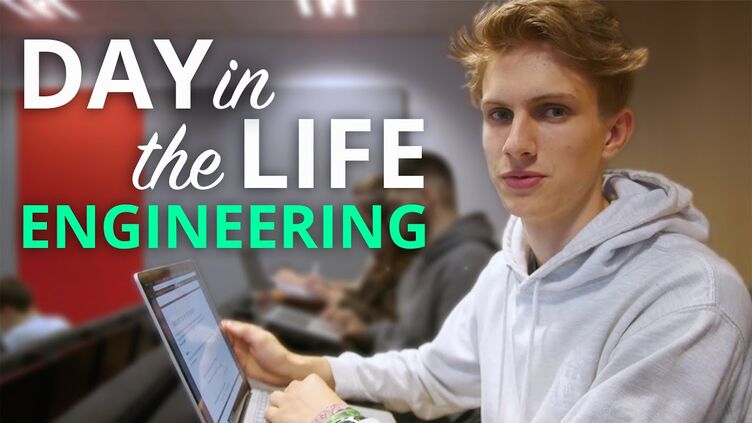
Student profiles
Fees and funding
Fees
Additional costs
The annual fee for your undergraduate course includes a number of items in addition to your tuition. If an item or activity is classed as a compulsory element for your course, it will normally be included in your tuition fee. There are also other costs which you may need to consider. These costs may increase due to price increases outside of the University’s control, if you defer entry or if you choose to change course.
Examples of what’s included and excluded in undergraduate fees
Funding your study
Depending on your circumstances, you may qualify for a bursary, scholarship or loan to help fund your study and enhance your learning experience.
Use our Student Funding Calculator to work out what you’re eligible for.
Visit
University open days
We host five open days each year, usually in June, July, September, October and November. You can talk to staff and students, tour the campus and see inside the accommodation.
Online events
Join our online information sessions to find out more about different aspects of University life.
Subject tasters
If you’re considering your post-16 options, our interactive subject tasters are for you. There are a wide range of subjects to choose from and you can attend sessions online or on campus.
Offer holder days
If you've received an offer to study with us, we'll invite you to one of our offer holder days, which take place between February and April. These open days have a strong department focus and give you the chance to really explore student life here, even if you've visited us before.
Campus tours
Our weekly guided tours show you what Sheffield has to offer - both on campus and beyond. You can extend your visit with tours of our city, accommodation or sport facilities.
Apply
The awarding body for this course is the University of Sheffield.
Recognition of professional qualifications: from 1 January 2021, in order to have any UK professional qualifications recognised for work in an EU country across a number of regulated and other professions you need to apply to the host country for recognition. Read information from the UK government and the EU Regulated Professions Database.
Any supervisors and research areas listed are indicative and may change before the start of the course.