
Social science ERW blog series part 2: So what does the inevitable lack of a stopping rule mean for the original ERW-D vision? How much progress has been made in the social and natural sciences?
What does ongoing uncertainty mean for ERW-D's future? Explore how social and natural science research has advanced and what challenges still lie ahead.

Part 2: So what does the inevitable lack of a stopping rule mean for the original ERW-D vision? How much progress has been made in the social and natural sciences?
At this stage, fundamental uncertainties and potential space-time misalignments remain outstanding at the intersection of deployment and our current social and natural scientific understandings of ERW to effect carbon removal at scale. Further work is needed to assess and move forward from this situation, in ways cognizant of environmental impacts and societal ramifications. Commercial deployments of ERW are underway, but no completely firm determinations have yet been reached from bodies of results obtained from field trials, testing for contaminants uptake by plants etc (but see Schiedung, M. et al., 2026).
It is understandable, in the absence of a stopping rule, that there should be uncertainty as to when the ERW’s scientific work programme can commit new, consolidated evidence and address the (increasingly damaging) effects of climate change. This is not a singular issue but rather one that is complex and relational, as it entwines environmental science and more social understandings together. The challenges are significant when considering whether modelling, field and experimental science can be used intelligibly to support mutual benefits for the environment, societies and people.
In her book After Geoengineering: Climate Tragedy, Repair, and Restoration, Holly Buck (2019) gives an account of why working towards a more complexly ‘relational’ orientation will become important in the aftermath of the climate tragedy that will long outlive specific technology programs. She conducted extensive research into both carbon dioxide removal (CDR) and climate engineering, using ethnographic field work with experts. Doing so enabled her to develop a well-grounded understanding of emerging prospects for CDR culminating in a set of reflections on how to start the “long work ahead” (p245) of opening-up possibilities for repairing and restoring climate damaged systems. Using evocative language, she called this “creativity in the ruins” (p247).
Moving Forward; Towards “creativity in the ruins?”
So how might the approach we have taken in our research, now in its final year, contribute further to programme-wide efforts towards making good on ERW-D?
An outstanding epistemological issue for us as social scientists working alongside ERW-D natural scientists is that we continue to generate further shareable knowledge and practical understanding drawing from our data-rich, public research workshops and stakeholder engagements. We consider this to be a key priority, as we write about our project methodologies and write up findings.
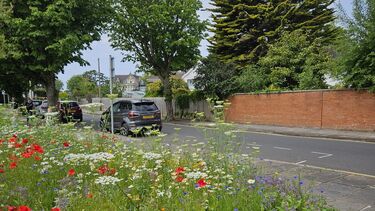
Possibly our situation resembles something that is known in the world of climate interventions - a prospect that might at first appear strange to some if science and technology approaches are still learning to play catch up with nature-based understandings. The photograph is of a nature-rich road verge: it was taken to evoke a generative outcome of NOT cutting back rough ground vegetation too early in the Spring. Known by growers and agri-scientists alike, the practice of grass cutting prematurely results in higher nutrient levels in the soil preventing desirable growth of the wild seedlings a few months later. We present it as potentially contributing to intellectual work, if interpreted to show the possibility of temporally informed ways of approaching landscape (here roadside) interventions in the climate and biodiversity problems-space.
Also, well-known – this time among social scientists – is a methodological approach to qualitative research that is both purposive and emergent: one we typically want to follow through on, including in our ERW-G project (Henwood, 2022). A purposive approach is aligned with more complex ideas of intentionality, as a researcher’s goal is not always fully disclosed at the outset. The term purposive can be used to direct intention towards an initial problem formulation (as outlined for the whole of ERW-D above) while incorporating emergent issues (Hammersley, 2022). Foregrounding these issues requires analysis to be unlike the kind for single indicators (and most readily commanding the attention of precision science and modelling) i.e. they are not “self-declaring” (Henwood and Pidgeon,1992).
Hence, in our further original analysis projects, the intention is not to provide exhaustive answers to matters fully formed from ideas built into a pre-planned project design. It is not to make discoveries as direct replacements for “self-declaring indicators” which, if followed through, can inform policy decisions for climate action. Rather, it is to bring to fruition valuable, generative insights requiring dedicated analysis, as informed by a programme of work carefully designed at the outset. This means not trimming back at too early a stage but rather working in a timely way towards effectively understanding changes taking place situated in time and space. This involves focussing attention on what comes centre stage in those contexts where it is possible to study the variously embedded ramifications of expert, technological knowledge, as it seeks to fulfil its intended purpose. It means being able to flesh out key emergent insights and perspectives using original ways of utilising data gathered up from our stakeholder interviews and public workshops.
As a further epistemological point, what currently lies undeclared might be partially known, albeit supressed by social, cultural and political forces and processes constitutive of persistent knowledge barriers. There is a risk that known-unknowns can be psychologically acted out within formal science, should it remain detached from concerns expressed by wider publics. The analysis of disavowal of emotions such as guilt and shame regarding our ecological debt (Randall, 2013) is relevant here – but such concepts tend to be considered out of bounds.
Accordingly, we frame our continuing analytical work creatively, and in ways that reflect our interest in using lively social sciences and arts methods for public engagement and net zero governance research (Henwood and Pidgeon, 2025). Some of the framings that we are currently working on are: Intangible realities: nature as part of place; Emplaced deliberative and participatory engagements; Image objects and model objects anchored in place; Institutional logics; and Life forms deserving of human care. All of these bear on this problematic of not cutting back too early on CDR social sciences analysis in order to generate creativity in the ruins.
References
- Buck, H. (2019) After Geoengineering: Climate Tragedy, Repair and Restoration London and New York: Verso
- Hammersley, M. (2022) Emergent Design. Chapter 4 in U. Flick (Ed) The Sage Handbook of Qualitative Research Design pp 55-68
- Henwood, K.L. and Pidgeon, N.F (2025) Lively methods for net zero governance and public engagement. British Academy Net Zero Governance Paper Series. www.thebritishacademy.ac.uk/documents/5825/Lively_methods_for_net-zero_governance_and_public_engagement_-_2025.pdf
- Henwood, K.L. (2022) Interpretive risk ethnography as a means of understanding risk problems: Encounters with the ordinary-extraordinary and what comes after? In B. Switek and Abramson, A., Swee, H. (eds) Extraordinary Risks, Ordinary Lives: Logics of Precariousness in Everyday Contexts. London, Palgrave Macmillan (10.1007/978-3-030-83962-8_12)
- Henwood, K.L. and Pidgeon, N.F. (1992). "Qualitative research and psychological theorising". British Journal of Psychology, 83, 97-111.
- Randall, R. (2013) Great expectations: the Psychodynamics of ecological debt. Chapter 5 in S. Weintrobe (ed) Engaging with Climate Change: Psychoanalytic and Interdisciplinary Perspectives, London: Routledge, pp87-102
- Schiedung, M. et al. (2026) ‘Uncertainties of enhanced rock weathering for climate-change mitigation’, Nature Reviews Earth & Environment, pp. 1–14. Available at: https://doi.org/10.1038/s43017-026-00761-7.