
Environmental impacts of alternative ironmaking materials for blast furnaces - insights from COP29
Attending COP29 in Baku was crucial in shaping how Lisa framed the real-world relevance of her research

Lisa’s research focuses on the steel sector, an area which contributes around 8% of global CO₂ emissions, with blast furnace ironmaking responsible for 70% of emissions in the integrated steelmaking route. While the UK has committed to a transition towards electric arc furnaces, high electricity prices and limited scrap availability mean blast furnaces are likely to remain important in the medium term.
Her research addresses a clear gap in existing knowledge of steelmaking processes by providing a UK-specific comparison of alternative reductants like charcoal and green hydrogen for blast furnace ironmaking, considering their environmental impact, costs and practical deployment. COP29 provided a wider lens through which to view these findings, highlighting how decarbonisation pathways are affected more globally by local resources, economics and system readiness.
COP29 helped me see my research not just as a technical assessment, but as part of a broader transition shaped by cost, context and real-world constraints.
Lisa Ahmad
While at COP29, Lisa reinforced key conclusions from her EngD through discussions with colleagues. Conversations around land stewardship highlighted why considerations of land availability and sustainability constrain the wider use of alternatives such as charcoal. Similarly, debates around hydrogen based steelmaking reflected the cost and infrastructure barriers she identified in her research, supporting the need for phased rather than immediate large-scale deployment.
These experiences at COP29 strengthened her confidence in engaging with policy and industry audiences, ensuring that her research contributes to practical decision-making as well as academic insights. In turn, this helped her place greater emphasis on realistic transition pathways that balance near-term actions with longer-term solutions in her final thesis.
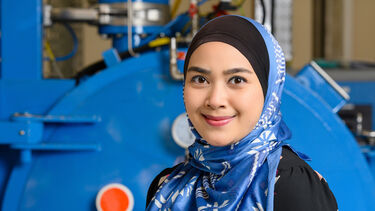
Biography
Lisa Ahmad is studying towards an EngD with the Centre for Doctoral Training in Advanced Metallic Systems within the Faculty of Engineering at The University of Sheffield. Her research focuses on decarbonising UK blast-furnace ironmaking through alternative reductants such as charcoal, grey hydrogen and green H2. Her work combines life-cycle assessment, economic considerations to inform practical deployment for UK steel decarbonisation. She also examines global insights into the enablers and barriers to deploying biomass in metallurgical applications. Beyond her research, Lisa works on deployment-focused energy transition pathways, spanning energy efficiency (AI-enabled optimisation and equipment upgrades), fuel switching, hydrogen, and CCUS.