
Combining Selective Powder Deposition (SPD) with Field-Assisted Sintering Technology (FAST) to produce complex multi-alloy titanium billets
Joe Hopkinson, EngD researcher based at The University of Sheffield has been investigating the capabilities of SPD as a method of laying multiple titanium alloy powders prior to sintering via FAST.
Field-Assisted Sintering Technology (FAST), also known as Spark Plasma Sintering (SPS), is a solid-state processing method capable of fully consolidating metallic and ceramic powders and particulates.
FAST involves laying powder in a reusable, conductive graphite mould where a low-voltage, pulsed DC in combination with uniaxial compression is applied. The DC is conducted through the graphite mould and the powder (provided it is conductive), where the powder is directly heated via the Joule heating effect. Each powder particle acts as an individual conductive element with individual resistance and thus becomes an individual heating element as per Joule’s law. The direct heating in combination with the uniaxial compression fully consolidates the powder without the material reaching its liquefication temperature, through a process called sintering.
FAST is a highly effective sintering method for a range of titanium alloys. The process can produce a variety of microstructures, some of which would traditionally require a far more complex processing route. In addition, FAST can produce multi-alloy billets through a process dubbed FAST for diffusion bonding (FAST-DB). Diffusion bonding is the solid-state diffusion of atoms between two metallic surfaces, creating a strong bond. FAST-DB exploits diffusion bonding to construct billets containing multiple alloys. This can be used as feedstock for components designed with sub-regions of distinct microstructure, specifically selected for their properties.
The current method of laying multiple powders involves a simple plastic divider placed within the graphite tooling. This allows each alloy to be laid separately from the other when filling the mould. Before sintering, the divider is carefully removed, leaving behind each alloy powder in its desired location. This is a simple and effective method; however, it is limited. Powder layup can only be controlled in the vertical plane, and the process of removing the divider must be done with extreme caution.
A new high-tech approach to powder layup has arisen from the Belgian company, Aerosint. Having adapted their selective powder deposition (SPD) technology for FAST, a graphite mould can be precisely filled by forming single layers of up to three alloy powders. Layer by layer, SPD gradually builds up the powder within the mould, allowing for novel multi-material structures to be sintered through FAST.
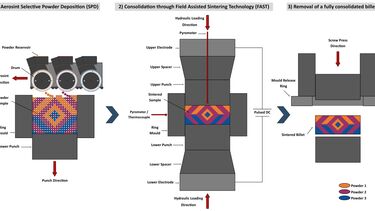
Figure 1 shows the SPD process and how it will work in combination with FAST. Each material powder sits in a reservoir, which feeds onto its drum. The drum has a fine mesh around its circumference and a suction device within it. The powder adheres to the mesh surface at a preset thickness. Inside the drum and pointing vertically down is the ejector. As the drum rotates, the ejector fires high-pressure air from the inside of the mesh, laying the powder in the desired pattern. Once a pass has been completed, the recoater returns to its starting position and the next layer is printed. Currently, the setup can produce billets of 40 mm in diameter, but this can be increased to 100 mm.
Utilising both manufacturing methods has allowed for complex multi-alloy titanium billets to be produced in just a couple of hours. There is a growing interest in multi-alloy and functionally graded components for industrial applications. Components often experience variable conditions throughout sub-component regions. Therefore, components are often over-engineered to withstand the most extreme conditions any sub-component region is subjected to. Producing components with microstructures and, hence, mechanical properties tailored to these specific regions could mitigate this. SPD-FAST can produce multi-alloy billets with complex internal geometry and as-forged microstructure in just two steps. The current setup demonstrates the technology on a small scale and shows the potential of scaling up. All samples produced through Aerosint’s SPD recoater at The University of Sheffield have been sintered with the FCT HP D 25, FAST machine located within the Royce Discovery Centre.
Equipment Used
FCT HP D25 (FAST/SPS), Royce Discovery Centre, University of Sheffield
FCT-H-HP D25 (Hybrid FAST/SPS Furnace), Royce Discovery Centre, University of Sheffield
Biography
Joe Hopkinson, EngD Candidate at The University of Sheffield.
Part of the Advanced Metallic Systems CDT and sponsored by Rolls-Royce.