
Writing History, Losing Credit: Rediscovering Rosemary Anne Sisson
Edward Frost, an MA English student, undertook a work placement in the Library during a work placement in 2026. Read on to hear about his experience of the Rosemary Anne Sisson Archive as he catalogued some of her film and television scripts.

Historical television acts as the primary architect of our collective memory, shaping how millions visualise the past through the vivid reality of the screen. In the mid-twentieth century, landmark series such as The Six Wives of Henry VIII and Elizabeth R brought the complexities of the Tudor court into living rooms worldwide, offering what many now consider the definitive interpretations of figures like Elizabeth I and Catherine of Aragon. Yet, while these productions remain cultural touchstones, the individuals who built these worlds from a blank page have largely faded into the background. While actors and directors receive the lion’s share of acclaim, screenwriters—particularly the women navigating the male-dominated studios of the 1970s—remain largely invisible. This professional erasure highlights a persistent irony: the very people responsible for constructing our historical myths are rarely recognized as their authors.
Rosemary Anne Sisson’s career offers a powerful example of this imbalance. A prolific force in British television, she contributed to pillars of the ‘Golden Age’ of drama, including Upstairs, Downstairs, while also lending her pen to international projects like Walt Disney’s The Black Cauldron and collaborating with Lucasfilm, writing several episodes for The Young Indiana Jones Chronicles. Despite an Emmy Award and a BAFTA nomination, her name is rarely centred in discussions of authorship.
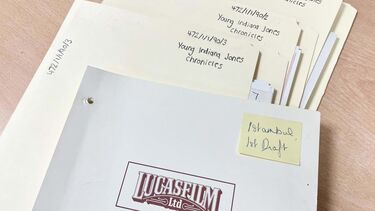
Sisson’s writing was notable for its refusal to lean on the romantic tropes that often plague period dramas, choosing instead to prioritise political agency. When you picture Elizabeth I, for instance, do you see a romantic lead or a sharp strategist? If it is the latter, you are remembering the specific creative labour of Sisson. In the Elizabeth R episode ‘The Marriage Game’, she presented Elizabeth’s refusal to marry as a calculated victory rather than a personal tragedy. By framing marriage as a risk to sovereign authority, Sisson helped cement the enduring image of the ‘Virgin Queen’ as a ruler who maintained control by navigating a patriarchal world on her own terms.
This intellectual rigor extended into her project Mary, Queen of Scots, where Sisson continued to subvert domestic expectations. In her episode The Wife of Darnley she avoided the temptation to present Mary’s marriage as a simple love story, instead foregrounding political tensions through sharp reversals of traditional gender roles. In one specific scene, Mary offers Darnley a ring to appease him before he leaves for leisure while she remains behind to govern—a quiet but radical depiction of power shifting within a royal household. Sisson understood that for women in history, the domestic was always political. However, as the documents in Sisson’s archive reveal, these nuances were not accidental; they were the result of a writer in a state of constant professional combat, often fighting against a production ‘boy's club’ that preferred simpler, more sentimental narratives.
The scale of this struggle is apparent in her correspondence and annotated drafts, which reveal a woman defending her intellectual territory. In The Six Wives of Henry VIII, Sisson fought to preserve the humanity of Catherine of Aragon against production cuts that threatened to reduce the Queen to a one-dimensional obstacle. Her insistence on retaining a scene depicting Catherine’s mental breakdown was a radical act of gendered reclamation; she refused to let a woman’s internal life be sacrificed for the sake of pacing. Furthermore, her labour extended beyond her own scripts. Sisson performed the unseen work of ensuring continuity and historical consistency across the entire series. She was essentially the invisible glue holding a male-led production together, even as her peers were granted the freedom to pursue their own disparate styles.
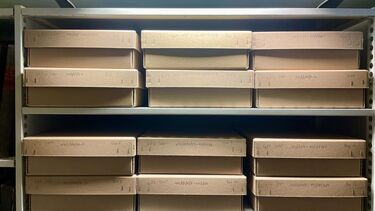
Beyond the creative friction of the studio, the archive reveals the cold legal realities Sisson faced regarding the ownership of her voice. Correspondence relating to Mary, Queen of Scots points to a battle over copyright, showing how she had to fight to retain the rights to her own intellectual property within a restrictive production environment. Her story is a reminder that ‘losing credit’ wasn't just an accidental oversight—it was often a by-product of the industry's structural design. These papers document a writer who was not only fighting for historical accuracy but for the legal recognition of her labour in an era where women's creative contributions were frequently subsumed by the vision of male directors. While these documents do not fully resolve the issue of public recognition, they make Sisson’s contributions undeniable, revealing the ink-stained fingerprints on the narratives that have shaped our understanding of the past for decades.
This visibility matters because television remains the primary gateway to history for the public. Writers like Sisson act as the filters through which we view our ancestors, influencing the framework through which we understand power and gender. Every time we watch a ‘strong female lead’ in a modern period drama, we are seeing the ripples of a wave Sisson started fifty years ago. When the screenwriter is obscured, we lose sight of the fact that history is a constructed narrative, shaped by individuals with specific intellectual commitments. By bringing Sisson’s work to light, we do more than recover a name—we rethink how authority is assigned in the telling of history.
The Rosemary Anne Sisson Archive needs further cataloguing work but will be accessible to the public towards the end of this year.
Information about how to access SCHA’s catalogued collections is on this webpage.
Related information

Postgraduate online open day
Find out more about becoming part of our community of talented postgraduate taught students. Register now to join us on Wednesday 25 November.