Hearing History Differently: A Beginner’s Guide to Transcription
Petar Pesic, MA History, shares his experience on a student work placement with The National Fairground and Circus Archive...

Introduction
Before starting my placement, I assumed transcription was pretty straightforward: listen to an audio recording and type what you hear. Simple. In reality, the art of transcribing, especially in a historical archive setting, is far more complex.
Working with oral history recordings at the JFK Library and the National Fairground and Circus Archive quickly revealed to me that transcription isn’t just a matter of pressing play. Poor audio quality, overlapping voices, and strong regional accents can make even the simplest of sentences nearly impossible to discern, often requiring repeated listening just to catch a single phrase.
This blog is a short introduction to what I’ve learned so far: what transcription really involves, why it’s more challenging than it seems, and why it plays such an important role in making historical material accessible.
What Transcription Actually Involves
At its core, transcription turns spoken words into written text. Simple, right? Well, not exactly. Listening passively and listening for transcription are very different. You see, transcription isn’t just about hearing words but interpreting them.
It’s kind of like learning a new language: you’re constantly making decisions such as where a sentence begins and ends, how to represent pauses or hesitation, and what to do when something simply isn’t clear. After all, spoken language itself rarely follows neat grammatical rules. People pause, repeat themselves, or change direction mid-sentence.
As a transcriber, you have to decide how much of that to preserve. Do you include every hesitation? Do you tidy things up for readability? Where does a sentence actually end?
These decisions might seem small, but trust me, they shape how the speaker’s voice comes across on the page.
The Reality of Working with Historical Audio
One of the biggest challenges is the quality of the recordings. Older audio often comes with background noise, distortion, and uneven volume. Sometimes the sound fades; sometimes it’s simply unclear. Sometimes there’s a random metal clang that jump-scares you (true story).
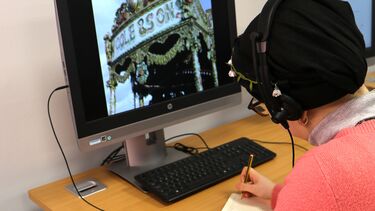
Regional accents add another layer of difficulty. Familiar words can sound completely different, and it may take several listens to understand even a short section. Is the speaker saying ‘wrote’ or ‘rode’? I guess we’ll never know for certain, so we have to use context clues to direct us. Since the above example comes from a discussion about old fairground attractions such as ferris wheels, we can conclude that it is the latter, ‘rode’.
This makes transcription surprisingly intense. You might replay a few seconds multiple times just to piece together a sentence. It’s slow and occasionally frustrating, but it also forces a very close engagement with the material. Once you get the hang of it though, it becomes extremely rewarding.
Dealing with Uncertainty
One of the most important lessons I’ve learnt is that you’re not expected to get everything perfectly. Some parts of the audio will remain unclear, and that’s okay.
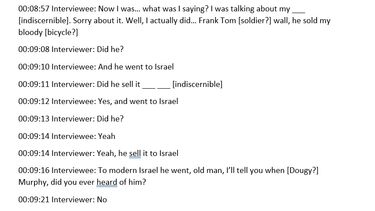
In such cases, transcribers use markers like [indiscernible] or [unclear] to indicate gaps in the record. At first, this can feel like a failure, but it’s actually about being honest about the limitations of the source.
This might require a dramatic shift in mindset, it certainly did for me. Rather than aiming for perfection, transcription involves balancing accuracy with practicality. It’s about doing your best with what’s available while also recognising uncertainty.
Why Transcription Matters
So what’s the point then? If it’s so tough, then why bother with it?
The answer is simple: accessibility. Audio recordings are valuable sources, but they’re not always easy to use. Transcripts make them searchable, readable, and usable to a much wider audience, from researchers to the general public.
More importantly, transcription also helps preserve voices and experiences that might otherwise be overlooked. Oral histories often capture perspectives that don’t appear in official records. Transcription of personal memories, local stories, and even everyday musings, ensures these voices can be heard and studied for generations. Isn’t that cool?
Skills and Takeaways
Even in a short time, transcription has developed skills I hadn’t fully considered before. Patience is probably the biggest one. You have to slow down and focus on detail, no matter how seemingly insignificant. Moreover, there’s careful listening, consistency, and concentration.
It has also highlighted the importance of “behind-the-scenes” work in historical research. Before sources can be analysed, they often need to be preserved, prepared, catalogued and made accessible. Transcription is a key part of that process.
Final Thoughts
Transcription initially seemed like a simple task, but it’s far more involved than I had ever expected. It requires both technical skill and careful judgement, as well as an awareness of the limitations of the source material.
While it can be slow, it’s also rewarding. You’re not just typing words—you’re helping transform difficult-to-access recordings into usable historical sources. That, ultimately, is what makes the process worthwhile.
Want to learn more? Join students Anna, Sam and Petar for an introduction to transcription skills with The National Fairground and Circus Archive on Friday 08 May 2026. Book your free place now.