
Cartoon Chaos, Silly Satires & Political Punchlines: Inside the Library’s Caricatures Collection
In celebration of National Cartoonist Day (5th May), Scarlett Cherry, MA History student, reflects on her experience of working with the Caricatures Collection in the Library’s Special Collections during a work placement in 2026.

As part of my MA History Work Placement, I have had the opportunity to explore the library's Caricatures Collection in Special Collections, Heritage and Archives (SCHA), helping to catalogue and digitise its contents making this fascinating material more accessible to researchers and the public.
The Caricatures Collection was assembled by Sir Charles Harding Firth, a Sheffield-born historian, in the early 20th century, who donated them to the University of Sheffield Library. When they arrived, many were glued into large books. Over a period of around 10 years, a paper conservator used special techniques and chemicals to safely separate the prints from their backing to preserve them for the future. They are all now stored in protective Melinex sleeves in archival boxes in Western Bank Library.
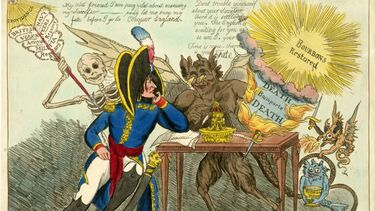
The collection comprises around 1,500 prints from approximately 1790-1810, a period widely recognised as the golden age of caricature! These prints offer a window into life in Britain at a time when printmaking and the press were rapidly expanding, presenting vibrant, detailed scenes that mocked members of society, criticised current affairs, and commented on social issues in ways that traditional news simply could not. They are full of chaotic scenes, some silly, some more serious and feature a range of imagery from theatre and fashion to mythology and magic, that are still entertaining today!
Printmaking flourished in the 18th century alongside Britain’s Industrial Revolution, and artists such as William Hogarth, Isaac Cruikshank, James Gillray and Thomas Rowlandson became well known for their distinctive styles and sharp commentary. Their work was not only reflective of public opinion but helped shape it, much like political cartoons, memes and viral images do today!
The growing popularity for political and social mockery, resulted in a thriving industry where speed was essential: prints had to reach audiences while the news was still fresh, and evidence of last-minute edits and different versions of the same print highlights just how reactive this artform was.
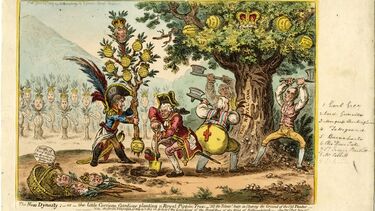
Creating these prints required real technical skill. Artists etched (scratched) designs onto copper plates, coated in an acid-resistant wax or ground, using an etching needle, which were then submerged in acid. The acid would eat away the exposed metal leaving lines or grooves. Ink was then pressed into these grooves, the surface wiped clean, and damp paper layered on top where it was run through a press to produce the final image.
Some prints were left monochrome, while others were coloured. Print colouring was a profession undertaken by many, including women and children, and watercolours were the most common medium for this process. This handmade colouring process means no two coloured prints are exactly the same, giving each caricature its own unique character. Very different from mass produced cartoons available today.
Adding colour made the prints highly desirable and were sold at a premium, almost double the cost of a plain print, and the increasingly wealthy middle class in 18th century Britain meant people were willing to pay for them.
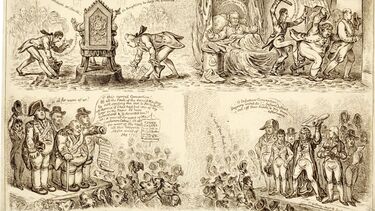
The caricatures were displayed everywhere: in decorative ‘print rooms’, hung in wealthy homes, or exhibited in shop windows where crowds could gather, laugh, and react to the latest satirical joke. In this way, caricatures made political commentary accessible even to those who could not read. Now we often gather in online spaces to create and consume digital media which critiques and satirises society.
Today, these prints have become valuable collectors items, with many selling privately for hundreds of pounds, as well as being in public collections such as here at the university, the British Library and the Royal Collection Trust, among others.
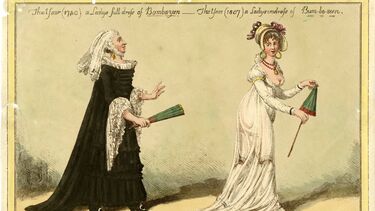
To make the prints more accessible, my work has involved continuing on the cataloguing of these caricatures in a spreadsheet, which means assigning them unique reference codes and recording different categories of information. This information will then be made available on SCHA’s online catalogue Discover our Archives making them easier to discover.
I have also been digitising some of them using one of SCHA’s fancy scanners, which I am told cost over a hundred grand! Expensive kit means high-quality scans, which means that these caricatures, once confined to Regency shop windows and stored in big books, can now be viewed in incredible detail online! This transformation reflects a broader continuity: just as caricatures once made politics accessible to the public, digital technology continues that mission today.
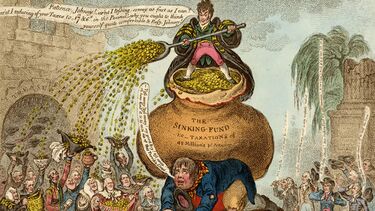
Whilst many of the caricatures have been catalogued and digitised, there is still lots to do! More will be catalogued and digitised this year and will be added to the Caricatures Collection for all to enjoy. There are also several published works of caricatures in SCHA listed on StarPlus.
All of this material can be looked at in person for free by booking an appointment to visit the SCHA reading room in Western Bank Library. Visit SCHA’s website to find out how to book an appointment.
Events like National Cartoonist Day on the 5th May every year are important to celebrate the art of cartooning. From eighteenth-century prints to today’s digital cartoons, the power of images to inform, critique, and entertain remains as strong as ever.
Related links:
Explore the Caricatures Collections online
Visit the Special Collections, Heritage and Archives in Western Bank Library