
Backstage with Rosemary Anne Sisson’s Archive
The Rosemary Anne Sisson Archive held in the Library’s Special Collections, Heritage and Archives has formed the basis of two MA student work placements in 2026. Aaron Kearsley, History MA student, reflects on his experience.

Stepping into Special Collections, Heritage and Archives (SCHA) offered a perspective on history that is not often visible from the outside. Rather than history as a finished product, you begin to see it as something carefully assembled, shaped through decisions around preservation, organisation, and accessibility. As an MA History student undertaking a placement module, this process was what drew me to archival work, the opportunity to engage directly with archival materials and providing a space for under-recognised histories.
My placement centred on the archive of Rosemary Anne Sisson (1923-2017), a British dramatist, novelist and screenwriter whose career spanned theatre, television, film, and literature. Sisson’s professional life was both varied and accomplished, yet she remains relatively absent from broader historical discussion of twentieth-century writers and creatives. Working with her archive therefore felt particularly significant, as it provided a chance to bring greater visibility to a pioneering figure whose contributions are often underrepresented, despite her significant contributions and work with Disney, the BBC and British animation studio Cosgrove Hall.
The primary aim of my project was the organisation, repackaging, and cataloguing of theatre-related materials. This included scripts, correspondence, notes, and research materials, which were carefully rehoused in archival grade packaging to ensure their long term preservation. Although these tasks are highly structured, they are essential in transforming a large and complex body of material into something that can be navigated with relative ease by the archive’s users.
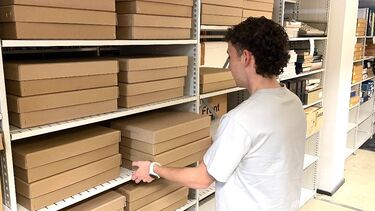
Working with original scripts was one of the most compelling aspects. These documents reveal the layers behind a finished piece of work, showing how ideas are developed, revised, and sometimes reworked over time. In some instances, the material required additional investigation to clarify context, such as identifying whether a play was performed or establishing connections with collaborators. This element of research added depth to the cataloguing process and highlighted how archival work often involves more than organisation alone. It also requires interpretation and inquiry.
The scale of SCHA’s holdings also became increasingly apparent throughout the placement. With over 400 archives, the work of cataloguing is ongoing and necessarily meticulous. Tasks such as repackaging may seem repetitive on the surface, but they play a vital role in ensuring that materials remain stable and accessible. This reinforced the importance of consistency and attention to detail in archival practice, as well as the cumulative impact of seemingly small tasks within a much larger project.
Beyond the practical experience, the placement also encouraged reflection on the broader purpose of archives. Sisson’s career reflects both the opportunities and constraints experienced by women working in creative, male-dominated industries during the mid-twentieth century. Engaging with her archive offered insight into these dynamics, while also demonstrating how archival collections can help recover and highlight contributions that might otherwise remain marginalised.
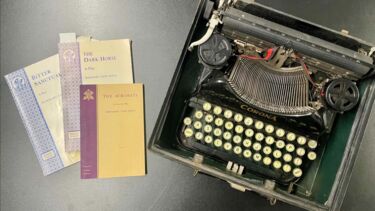
Working with the Sisson Archive has been a valuable introduction to archival practice and the principles that guide it. It has strengthened my understanding of how historical materials are preserved and made accessible. As the archive continues to be developed, it will provide important resources and an opportunity to further explore Sisson’s work and the wider history of women in theatre and screenwriting.
The Rosemary Anne Sisson Archive needs further cataloguing work but will be accessible to the public towards the end of this year.
Information about how to access SCHA’s catalogued collections is on this webpage.
Related information
Find out more about our Special Collections, Heritage, and Archives

Experience Sheffield for yourself
Find out what studying at Sheffield is like by visiting us or booking onto an online event.