

The University Library is pleased to announce the opening of the archive of Arthur Scargill, socialist, trade unionist and President of the National Union of Mineworkers (NUM) from 1982 to 2002. This collection is an essential resource for the study of the British labour movement of the late 20th and early 21st centuries.
National Union of Mineworkers
Arthur Scargill was born in Worsborough, near Barnsley, in 1938. He followed in his father's footsteps and became a coal miner at Woolley Colliery aged 15. Whilst working there he became a branch delegate in 1965 and became a member of the NUM Yorkshire Area Executive Committee in 1969. He would play a role in the unofficial miners’ strike the same year, but rose to national prominence for his role in the 1972 Miners' Strike and in particular his role during the Battle of Saltley Gate.
Later in 1972, he became a full-time trade union official. Arthur was elected to the position of Compensation Agent for the NUM Yorkshire Area, which would see him play an important role in the response to the Lofthouse Colliery Disaster in March 1973 and in representing the NUM at the subsequent public inquiry. The following year he became area president and would lead the Yorkshire Miners during the 1974 Miners' Strike, which preceded the fall of the Conservative Government led by Edward Heath.
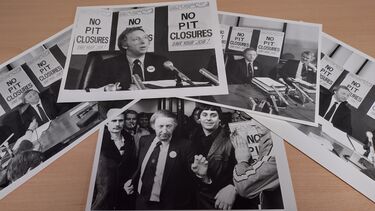
In December 1981, Arthur Scargill was elected President of the national union and assumed office April the following year; a position he held until retirement in 2002. As a national official he would become known worldwide for his leadership of the union during the 1984/85 Miners' Strike over the issue of pit closures, and the Battle for Orgreave in particular.
Arthur Scargill's work with the NUM also included legal representation. Some of his most famous cases being the Lofthouse Colliery Disaster Public Inquiry (1973), the Houghton Main Colliery Disaster Public Inquiry (1975), and a High Court case involving the Mineworkers' Pension Scheme (1984) in which he advocated for the ethical investment of pension funds. His international work led him to becoming co-founder and President of the International Energy and Mines Organisation (IEMO)/Organisation International de L’Energie et des Mines (OIEM).
Politics
An avowed socialist, Arthur Scargill was involved in political organising from an early age. In 1955 he joined the Young Communist League (YCL) and was a member for several years before leaving to join the Labour Party in 1962.
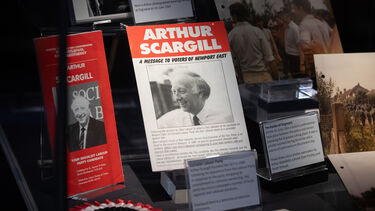
Arthur Scargill would remain a Labour Party member for over three decades. This came to an end in 1995 when he left the party following the amendment of Clause IV and the dropping of the party's commitment to common ownership. He proposed the formation of a new political party which led to the establishment of the Socialist Labour Party (SLP) the following year and he would go on to contest a number of elections.
Scargill was also involved in the Co-operative movement, and was elected chair of the anti-nuclear campaign group Energy 2000 in 1977.
The Archive
At almost 700 boxes, this archive is one of the largest held by the University's Special Collections. It is a collection of national significance and includes correspondence, subject files, transcripts of speeches, photographs and audio/visual material. The majority of this material concerns Arthur Scargill's most well-known role as National President of the NUM, but it also includes material relating to his earlier work as leader of the Yorkshire Miners.
Related papers acquired from other NUM officials can also be found within the archive. This includes Lawrence Daly (NUM General Secretary), Joe Gormley (NUM President), Peter Heathfield (NUM General Secretary), Frank Cave (NUM Vice-President), and others.
The collection also contains a significant amount of material concerning his work founding and leading the Socialist Labour Party. This includes administration, policy formation, party publications and election efforts, which offer an insight into left wing politics around the turn of the 21st century.
Also held within the archive is material related to Arthur Scargill's less well known occupations including his work as a trustee of the Yorkshire Miners' Welfare Convalescent Homes (YMWCH), Yorkshire Miners' Welfare Trust Fund (YMWTF), and the NUM Superannuation Scheme. The archive also contains papers concerning his role as consultant (following his retirement) to the Lancashire and Yorkshire Area trust funds.
As well as papers relating to his professional roles, the archive holds personal material which reflect Arthur's interest in coal mining, labour history and socialism. This includes some material connected with the political movement Women Against Pit Closures (WAPC), and its role in the 1984/85 Miners' Strike, and the 1993 pit occupations.
Percy Riley Archive
Arthur Scargill also donated a small archive, which he had received posthumously from his long-time friend and comrade Percy Riley (1920–1986). A communist and NUM member, Percy was heavily involved in the labour movement, and became well known locally for his tireless collecting at Fargate in Sheffield during the 1984/85 Miners' Strike, which became known as Percy Riley's Corner.
The archive contains material reflecting Percy's involvement with the labour movement during the 1970s and 1980s. A highlight of the collection is a series of audio cassettes which Percy produced during the course of this activity. These recordings cover significant industrial disputes such as the Grunwick Dispute (1976–78), the Steel Strike (1980), the Miners' Strike (1984–85), and various smaller disputes. Campaigning against the sale of council houses (i.e., the right to buy) was also a significant part of Riley's life and this is also represented.
These tapes are currently being catalogued, and will be made fully available in stages as the work is completed.
Accessing the Arthur Scargill Archive
Following a two year project that was philanthropically supported by generous alumni of the University, the catalogue for the Arthur Scargill Archive is now online and material is available to view by appointment in Western Bank Library. The archive is open to all researchers and members of the public.
Access the catalogue:
For more information and to book an appointment please visit our website:
Special Collections, Heritage, and Archives
To contact us:
Written by Robert Astin-Hardman, Project Archivist