
Theme 4 integrated system modelling: summary 2016-2025
Here we summarise work on this part of Theme 4, from 2016-2025.

Theme 4 is our embedded analyses of sustainability, macroeconomics, risk perception and ethics. Our social science programme aims to determine and reflect upon the fundamental sustainability, economic feasibility, risks, public perception and ethics surrounding possible enhanced weathering (EW) proposals. Our Open University and Exeter teams work on the macroeconomics element of this theme.
- Aims and questions
- Cross-theme integration
- 2016-2017
- 2017-2018
- 2018-2019
- 2019-2020
- 2020-2021
- 2021-2022
- 2022-2023
- 2023-2024
- 2024-2025
- 2025-2026
- Papers featuring our integrated system modelling work
Aims and questions
Transitioning to sustainability on decadal timescales through novel solutions to CO2 removal, like ERW, implies radical departures from established behaviours and equilibrium trade balances. The success of such a transition depends on rates of uptake of new technologies and their diffusion across sectors and regions, in competition with alternative options. On the same timescale, the socially stratified responses to environment and climate change will feed back on the societal acceptance of new mitigation options. The aim of this workstream is to assess these inter-related processes.
We have several overarching research questions for this theme that aim to determine and reflect upon. The key research questions relating to our part of Theme 4 are:
- Can we create a global EW sustainable supply chain capable of accelerating CO2 reduction through the 21st Century?
- If EW was adopted, how might its net costs and potential benefits be re-distributed through time and across different regions, economic sectors and societal groups?
- To what extent could EW, and other carbon removal options, play a role in climate change mitigation policy for transitioning society towards a zero-carbon future?
- How will public groups in the UK, North America and non-western countries, respond to and perceive the risks and benefits of possible EW proposals as an innovative response to the problem of climate change?
- What are the ethical implications of capturing CO2 with EW, in relation to questions of blame and responsibility for removing the onus on developed countries to reduce fossil fuel emissions?
These questions feed into our original research objectives:
- To build a global, sustainable, integrated EW supply chain framework for analysing and understanding long-term environmental, social and economic impacts.
- To undertake a full ‘cradle-to-cradle’ environmental impact assessment of EW using a combination of primary supply chain/operational process data and secondary Life Cycle Inventory databases.
- To create a next-generation integrated assessment model for addressing the dynamic and uncertain impacts of possible EW actions and the resulting interactions between natural/socio-economic systems.
- To quantify potential trade-offs between winners and losers in different social groups, economic sectors and countries resulting from a range of possible mitigation strategies involving EW.
- To investigate wider public views on EW strategies to mitigate climate change using analytic-deliberative approaches for analysing complex risk problems, following US National Academy of Sciences guidelines, as a part of the Responsible Research and Innovation process.
- To bring philosophy, human behaviour and economics together to assess the relative risks and advantages of EW versus alternative proposals, and the risk of politicians exploiting its availability to avoid emissions reductions.
We’ve been using a range of methods. We’ve constructed a new integrated assessment model (IAM) based on the global macro-econometric energy-environment-economy model (E3ME), which has already been coupled to a model of future technology transformations in the power sector, and to GENIE framework Earth system models. Working closely with the other themes, particularly the modelling in Theme 1, this coupled system will be extended by developing a new model of land-use decision-making, including a statistical representation of vegetation and crop responses to EW25, and integrating the life cycle analysis (LCA) analysis of supply chain economics. The resulting IAM will be unique in its ability to assess how changes in agent preferences, guided by policy and price signals, at the spatial scale of the 59 global regions represented in E3ME, drive the diffusion and uptake of new technologies related to EW, and to assess resulting impacts on both economy and environment. Interaction with stakeholders and with perception and philosophy work will be essential in refining policy options and scenarios of social preference. Impact analyses will focus on the relative benefits and costs of EW options focusing on 'hotspot' sectors, global regions and social groups likely to be most affected, either by mining and processing activities, by purely environmental impacts, such as pH changes at major estuaries, or by displacement of alternative land-use and energy systems.
Cross-theme integration
Supply-chain analysis and integrated assessment modelling will be directly, quantitatively informed by the lab and field experiments of Themes 2 and 3, and the detailed numerical Earth system modelling (Theme 1).
Now let’s look at progress on this work strand since our inception in 2016.
2016-2017
Model-based decarbonisation assessments and scenarios often struggle to capture transformative change and dynamics associated with disruptive carbon capture strategies, hence the need for developing a dynamic IAM strand in Theme 4. We are developing a novel IAM incorporating a dynamic representation of socio-economic change coupled to a dynamic representation of the natural Earth system. Our PDRA was initially scheduled to start approximately six months into the project but following delays in recruitment was due to start in autumn 2017. Nevertheless, substantial progress has been made in developing the framework for modelling stringent mitigation scenarios. Our collaborators, Neil Edwards, Hector Pollitt and Jean-Francois Mercure, are currently writing up this work, which addresses the impact of recent geopolitical events on the potential to reach the ambitious targets of the Paris agreement.
Meanwhile, work is under way to assess how the core new IAM module assessing the diffusion of agricultural technology, which is already partially developed, can be coupled with detailed information from the Sheffield dynamic vegetation model (SDGVMv2.0) on the dynamics of crops, notably those subject to enhanced interventions. We have initiated an initial investigation of the impacts of enhanced weathering on tropical and global economics, based on estimates of overall cost, but without detailed modelling of agricultural dynamics. We expect to complete this broad scoping analyses in the coming year.
2017-2018
The modelling strand aims to develop a novel framework to assess the broader socio-economic impacts of EW and the effectiveness of global and regional policy measures to incentivise uptake. The limitations of conventional approaches in representing green growth and rapid decarbonisation demand the development of a new framework for this purpose.
The appointment of a PDRA to take on this activity was derailed during the past year by UK immigration practices, so we re-advertised and secured another strong candidate. Pending the arrival of the new PDRA in October 2018 (assuming no further visa-related delays), we plan to engage an experienced researcher from August 2018 to get the work moving. Meanwhile, the modelling group has successfully demonstrated the power of their approach with a high-impact study in Nature Climate Change that reveals the massive economic implications of stranded fossil-fuel assets in the energy transition. Further work from the group in review has also demonstrated serious drawbacks, and viable alternatives, to the massive deployment of bioenergy with carbon capture and storage to achieve the objectives of the Paris Agreement, setting the scene for a detailed study of ERW.
2018-2019
Our newly appointed PDRA for this aspect of the programme, Dr Negar Vakilifard, was finally installed in January 2019 and able to start work. Since January she has been familiarising herself with the E3ME-FTT:agri-GENIE modelling framework and the literature relevant to integrated modelling of negative emissions policy in the enhanced weathering context. Meanwhile, the FTT:agri module, representing the dynamics of modifications to the agricultural economy, is close to operational and is in the process of being coupled to the macroeconometric model E3ME.
Research priorities for the coming year include an investigation, based on existing simulations, of the impacts and effectiveness of various policy options on the demand for negative emissions, and an investigation of the effects of EW-related policy measures on land-use and agricultural practices, using the new FTT:agri module. Prior to the new PDRA starting work, Dr Phil Holden was engaged on the project to initiate integrated modelling activity, collaborating with Theme 1 researchers in order to (i) develop a coupling from the PLASIM-GENIE climate model to the Sheffield Weathering Model (SWM), and (ii) to develop the statistical framework that will be used to calibrate the Sheffield Dynamic Global Vegetation Model (SDGVM). Future work will address the application of these tools and is awaiting the calibration of SWM (for i) and an ensemble of SDGVM simulations (for ii). Finally, Neil Edwards contributed to a paper on NETs-related policy led by Dr Emily Cox.
2019-2020
Dr Negar Vakilifard has started investigating the effects of ERW application on mitigating CO2 emissions and ocean acidification, as well as meeting climate change targets. Using the Earth system model GENIE, she has analysed the results of simulations driven by alkalinity data derived from the Sheffield Weathering model in plausible global ERW application scenarios. The results show that carbon capture and storage (CCS) and ERW technologies are comparable in terms of their effect on lowering CO2 emissions in RCP2.6 climate change projection scenario (Fig. 1), both driving around 18% decrease in probability of exceeding 1.5 degree by the end of century (Fig. 2). Co-deployment of these two technologies doubles the impact on the climate response and can contribute significantly in meeting the Paris agreement climate target.
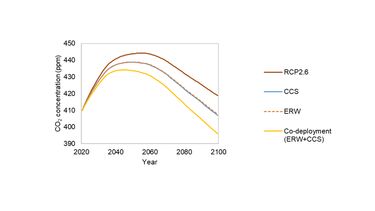
Fig. 1: Comparison of the effect of different CO2 removal strategies in decreasing atmospheric CO2 with the strong mitigation (RCP2.6) climate change projection scenario.
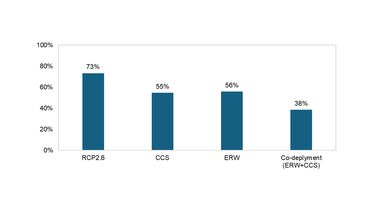
Fig. 2: Probability of exceeding 1.5 degree (Paris agreement climate target) in various NET application by the end of century.
Additionally, we completed a large set of runs to compare the results of the intermediate complexity model GENIE with the idealised Gnanadesikan box model with Katherine Turner to better understand the importance of timing and co-deployment in negative emissions deployment scenarios. Neil Edwards contributed to the Theme 4-led paper on policy levers for negative emissions technologies published in Climate Policy. Meanwhile Phil Holden contributed Earth system model simulations to a major intercomparison paper examining the ‘zero emissions commitment’ corresponding to the climate change signal expected in the absence of any further human-induced emissions. Team members have also contributed future energy-economy modelling results with and without climate policy as input to the major integrated study of global ERW potential published in Beerling et al., (2020). Finally, the team are currently contributing energy economy modelling results to two further LC3M integrated studies on, respectively, the potential for ERW to contribute to UK domestic climate policy targets, and a global lifecycle assessment of the impacts of the ERW supply chain.
2020-2021
In collaboration with team members from Theme 1, Negar has completed the realistic first assessment of the effects of ERW application on global carbon cycle, climate and ocean biochemistry in a high climate change mitigation scenario. In this work, Negar quantified the Earth system responses to ERW and have compared it with CCS, and co-deployment of ERW and CCS (Vakilifard et al.). Negar evaluated the co-benefits of ERW deployment for the ocean acidification and marine coral ecosystem environment. To the best of our knowledge, this is the first time the co-deployment of two carbon drawdown strategies has been evaluated within an Earth system modelling framework.
The results indicate that ERW deployment with croplands to deliver 2 billion tonnes of CO2 removal annually approximately doubles the probability of meeting the Paris 1.5 °C target at 2100 from 23% to 42% in a high climate change mitigation scenario. Co-deployment of ERW and CCS tripled the chances of meeting at 1.5 °C target (from 23% to 67%), and may be sufficient to reverse about one third of the surface ocean acidification effect caused by increases in atmospheric CO2 over the past 200 years. ERW increased the percentage of coral reefs above an aragonite saturation threshold of 3.5 from 16% to 39% at 2100, higher than CCS, highlighting a co-benefit for marine calcifying ecosystems (Fig. 3). Negar showed that the effect of co-deployment of ERW and CCS was additive: implying that there is no adverse interaction for these two negative emissions technologies within the Earth system.
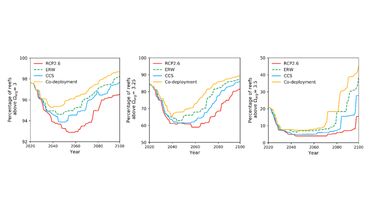
Fig 3: Percentage of coral reefs sites surrounded by global waters with the aragonite saturation state of above (a) 3, (b) 3.25 and (c) 3.5 as a function of time (median values). Note the different scaling of the y-axis in each critical aragonite saturation threshold ( Ωarg).
2021-2022
In addition to providing scenario and climate carbon-cycle analysis for wider LC3M outputs, we had three high profile outputs, in Nature Energy, Environmental Research Letters and Nature Climate Change. Below we summarise the key findings from each of these papers.
In Mercure et al (2021), we present evidence confirming that the transformation of energy systems is well under way, and we show that the framing of climate policy as economically detrimental to those pursuing it is a poor description of strategic incentives. Instead, a new climate policy incentives configuration emerges in which fossil fuel importers are better off decarbonising, competitive fossil fuel exporters are better off flooding markets and uncompetitive fossil fuel producers—rather than benefitting from ‘free-riding’—suffer from their exposure to stranded assets and lack of investment in decarbonisation technologies.
In Vakilifard et al (2021), we show that ERW deployment with croplands to deliver net 2 Gt CO2 yr−1 removal approximately doubles the probability of meeting the Paris 1.5 °C target at 2100 from 23% to 42% in a high mitigation Representative Concentration Pathway 2.6 baseline climate. Furthermore, ERW increased the percentage of coral reefs above an aragonite saturation threshold of 3.5 from 16% to 39% at 2100, higher than CCS, highlighting a co-benefit for marine calcifying ecosystems.
In Semieniuk et al (2022), we trace USD $1 trillion stranded asset costs from 43,439 oil and gas production assets through a global equity network of 1.8 million companies to their ultimate owners. Most of the market risk falls on private investors, overwhelmingly in OECD countries, including substantial exposure through pension funds and financial markets. The ownership distribution reveals an international net transfer of more than 15% of global stranded asset risk to OECD-based investors who therefore have a major stake in how the transition in oil and gas production is managed.
2022-2023
Phil and Neil, with co-authors including collaborators in Thomas Piketty’s World Inequality Lab, (which hosts the most extensive public database on global inequality dynamics), published a commentary in the journal Nature Climate Change (Semieniuk et al) locating the ultimate owners of stranded fossil-fuel assets expected to arise in the transition to cleaner forms of energy. The study identified that most of the anticipated $1 trillion losses will fall on the wealthiest individuals but will represent less than 2% of their wealth. In contrast, while only 3% of the impacts are expected to fall on the poorest 50%, these losses often represent a substantial fraction of an individual’s wealth – usually through pension fund exposure. However, these losses can be affordably compensated by governments, totalling $9 billion across Europe and $12 billion in the USA (Fig. 4). The study concluded that the prospect of stranded asset losses to low- and middle-income owners does not represent a credible deterrent to bold climate action by high-income governments.
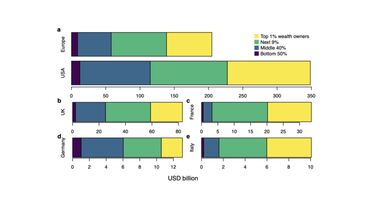
Fig. 4. Partition of country or regional stranded assets by wealth fractile for (a) Europe as a whole and the United States, and (b)-(e) four major European countries. Middle 40% corresponds to the group of the population between the bottom 50% and the top 10% of the population. Next 9% corresponds to the group between percentiles 90 and 99.19
2023-2024
Work paused in this year because of a recruitment gap after the PDRA left.
2024-2025
Our team is now addressing potential economic implications of and incentives for implementing ERW in Malaysia's palm oil sector, using the E3ME macroeconomic model. E3ME is a demand-driven global econometric model where economic output responds to demand, rather than supply constraints, as in conventional economic modelling. This is critical to determining the economic effects but creates a specific challenge when modelling productivity improvements from ERW.
Field trials in Malaysia demonstrate potential for a 15% yield increase in palm oil production over six years, alongside significant carbon removal potential when expanded to the nation scale (19.2 MtCO₂/year nationally). The modelling challenge arises because E3ME's demand-driven structure means that simply increasing productive capacity through ERW doesn't automatically translate to higher output without corresponding demand. Our approach addresses this by ensuring the enhanced productive capacity is utilised through:
- Gradual implementation: Reflecting the realistic timeline for productivity improvements rather than instant benefits
- Demand-side adjustments: Capturing how additional revenue from yield improvements stimulates market demand for increased production
- Market feedback mechanisms: Modelling how cost reductions and quality improvements from ERW translate into competitive advantages that drive demand
The goal is to accurately capture both the supply-side productivity improvements and their demand-side implications, reflecting real-world economics, where higher yields and lower costs would naturally expand market opportunities for Malaysian palm oil, with potential extension for additional countries in the global south. A central question is whether ERW offers potential as a climate-change mitigation approach that avoids the massive infrastructure investment costs that put most other carbon-negative technologies out of reach for low and middle-income countries in the global south.
2025-2026
Although field trials in Malaysia have substantiated the potential for higher palm oil yields, these findings are equally relevant to the Indonesian context. Indonesia remains the dominant global exporter of palm oil and relies heavily on the sector for foreign exchange and economic development. Accordingly, this study investigates the techno-economic feasibility of Enhanced Rock Weathering (ERW) within the Indonesian market. Beyond agronomic benefits, it is postulated that operational costs in Indonesia may prove lower than those in Malaysia due to favourable labour economics. Early data regarding the viability of ERW suggests that initial implementation may lack profitability; however, learning-by-doing effects are expected to reduce costs significantly. With the integration of carbon credit revenues, operations are projected to reach a break-even point within ten years.
Preliminary results:
The most critical early stage results we have is for Indonesia’s trade balance and overall Real GDP difference from baseline.
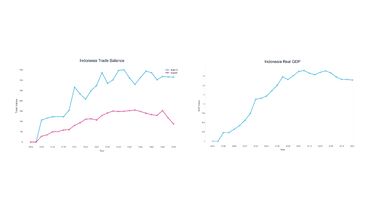
Fig. 5. Projected evolution of Indonesia’s trade balance (2024–2050) under the Enhanced Rock Weathering (ERW) scenario. The divergence between export volumes (blue) and import volumes (red) illustrates the net accumulation of foreign currency reserves over the simulation period. Projected trajectory of Indonesia’s Real GDP Index (2024–2050). The trend reflects the incremental economic growth resulting from the Keynesian fiscal stimulus required to scale ERW operations to capacity.
Fig. 5. illustrates the impact of ERW implementation on Indonesia’s trade balance. The data indicates a direct increase in total foreign currency availability, a crucial factor in circumventing the development trap often faced by emerging nations. Complementing this, the subsequent figure presents the projection for Indonesia’s real GDP. It demonstrates a sustained incremental increase from the baseline scenario, driven by the Keynesian fiscal stimulus necessary to scale ERW to a level capable of delivering significant abatement effects.
Papers featuring our integrated system modelling work
- Mercure, J.-F., Pollitt, H., Viñuales, J.E., Edwards, N.R., Holden, P.B., Chewpreecha, U., Salas, P., Sognnaes, I., Lam, A. & Knobloch, F. (2018) Macroeconomic impact of stranded fossil fuel assets. Nature Climate Change, 8, 588-593. https://doi.org/10.1038/s41558-018-0182-1. Published 4 June 2018.
- Cox, E. & Edwards, N.R. (2019) Beyond carbon pricing: policy levers for negative emissions technologies. Climate Policy, 19, 1144-1156. https://doi.org/10.1080/14693062.2019.1634509. Published 26 June 2019.
- MacDougall, A.H., Frölicher, T.L., Jones, C.D., Rogelj, J., Matthews, H.D., Zickfeld, K., Arora, V. K., Barrett, N. J., Brovkin, V., Burger, F. A., Eby, M., Eliseev, A.V., Hajima, T., Holden, P.B., Jeltsch-Thömmes, A., Koven, C., Mengis, N., Menviel, L., Michou, M., Mokhov, I.I., Oka, A., Schwinger, J., Séférian, R., Shaffer, G., Sokolov, A., Tachiiri, K., Tjiputra, J., Wiltshire, A. & Ziehn, T. (2020) Is there warming in the pipeline? A multi-model analysis of the Zero Emissions Commitment from CO2. Biogeosciences, 17, 2987–3016. https://doi.org/10.5194/bg-17-2987-2020. Published 15 June 2020.
- Vakilifard, N., Kantzas, E. P., Edwards, N. R., Holden, P. B. & Beerling, D. J. (2021) The role of enhanced weathering deployment with agriculture in limiting future warming and protecting coral reefs. Environmental Research Letters, 19, 094005. https://doi.org/10.1088/1748-9326/ac1818. Published 12 August 2021.
- Mercure, J.-F., Salas, P., Vercoulen, P., Semieniuk, G., Lam, A., Pollitt, H., Holden, P. B., Vakilifard, N., Chewpreecha, U., Edwards, N. R. & Vinuales, J.E. (2021) Reframing incentives for climate policy action. Nature Energy, 6, 1133-1139. https://doi.org/10.1038/s41560-021-00934-2 Published 6 December 2021.
- Eufrasio, R. M., Kantzas, E. P., Edwards, N. R. et al. (2022) Environmental and health impacts of atmospheric CO2 removal by enhanced rock weathering depend on nations’ energy mix. Commun Earth Environ 3, 106. https://doi.org/10.1038/s43247-022-00436-3. Published 5 May 2022.
- Semieniuk, G., Holden, P.B., Mercure, JF. et al. (2022) Stranded fossil-fuel assets translate to major losses for investors in advanced economies. Nat. Clim. Chang. 12, 532–538. https://doi.org/10.1038/s41558-022-01356-y. Published 26 May 2022.
- Vakilifard, N., Williams, R.G., Holden, P.B., Turner, K., Edwards, N.R. & Beerling, D.J. (2022) Impact of negative and positive CO2 emissions on global warming metrics using an ensemble of Earth system model simulations. Biogeosciences, 19, 4249-4265. https://doi.org/10.5194/bg-19-4249-2022. Published 8 September 2022
- Beerling, D.J., Kantzas, E.P., Lomas, M.R., Taylor, L.L., Zhang, S., Kanzaki, Y., Eufrasio, R.M., Renforth, P., Mecure, J-F., Pollitt, H., Holden, P.B., Edwards, N.R., Koh, L., Epihov, D.Z., Wolf, A., Hansen, J.E., Banwart, S.A., Pidgeon, N.F., Reinhard, C.T., Planavsky, N.J. & Val Martin, M. (2025) Transforming US agriculture for carbon removal with enhanced weathering. Nature. https://doi.org/10.1038/s41586-024-08429-2 Published 5 February 2025.