
Theme 1 blog update: Maria Val Martin (& research group) 2017-2026
Dr Maria Val Martin and her research group form a vital cornerstone of the work of LC3M. Maria joined the Centre in 2017 and has been a UKRI Future Leaders Fellow since 2020.

Maria leads internationally recognised research on atmosphere–biosphere–climate interactions using Earth system models informed by satellite and ground-based observations.
Her UKRI Future Leaders Fellowship builds directly on LC3M’s work on enhanced rock weathering (ERW). Through this research, Maria investigates how large-scale deployment of weathering and other land-based mitigation strategies—including forestation and wetland restoration—affects atmospheric composition, air quality and climate feedbacks. This work is central to quantifying both the climate benefits and potential environmental trade-offs of land-based climate solutions, and plays a key role in advancing LC3M’s mission to deliver policy-relevant climate science.
Here we review the progression of Maria’s research since she joined LC3M in 2017.
Jump to:
- 2017-2018
- 2018-2019
- 2019-2020
- 2020-2021
- 2021-2022
- 2022-2023
- 2023-2024
- 2024-2025
- 2025-2026
- Papers featuring Maria's work
2017–2018
Following the appointment of Dr Maria Val Martin in 2017, research focused on developing new approaches to investigate the impacts of enhanced rock weathering on soil trace gas emissions—specifically nitric oxide (NO), nitrous oxide (N₂O) and ammonia (NH₃)—and the resulting implications for atmospheric composition, including tropospheric ozone (O₃), and climate feedbacks. N₂O is a particularly important target, as it is a potent greenhouse gas with a global warming potential 265–298 times that of CO₂ over a 100-year timescale.
Motivation for this work came from observations at ERW field trials in the USA (Theme 3), which indicated that ERW can perturb the soil nitrogen cycle. To investigate these effects at scale, Maria’s group used the Community Earth System Model (CESM), a fully coupled Earth system model developed at the National Center for Atmospheric Research, which represents interactions between the atmosphere, land, ocean and sea ice.
Several model developments were required. Within the land model component of CESM, the team implemented and improved a suite of soil nitrogen flux schemes, incorporated a new soil pH database to represent changes arising from ERW applications, and coupled soil nitrogen emissions to the atmospheric chemistry model to simulate downstream impacts on atmospheric composition and climate.
Model performance was assessed by evaluating simulations against a newly compiled set of Earth observations, including field measurements from croplands and natural systems, satellite-based observations, and detailed emission inventories. Preliminary evaluations showed that simulated soil NO and N₂O fluxes were in good agreement with global estimates reported in the literature. These developments laid the foundation for future Earth system experiments designed to test the hypothesis that ERW can reduce soil N₂O and NOₓ emissions, suppress tropospheric ozone formation, limit crop damage, and reduce climate radiative forcing.
2018–2019
Building on this modelling framework, Maria’s group collaborated with the University of Illinois Energy Farm (Dr Elena Blanc, Dr Ilsa Kantola and Dr Evan DeLucia) to implement an empirical parameterisation of enhanced weathering within the CESM land model (CLM5), focusing on corn systems.
The parameterisation was based on soil N₂O and soil pH measurements collected during LC3M Energy Farm trials between 2016 and 2018. It represents changes in denitrification rates as a function of soil pH, thereby directly linking ERW-driven alkalinity changes to soil N₂O and NOₓ emissions. For example, a soil pH increase of 0.25 units resulted in reductions of approximately 15% in soil N₂O emissions—consistent with field observations—and around 25% in soil NOₓ emissions (Fig. 1).
These developments enabled a much closer integration of field-scale observations with Earth system modelling.
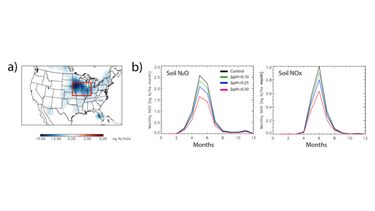
Fig. 1: Response of soil N2O and NOx from enhanced weathering in croplands with CESM2. Changes in summertime soil N2O flux for a ΔpH increase of 0.25 in the continental US (a) and sensitivity of monthly soil N2O and NOx fluxes to varying levels of soil pH over the main US Corn Belt region (b). US corn belt region is depicted in (a).
2019–2020
In this period, the focus shifted toward global and regional Earth system experiments. For global atmospheric–climate–ERW simulations, the team developed an asynchronous coupling approach that allowed CESM to incorporate long-term changes in soil pH arising from basalt application to croplands, as estimated by the enhanced weathering model (Beerling et al., 2020).
The performance of this new coupling method was assessed, and a suite of modelling experiments was designed to quantify how ERW-driven reductions in soil N₂O and NOₓ emissions influence surface ozone formation, crop damage and climate radiative forcing.
At the regional scale, Maria enabled CLM5 to run at high resolution across the UK (21 × 30 km²). Evaluation against national inventories showed that simulated soil N₂O emissions (49 kt N₂O yr⁻¹) closely matched estimates from BEIS (48 kt N₂O yr⁻¹) and the inveN₂Ory project (52 kt N₂O yr⁻¹). Preliminary scoping calculations suggested that ERW could reduce cropland N₂O emissions by approximately 8 Mt CO₂-equivalent per year—around 50% of current farmland emissions—substantially lowering climate impacts per unit yield.
2020–2021
Building directly on previous developments, the CESM framework was further refined through the implementation of a module accounting for rain-induced pulses of NO during nitrification. A series of global simulations was conducted to identify model configurations that best capture atmospheric responses to ERW, with evaluation underway using bottom-up emission inventories and observations across major cropland regions worldwide.
At the regional scale, high-resolution CLM5 simulations were used to provide climate and soil inputs for the ERW model, accounting for the combined effects of climate and nitrogen fertiliser use on soil alkalinity balance and weathering kinetics. Time-varying soil pH changes from long-term basalt application were then coupled back into CLM5 under a range of deployment scenarios to assess mitigation potential.
Results showed that ERW deployment on UK croplands could reduce soil N₂O emissions by 0.1–1.5 Mt CO₂-equivalent per year by 2070, comparable to other proposed N₂O abatement measures (Fig. 2). In parallel, this modelling framework was extended to the United States, with new experiments designed to assess ERW impacts on surface ozone formation and associated crop damage.
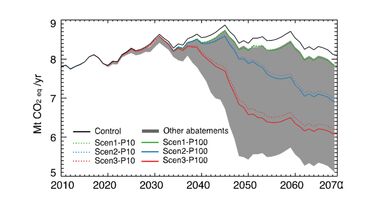
Fig. 2: Soil N2O emission reductions from croplands (as CO2 equivalents) following ERW deployment. N2O results are shown as 10-yr annual running averages for low- (Scen1), medium- (Scen2) and high- (Scen3) resource extraction scenarios and two particle size rock distributions (p80 = 10 μm diameter and p80 = 100 μm diameter). Other abatements include reduce N fertilizer and improve timing of mineral and manure fertilizer N applications, improve land drainage, avoid N excess, application of nitrification inhibitors and use of biological N fixators (e.g., clover).
2021–2022
In the first year of Maria’s UKRI Future Leaders Fellowship, the research programme broadened to examine the indirect climate and atmospheric feedbacks of two major land-based CO₂ removal strategies: reforestation and afforestation, alongside ERW in US croplands.
While large-scale tree planting is widely promoted as a climate solution, trees emit biogenic volatile organic compounds (BVOCs) that influence climate and air quality through secondary organic aerosol formation, cloud interactions, and changes in atmospheric oxidation affecting ozone, methane and sulphate aerosol. Although CO₂ removal benefits are relatively well understood, impacts on atmospheric composition and air quality remain less explored.
Using UKESM1 and CESM2, the team designed experiments comparing a deforestation baseline scenario with a maximum plausible tree-planting scenario under SSP3-7.0 conditions. Results showed that isoprene emissions were approximately 20% higher by 2050 in the tree-planting scenario, rising to around 40% by 2095. Ongoing work examines resulting changes in SOA, ozone and radiative forcing, as well as differences between Earth system models.
In parallel, ERW simulations for the US Corn Belt showed that basalt application reduces summertime surface ozone through decreased soil NOₓ emissions. The crop protection metric AOT40 was projected to decline by around 3 ppm·hr (Fig. 3), corresponding to estimated maize yield increases of 2–4%. This analysis is now being extended to additional crops, pollutants (PM₂.₅), and higher-resolution simulations.
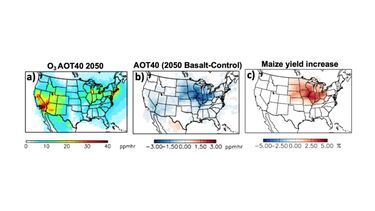
Fig. 3. Impact of basalt application of summertime surface ozone (O3), with (a) surface O3 AOT40 (air quality standard to protect crop health) in 2050, (b) changes in AOT40 (air quality standard to protect human health) and (c) increases in maize crop yield in the US Corn Belt resulting from reductions in summertime ozone shown in (a).
2022–2023
As part of the US ERW modelling effort, Maria led a series of CESM2.2 air-quality simulations to assess potential unintended consequences of basalt application. While ERW suppresses soil NO emissions, increased soil pH can enhance NH₃ volatilisation, with implications for fine particulate matter (PM₂.₅) formation.
Simulations indicated that ERW could increase soil NH₃ emissions by 4–6% by 2070 (Fig. 4). However, reduced NO emissions limited nitric acid formation, leading to an overall decrease in secondary inorganic aerosol production and a projected 5% reduction in spring and summertime PM₂.₅ concentrations. These findings suggest that ERW could support future PM₂.₅ control strategies in agricultural regions.
This year also saw new work on the implications of ERW-driven N₂O reductions for stratospheric ozone recovery. As chlorinated compounds decline under the Montreal Protocol, N₂O is projected to become the dominant ozone-depleting substance. To address remaining uncertainties, Dr James Weber initiated Earth system experiments exploring sustained N₂O reductions from ERW and other agricultural mitigation strategies under different climate scenarios.
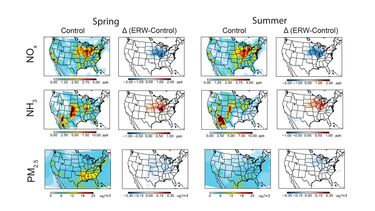
Fig. 4. Simulated PM2.5 and relevant chemical species for control in 2070 and changes due to EW, for nitrogen oxides (NOx in ppb), ammonia (NH3 in ppb) and anthropogenic PM2.5 (in ug m-3) during spring and summer.
2023–2024
Maria extended the regional modelling framework to Australia, enabling high-resolution (25 × 25 km) simulations using CLM5. As in previous regional studies, the framework coupled climate, fertiliser use and time-varying soil pH changes from ERW to assess impacts on soil alkalinity balance, weathering kinetics and N₂O emissions.
Evaluation against published estimates showed that simulated soil N₂O emissions (43 kt N yr⁻¹) compared well with literature values, although remaining slightly higher than national inventory estimates. Ongoing work focuses on validating simulated water infiltration—a key parameter controlling weathering rates—using observations from the Australian Bureau of Meteorology.
2024–2025
Working with postdoctoral researcher Dr Ru Xu, Maria led the development of a new global oil palm representation within CLM5. Building on earlier point-based schemes, this implementation dynamically simulates oil palm growth and biogeochemical processes across regions of current and future cultivation.
The team also developed a spatial dataset projecting oil palm expansion potential through 2100, integrating economic demand projections with bioclimatic suitability and land-use constraints to protect biodiversity and food security (Fig. 5). Together, these advances provide a new platform for assessing enhanced weathering and other land-based climate solutions in tropical agroecosystems.
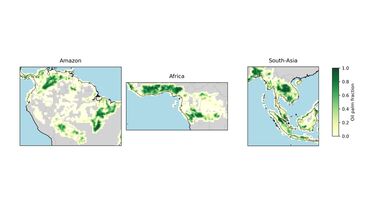
Fig. 5. Potential oil palm expansion for 2050 in South America, Africa and southeast Asia.
2025–2026
Building on this work, Maria and Ru, in collaboration with Euripides, have begun extending the enhanced weathering modelling framework to tropical agroecosystems. New Earth system simulations are underway to assess the combined impacts of oil palm expansion and ERW on atmospheric composition and air quality across the tropics.
In parallel, Maria has initiated the development of a new regional modelling framework for China, enabling future assessment of enhanced weathering applications in one of the world’s most important agricultural regions.
Over nearly a decade, Maria’s research has helped redefine how we evaluate climate solutions. By examining how land-based mitigation strategies affect atmospheric chemistry, air quality and climate, her work helps ensure that carbon removal efforts are effective and sustainable for food systems and public health. This integrated perspective is now central to LC3M’s mission of delivering climate science that works in the real world.
Papers featuring Maria’s LC3M work
Arnold, S.R., Lombardozzi, D., Lamarque, J.-F., Richardson, T., Emmons, L.K., Tilmes, S., Sitch, S.A., Folberth, G., Hollaway, M.J. & Val Martin, M. (2018) Simulated global climate response to tropospheric ozone-induced changes in plant transpiration. Geophysical Research Letters, 45. https://doi.org/10.1029/2018GL079938 Corrected 12 November 2019
Lawrence, D.M. et al (including Val Martin, M). (2019) The Community Land Model version 5: Description of new features, benchmarking, and impact of forcing uncertainty. Journal of Advances in Modeling Earth Systems, 11, 4245-4287. https://doi.org/10.1029/2018GL079938 Corrected 12 November 2019
Fung, K. M., Val Martin, M., & Tai, A. P. K. (2022), Modeling the interinfluence of fertiliser-induced NH3 emission, nitrogen deposition, and aerosol radiative effects using modified CESM2, Biogeosciences, 19, 1635–1655, https://doi.org/10.5194/bg-19-1635-2022. Published 21 March 2022.
Redondo-Bermúdez, M., Jorgensen, A., Cameron, R. & Val Martin, M. (2022) Green infrastructure for air quality plus (GI4AQ+): Defining critical dimensions for implementation in schools and the meaning of ‘plus’ in a UK context, Nature-Based Solutions, Volume 2. https://doi.org/10.1016/j.nbsj.2022.100017 Published 28 March 2022.
Kantzas, E. P., Val Martin, M. & Lomas, M. R. et al. (2022) Substantial carbon drawdown potential from enhanced rock weathering in the United Kingdom. Nat. Geosci. 15, 382–389. https://doi.org/10.1038/s41561-022-00925-2 Published 25 April 2022.
Beerling, D., Kantzas, E., Val Martin, M., Espinosa, R., Pidgeon, N. & Banwart, S. (2023): UK Government Policy Brief: Potential of enhanced rock weathering deployed with UK agriculture to sequester atmospheric carbon dioxide. Available at figshare. Online resource. https://doi.org/10.6084/m9.figshare.22888646.v3 Published 17 May 2023.
Val Martin, M., Blanc-Betes, E., Fung, M.K., Kantzas, E.P., Kantola, I.B., Chiaravalloti, I., Taylor, L.L., Emmons, L.K., Wieder, W.R., Planavasky, N.J., Masters, M.D., DeLucia, M.D., Tai, A.P.K. & Beerling, D.J. (2023) Improved nitrogen cycle in a land surface model (CLM5) to quantity soil N2O, NO, and NH3 emissions from enhanced weathering with croplands. Geoscientific Model Development, 16, 5783-5801. https://doi.org/10.5194/gmd-16-5783-2023 Published 18 October 2023.
Beerling, D.J., Epihov, D.Z., Kantola, I.B., Masters, M.D., Reershemius, T., Planavsky, N.J., Reinhard, C.T., Jordan, J.S., Thorne, S.J., Weber, J., Martin, M.V., Freckleton, R.P., Hartley, S.E., James, R.H., Pearce, C.R., DeLucia, E.H. & Banwart, S.A. (2024) Enhanced weathering in the US Corn Belt delivers carbon removal with agronomic benefits. Proceedings of the National Academy of Science of the United States of America 121(9), e2319436121. Published 22 February 2024.
Weber, J., King, J. A., Abraham, L., Grosvenor, D., Smith, C., Shin, Y., Lawrence, P., Roe, S., Beerling, D. J. and Val Martin, M. (2024) Chemistry-albedo feedbacks offset up to a third of forestation’s CO2 removal benefits, Science, 383, 860-864, 2024, DOI:10.1126/science.adg. Published 22 February 2024.
Weber, J., Keeble, J., Abraham, N.L., Beerling, D.J. & Val Martin, M. (2024) Global agricultural N2O emission reduction strategies deliver climate benefits with minimal impact on stratospheric O3 recovery. npj Climate and Atmospheric Science, 7. https://doi.org/10.1038/s41612-024-00678-2 Published 7 June 2024.
King, J. A., Weber, J., Lawrence, P., Roe, S., Swann, A. L. S. & Val Martin, M. (2024) Global and regional hydrological impacts of global forest expansion. Biogeosciences, 21, 3883–3902. https://doi.org/10.5194/bg-21-3883-2024 Published 3 September 2024.
Beerling, D.J., Kantzas, E.P., Lomas, M.R., Taylor, L.L., Zhang, S., Kanzaki, Y., Eufrasio, R.M., Renforth, P., Mecure, J-F., Pollitt, H., Holden, P.B., Edwards, N.R., Koh, L., Epihov, D.Z., Wolf, A., Hansen, J.E., Banwart, S.A., Pidgeon, N.F., Reinhard, C.T., Planavsky, N.J. & Val Martin, M. (2025) Transforming US agriculture for carbon removal with enhanced weathering. Nature. https://doi.org/10.1038/s41586-024-08429-2 Published 5 February 2025.
Shi, Y., Heald, C. L. & Val Martin, M. (2025) Future anthropogenic land use change impacts on carbonaceous aerosol and implications for climate and air quality. Geophysical Research Letters, 52. https://doi.org/10.1029/2024GL110962 Published 13 March 2025.
Bhattarai, H.*, Val Martin, M., Sitch, S., Yung, D. H. Y., and Tai, A. P. K. (2025) Global wildfire patterns and drivers under climate change, Biogeosciences, 22, 7591–7610, https://doi.org/10.5194/bg-22-7591-2025. Published 3 December 2025.