
Disability Matters Online Symposia 2025: Honouring the Legacy of Professor Anita Ghai
An online symposium from India on 11th December, 2025.
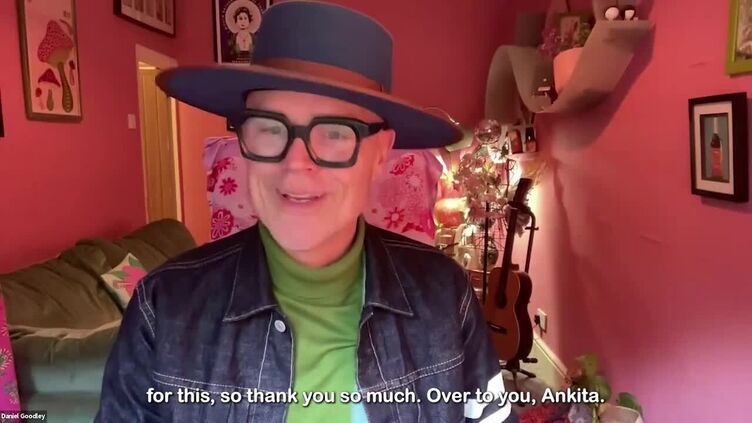
Introduction by Dan Goodley and Ankita Mishra
Disability Matters is a major six year pan-national programme of disability, health and science research, funded by a Wellcome Trust Discretionary Award.
A key ambition of Disability Matters is to make disability the driving subject of research. We will be promoting scholarship that demonstrates the contribution of disability studies to a host of fields including medicine, medical humanities, medical sociology, science and technology studies, health sciences, population health as well as other key areas including education, law, business, legal studies, health psychology, social work, etc. Between 2023 and 2029, the programme is running a number of short and accessible Online Symposia.
We were fortunate to partner with India through Anita. She brought Disability Matters to India and India to Disability Matters, for which we are eternally grateful. As we all know, Anita was a foundational figure in Indian Critical Disability Studies, and her work has deeply shaped conversations about gender, identity, inclusion, power, culture, and activism. In Anita’s memory and to honour her legacy, we are organising an online symposium dedicated to centre Indian Disability Studies, its epistemology, theory, activism, and social engagement as it marks a year to Anita’s departure on 11 December. We hope to create a living archive that celebrates and extends the work of Indian Disability Studies, inspired by Anita Ghai’s scholarship, activism, and imagination.
In Anita’s memory and to honour her legacy, we have organised a series of Disability Dialogues contributions and today’s online symposium dedicated to centre Indian Disability Studies, its epistemology, theory, activism, and social engagement as it marks a year to Anita’s departure on 11 December. You can read the Disability Dialogues contributions here.
We express our immense gratitude to the wonderful contributors:
Dr Shilpaa Anand
Professor Tanmoy Bhattacharya
Professor Rachana Johri
Professor Nivedita Menon
Professor Nilika Mehrotra
Dr Ritika Gulyani
Dr Karuna Rajeev
Dr Shweta Verma
We hope to have created a living archive that celebrates and extends the work of Indian Disability Studies, inspired by Anita Ghai’s scholarship, activism, and imagination.
I would now like to invite Professor Dan Goodley to share a few words with us about his friendship and connection with Anita. Read his reflections here.
The format of the symposium will be:
Introduction (5 minutes)
Three x spoken provocations (10 minutes x 3)
Q&A (20 minutes)
Online plenary and open discussion (15 minutes)
Close (5 minutes)
Total duration: 1 hour 15 minutes
Speakers
Prof. Shubhangi Vaidya is with the School of Interdisciplinary and Trans-disciplinary Studies at the Indira Gandhi National Open University. A sociologist by training, she has research interests in the areas of disability, gender and the family, with a special focus on neurodiversity. She is the author of ' Autism and the Family in Urban India: Looking Back, Looking Forward' ( Springer, 2016) and ' Embodying Motherhood: Perspectives from Contemporary India' co-authored with Anu Aneja ( Sage-Yoda, 2016). She is also engaged in awareness raising and advocacy for persons with disability and their families.
Sandeep R. Singh is an Assistant Professor of Comparative Literature and Translation Studies at Dr. B.R. Ambedkar University Delhi, India where he teaches courses on Disability Studies, World Literature, Literary Comparison, Narratology and Life-Writing at the Undergraduate and Postgraduate level. He is pursuing his PhD titled “Writing Life, Narrating Self: Disability Discourse in the Works of Oliver W. Sacks” at Jawaharlal Nehru University, New Delhi and he is due to submit by December 2025. He is also a co-applicant on the Disability Matters Project, a major six-year pan-national programme of disability, health and science research, funded by a Wellcome Trust Discretionary Award (2023 - 2029).
Dr. Sruti Mohapatra is a national icon in the disability rights movement - an author, scholar, international inclusion trainer, and tireless advocate for equity and accessibility. As the founder of Swabhiman, a leading nonprofit working in inclusive education, accessibility, and policy reform, she has conceptualized award-winning programs such as Anjali, Saksham, Prerana, and others that have influenced policy and practice across India. She has played a key role in shaping disability legislation, and serves on key national education and policy bodies. Dr. Mohapatra is a five-time TEDx speaker and recipient of over 77 national and international awards, including the Nari Shakti Puraskar from the President of India. Her journey has inspired two films, one by the Films Division of India and another in Odia language, highlighting her contributions and spirit.
Disability Studies in India: The Legacy of Anita Ghai by Prof Shubhangi Vaidya
To cite this work: Vaidya, Shubhangi (2025). Disability Studies in India: The Legacy of Anita Ghai. In Goodley, D., Halsey, R., Scully, J., Singh, S., Titchkosky, T. and Wong, M.E. (Editors). The Disability Matters Scholarship Collection. Sheffield: University of Sheffield.
Disability Studies has developed as vibrant site of interdisciplinary engagement in India over the past couple of decades. An exciting body of scholarship has emerged across the social sciences and humanities; law and public policy; architecture and design; development studies and gender studies; interrogating ableist and discriminatory structures, systems and mindsets and advocating for inclusion and social justice. This scholarship is attentive to the intersections of disability with gender, caste, class and other axes of exclusion and inclusion; cultural representations and framing of ‘difference’; and the complex, multi-layered history of the sub-continent. It situates local realities against global discourses, complicating the notion of individual rights and entitlements in a collectivist culture that valorizes family, kinship and communitarian ties. Disability is undoubtedly an issue of development, and needs to be studied in relation to structural issues like poverty, inequality, patriarchy, environmental and climate justice. With a population of over 1.4 billion; immense cultural, religious, linguistic and other diversities; and the historical baggage of two centuries of colonial rule, India is a complex and fascinating site for critical disability studies. It is in this context that Professor Anita Ghai’s pioneering contributions in theorizing disability with a post-colonial lens assume significance. Her nuanced reading of representations of disability in religious literature and mythology, for instance unpacks the cultural understandings of disability as karmic consequence and familial responsibility.
Anita sought to open up conversations between the disability and women’s movements around issues like access, sexuality, motherhood, care giving, pre-natal testing, abortion, reproductive rights. Complicating feminist discourse, she spoke of the existential realities of women with disability in India and their erasure from rights movements (Ghai 2002, 2003). Her attempts to make space for disability in the Indian Association for Women’s Studies (IAWS) was a step in this direction. Disability Studies in India has strong critical, feminist foundations, as is seen in the work of Asha Hans, Renu Addlakha, Nilika Mehrotra, Nandini Ghosh, Upali Chakravarti and many others.
Anita’s autobiographical writing has a special resonance. Her reflections on growing up as a disabled girl and woman in a North Indian family is an apt example of the feminist dictum ‘the personal is the political’ (Ghai, 2015). Polio in childhood left her with a permanent disability, which her family tried very hard to ‘cure’ through various kinds local ‘remedies’, faith healers and miracle cures. When they eventually came to terms with her disability, they focused their attention on her education and career. She writes of the dawning realisation that she would not have access to normative adult feminine roles of wifehood and motherhood. “Slowly but surely culture stamped me with the identity of being a disabled person. Like all families, mine, too, was a product of a given culture. My parents clearly understood that in a patriarchal milieu where arranged marriages are the rule, non-availability of the traditional role would be extremely difficult. I now understand that what the family sanctioned was worked out as a strategy. It became clear to me that the idea of a liberated family was illusory” (ibid. p. 8). She writes with candour about her psychological struggles with her ‘disabled’ identity; her initial refusal of assistive devices; the attempts to “overcome” and negotiate normative ideas of beauty and desirability. Her account of her experiences of heart disease and cancer starkly illustrate the existential frailty of the body and the intersections of disability, illness and debility which have become even more salient in the aftermath of the COVID 19 Pandemic. She examines this further in an autoethnographic reflection on her experiences during the national lockdown and contracting the virus during the terrible days of the ‘second wave’ in April 2021 (Ghai and Tenneti, 2024). Deploying Bury’s (1982) concept of ‘biographical disruption’ she expands the concept to encompass the social disaster and enhanced vulnerabilities and precarities experienced by people with disabilities. She powerfully invokes the terror of isolation, loneliness and deprivation of the human touch during this period; experiences that mirror the existential realities of many individuals with disabilities who live on the social margins.
Anita’s scholarship and activism influenced my engagement with disability studies as the mother of a person with autism and a feminist scholar with research interests in neurodiversity, gender and family. Her work compelled me to question my understandings of capacity, personhood and agency and look at relations of care with a more critical lens, especially with regard to persons with high support needs whose voices we make little effort to hear.
I was also privileged to be one of the contributing authors in her edited volume ‘Disability in South Asia: Knowledge and Experience’ (2018); an invaluable introduction to the field. In her Introduction to the book she raises the questions: “… how do we come to know disability? What are the conceptions of the normal? What is autonomy? When exactly is life not worth living? Why does rationality have to be the sole determinant of our humanity? How do we define limit” ? (ibid., xx). These are questions that demand critical reflection and a willingness to engage with multiple voices and subjectivities. Her own chapter “Unification of Disability in Diversity: A Different Voice” critically interrogates the ‘feel good’ concept of disability as ‘diversity’ and cautions that diversity may not always result in full inclusion, particularly of individuals with profound cognitive impairments whose personhood may not be acknowledged. The diversity paradigm thus runs the risk of de-politicising disability and glossing over the systemic oppressions experienced by persons with disability. She writes: “To me, diversity works as a manoeuvre in neoliberal political and economic markets that work to ratify the status quo through ‘feel good’ politics” (ibid., 428) It is in this context that she also interrogates the term ‘divyang’ which has now been incorporated into the disability terminology of the state.
Anita’s sudden departure is a massive rupture which will take us all a long time to recover from. The core concerns that engaged her throughout her life centred around the value of human life, the indispensability of human connection and the need to build solidarities. As her friend Rachna Johri aptly said, Anita wanted a life of both joy and justice. There can be no better epitaph.
References
Bury, M. (1982) “Chronic illness as biographical disruption”. Sociology of Health and Illness, 4(2), 167–182.
Ghai, A. (2002) “Disabled Women: An Excluded Agenda of Indian Feminism”. Hypatia 17(3): 49-66.
-- (2003) (Dis)Embodied Forms: Issues of Disabled Women. New Delhi: Har-Anand Publications
-- (2015) Rethinking Disability in India Routledge, India
-- (2018) Disability in South Asia: Knowledge and Experience. New Delhi: Sage.
Ghai, A. and Tenneti, S. (2024) “An Autoethnographic Reflection of COVID-19 and/as Biographical Disreuption”. Indian Journal of Gender Studies, 31 (1): 43-60. https://doi.org/10.1177/09715215231210537
In Memoriam — Becoming Ancestor: The Living Legacy of Anita Ghai by Sandeep R. Singh
To cite this work: Singh, Sandeep R. (2025). In Memoriam — Becoming Ancestor: The Living Legacy of Anita Ghai. In Goodley, D., Halsey, R., Scully, J., Singh, S., Titchkosky, T. and Wong, M.E. (Editors). The Disability Matters Scholarship Collection. Sheffield: University of Sheffield.
To think about Professor Anita Ghai—or Anita, as she always insisted I call her—comes from a place of shared experience, of navigating worlds never designed with our bodies, our histories, or our ways of knowing. As a fellow disabled person, I recognised in her not only a mentor and a friend but someone who stood far larger than any of these definitions could encapsulate. Anita has been, and always will remain, my disability ancestor. As one of the pioneering architects of disability scholarship in India, Anita expanded the conceptual, pedagogical, and ethical discourses that have shaped disability studies in the Global South. In placing disability at the centre of critical inquiry, she generated modes of thought and practice that will continue to inform our work. Her presence opened conceptual terrains of possibilities for thinking, writing and living disability in a far more nuanced and intersectional manner. In the clarity of her thought and the generosity of her practice, she cultivated conditions in which alternative modes of knowledge, care, and embodiment could take form, enabling others to imagine lives that exceeded inherited limits.
If disability studies in India exists today as a discourse of epistemic enquiry, it is because Anita had already been doing the difficult intellectual, political, and affective labour of making such interventions possible. Her work did not simply shape a discipline, it shaped the conditions under which many of us could enter that discipline with integrity, imagination, and courage.
Anita was a foundational figure in Indian Critical Disability Studies. Her scholarship shaped how disability was thought, narrated, and politicised in the Indian academia and beyond. She brought disciplinary conversations to a framework that refused the divide between gender and disability, insisting instead that disability must be analysed as a category interwoven with identity, embodiment, culture, and community. Her work questioned the developmentalist, charitable, and medical paradigms that had long dominated disability discourse in India. She argued for disability as a site of agency, cultural meaning, and political struggle. Through her interventions, she helped shift the conversation from inclusion as benevolence to inclusion as social justice; from impairment as pathology to embodiment as a locus of knowledge; from disability as an individual misfortune to disability as a structural, relational, and cultural phenomenon.
What I learned from her however, was never only gleaned from texts or institutional interactions, it emerged from the resonance of a shared embodiment and the ethical labour of thinking with a fellow disabled person. Anita taught me to see disability studies not as a detached academic field but as a lived, ethical, and political practice. With her, the discipline unfolded as a site where epistemology and activism were not parallel pursuits but entwined commitments—where thinking was a form of resistance, and resistance itself was knowledge production. She always told me that theory must remain accountable to lived experience, that activism is also epistemic labour, and that disability studies, when done well, challenges entrenched assumptions about who gets to define knowledge and why.
Anita always batted for interdependence, not as a concession but as a philosophical stance. She questioned the fetish of independence that dominates modern political imaginaries, showing how it obscures the deep interpersonal nature of human life. For her, interdependence was vital to the human condition. She always asked, what if political and social communities recognised that vulnerability is universal, that care is a shared responsibility, and that dependence is not a flaw but a condition of coexistence? Anita’s work urges us to think that autonomy itself is sustained by networks of reciprocity, and that democratic life is impoverished when these networks are denied or hidden. Through these questions, she offers not merely a critique but a reimagined ethical horizon that is grounded in interdependence, dignity, and collective flourishing.
Her mentorship taught me to stay with discomfort; not to turn away from it, to examine the assumptions that even disabled scholars can so easily internalise, and to recognise intersubjectivity as central to intellectual practice. She asked questions that opened interpretive frames within disability discourse that I had not known were available to me. Her intellectual generosity was never performative; it was a deeply embodied ethic. Through her, I learnt that the epistemology of disability is also an epistemology of survival, community, critique, and imaginative possibilities.
Anita’s friendship too, was a space of recognition that only another disabled person could offer. Our conversations spilled easily into humour, our shared frustrations, and those small yet profound moments of understanding that emerge only from disabled kinship. Anita’s companionship was grounded, steady and disarmingly honest. She brought to friendship the same commitments she brought to scholarship; those of rigour, care, accountability, and a refusal to abandon complexity for convenience.
To call her my disability ancestor, then, is not merely a metaphor, it is an acknowledgement of a lineage she embodied and passed on—a lineage of intellectual courage, feminist insistence, political sharpness, and the capability of imagining freedoms not yet available. She made possible a space in which people like me could think, study, speak, and claim disability not as deficit but as a generative way of being in the world. She walked ahead so that many of us could arrive with less fear.
So yes, she was my mentor. But that word holds only a fraction of what she gave me. Anita shaped how I thought, how I understood disability studies, and how I inhabited my own disability without apology. She taught me that rigour and tenderness could coexist, that critique and care were not binaries, and that intellectual life—especially for disabled people—was always collaborative work. In her presence, it became possible to imagine a scholarship that was neither alienated from lived experience nor trapped within it, a scholarship that practised what it theorised.
For her friendship, her solidarity, her example, and for the place she occupies in my own lineage of becoming, I remain deeply grateful. Even in her absence, Anita continues to shape not only my intellectual commitments but my sense of how one moves through the world—disabled, thinking, resisting, and still making room for joy.
Honouring the Legacy of Professor Anita Ghai by Dr Sruti Mohapatra
To cite this work: Mohapatra, Sruti(2025). Disability Matters Online Symposia 2025: Honouring the Legacy of Professor Anita Ghai. In Goodley, D., Halsey, R., Scully, J., Singh, S. R., Titchkosky, T. and Wong, M.E. (Editors). The Disability Matters Scholarship Collection. Sheffield: University of Sheffield.
In the quiet of a morning that has not yet learned its name
a woman lifts her voice and the world stirs
her body becomes a doorway into truth
and her truth becomes a light that refuses to go out.
Anita Ghai was born in October nineteen fifty eight. She lived with polio from early childhood, and from the beginning her life unfolded in a world that treated disability as something to hide or correct. Her family, like many families of that time, took her to faith healers and rituals of cure. She witnessed the silent sorrow that society imposes on difference. Yet what she absorbed was not shame. She absorbed a stubborn clarity that her body did not need fixing. The world around her did.
She grew into a thinker shaped by both tenderness and steel. As a young woman she found her way into the study of psychology and later into the world of teaching. She spent many years at Jesus and Mary College where she became a beloved teacher, a thoughtful colleague, and a person who made ideas feel human and alive. Those who worked with her often remember how she challenged them, not with aggression but with a firm, questioning gentleness that stayed long after the conversation ended.
Her life took a transformative turn when she joined Ambedkar University Delhi. There she helped build the disability studies programme from the ground up. For her, this was not merely an academic exercise. It was an act of justice. A declaration that disabled lives deserved their own intellectual space and deserved it without apology. She saw disability not as a medical flaw but as a social and political condition created by barriers, prejudice, and unequal structures. She argued that society imposes disability through inaccessible spaces, through ignorance, through fear, and through a refusal to acknowledge the fullness of human diversity.
Her writings reshaped the field in India. Her book titled “Dis-Embodied Form: Issues of Disabled Women” brought attention to the specific experiences of disabled women. Rethinking Disability in India questioned every easy assumption about normalcy. She edited works that helped locate disability in the specific cultural and political contexts of South Asia. Readers across the country still turn to her writing to understand not only disability but the meaning of justice itself.
Her scholarship was not separate from her life. It was born from her body, her pain, her joy, her memories. She often spoke of the ways in which disabled women navigate desire, agency, and dignity in a world that either infantilises them or erases them completely. She challenged mainstream feminism for ignoring disability. She challenged disability rights spaces for ignoring gender. She refused every kind of compartmentalisation, insisting that real justice must see the whole person.
She lived her activism. When an airline failed to provide her a wheelchair at an airport and she was forced to crawl on the tarmac, she did not accept humiliation quietly. She spoke about it publicly. She demanded accountability. She insisted that accessibility was not charity but a right. That dignity was not negotiable. That disabled people should not have to plead for basic respect.
At Ambedkar University she also played a vital role in institutional justice. A colleague recalls that when a Dalit sanitation worker came forward with a grave complaint of sexual harassment, Anita was heading the Internal Complaints Committee. She took the case seriously and sent a clear message that no position of power could overshadow the suffering of a woman from a marginalised background. In a system where caste, class, and gender often silence the most vulnerable, Anita ensured that justice was not merely discussed but delivered. This memory remains one of the clearest examples of her courage and her unwavering commitment to equity.
In the center of her long journey
there burned a single flame
quiet but unyielding
a promise that every human being deserves to belong.
Her colleagues remember her warmth. Her students remember how she made theory breathe. Her friends remember her wit, her laughter, her stubborn hope. Even when she was dealing with serious health challenges including heart surgeries, cancer, and the lingering effects of childhood polio, she did not allow despair to define her. She believed in the shared vulnerability of human beings. She believed that difference is not a wound. It is a form of richness that society refuses to understand.
She wrote about interdependence as an ethical stance. Not the forced independence that society idolises, but an honest acceptance that human beings need one another. She wrote about the slow violence of ableism, about the way ignorance embeds itself into institutions, about how exclusion becomes normal unless we deliberately name it and dismantle it. She wrote with the steady conviction that compassion must be structural. It cannot be left to goodwill. It must be built into the bones of society.
Her passing in December twenty twenty four shook many communities. Scholars, activists, students, colleagues, and friends felt the loss as something deeply personal. It was not only the loss of a teacher or an author or an activist. It was the loss of a presence that had quietly held together so many conversations about justice, difference, and belonging. It was the loss of someone who had lived her convictions so completely that her life itself became a lesson.
Yet her legacy remains vibrant. Her writings continue to guide those trying to reshape institutions. Her teachings continue to influence young scholars and activists who want to build more accessible worlds. The disability rights movement and the womens rights movement both recognise her as one of the most critical voices of the last several decades. Her life reminds us that a single person, living with integrity, can shift the direction of entire fields.
Her ideas continue to spark reflection. What does it mean to truly see another person. What does it mean to recognise difference without fear. What does it mean to build a world where dignity is not conditional. She did not offer simple answers. She offered clarity. And courage. And compassion grounded in truth.
And now in the soft twilight of memory
her voice returns like a steady wind
whispering that justice is made not of words but of choices
and that love is the greatest form of courage we carry.
To remember Anita Ghai is to remember a woman who lived fully, intellectually, politically, and emotionally. A woman who questioned the foundations of exclusion and taught us that to honour disability is to honour humanity itself. A woman who held both fire and gentleness together in her voice. A woman whose words refuse to fade.
Her story continues. Because every act of fairness carries her name. Every accessible classroom carries her vision. Every student who learns to see disability as difference rather than defect carries her thought forward. Every instance of justice rendered to someone ignored by society becomes part of her unfinished work.
May we continue to carry her light. May we continue to question. May we continue to create a world that welcomes every body. May we live in a way that would make her smile. VP

iHuman
How we understand being ‘human’ differs between disciplines and has changed radically over time. We are living in an age marked by rapid growth in knowledge about the human body and brain, and new technologies with the potential to change them.