
Reflections from the Sustainability in Drinks Conference 2026
In October, Dr Olga Cam of Sheffield University Management School presented findings from the NETWINE research network at the Sustainability in Drinks Conference 2026 in London.

In October, Dr Olga Cam of Sheffield University Management School presented findings from the NETWINE research network at the Sustainability in Drinks Conference 2026 in London, on a panel exploring how science and data are shaping sustainability in wine. Here we share some reflections from the session.
The session SID Science & Data in Practice, held on 20 October at Christ Church Spitalfields and led by Becky Sykes of the Regenerative Viticulture Foundation, brought researchers and practitioners together. Dr Cam's research forms part of NETWINE, an international network funded by the Grantham Centre for Sustainable Futures Go Fund and by CNPq, Brazil's National Council for Scientific and Technological Development. Its starting point is an accounting question: wineries measure more than ever, but who owns each number, who answers for it, and who outside the business can see it?
The SID Science & Data in Practice panel, London, October 2026.
Dr Olga Cam, Lecturer in Accounting at Sheffield University Management School, presented findings from 28 interviews across the UK, France, Italy, Spain, South Africa and Brazil, conducted with partners including UFRGS, KEDGE Business School, Stellenbosch University, the University of Alicante and Embrapa. The first findings were shared with Brazilian winemakers at an Embrapa seminar in 2025, led by Dr Aurora Zen of UFRGS.
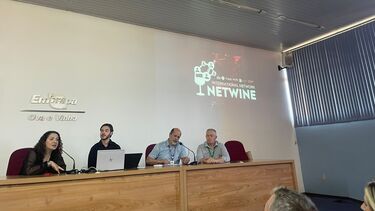
The NETWINE seminar for winemakers at Embrapa Uva e Vinho, Brazil, 2025.
The central finding was that sustainability is one word with six answers. In Brazil, economic viability comes first, so measures are cheap and practical. In Spain, the denomination produces one carbon footprint for all members, because no single winery could build one alone. In Italy, tax relief of 30 to 40 per cent decides what gets bought. In the UK, measurement is detailed and owned by the business: one grower found that twelve years of copper sprays had raised soil copper by nearly 20%, and changed his spray programme.
Yet the biggest problems sit beyond the data. Only about one UK grower in five joins the sustainability scheme, and the largest impact is packaging: no UK glassmaker can make a sparkling-wine bottle that holds 13 bar, so every one is imported. A review of 403 articles by the team (Mendes, Cam, Zen, Jaeger, Callegaro-de-Menezes and Matos de Meira, 2026, Business Strategy and the Environment) shows research on environmental, economic and social sustainability climbing, while research on governance stays flat. The tools for carbon and water keep arriving; the tools for accountability are not being built.
Dr Florian Payen of HESTIA, University of Oxford, presented a global meta-analysis showing that every alternative vineyard practice studied, from cover crops to biochar, increased soil organic carbon, at an average of 7.53 t CO₂-eq per hectare per year. That will not make wine carbon neutral, but it could inset the emissions of the vineyard phase.
Tom Griffin, also of HESTIA, surveyed 40 English vineyards. On average, English grapes are a net emitter, yet 13 vineyards were carbon-negative, and prior land use decided the outcome: vineyards on former cropland tended to store carbon, while those on converted pasture lost it. He called for policy to reward planting on low-quality, carbon-depleted cropland.
Ian Beecher-Jones, co-founder of JoJo's Vineyard, gave a grower's view of vineyard technology: a confusing market that often over-promises, and a case for grower-owned, open vineyard data that works with any provider.
Dr Andrew Wood, author and analyst behind Noble Nine, completed the panel with presenting his book and reflecting on his research.
Several lessons emerged. First, measurement tools are advancing quickly, from soil carbon to digital vineyard maps. Second, what counts as sustainable depends on context, and a single global metric risks missing what matters locally. Third, accountability is the missing link: the copper case shows what happens when a number has an owner who acts, while the imported bottle and the four growers in five outside the scheme show what happens when it does not. Fourth, the questions are interdisciplinary, linking accounting and governance with soil science, land-use policy and agricultural technology.
The conference floor showed solutions already reaching the market: lighter bottles, closures and labels moving away from plastic, better water management, and cloudy, unfined wine challenging drinkers' expectations.
Looking forward, NETWINE is aiming to grow and formalise the network, and the findings will feed into a practitioner e-book chapter on measuring sustainability in wine.
We are grateful to the Grantham Centre for Sustainable Futures and CNPq for funding NETWINE; to Dr Aurora Zen, Embrapa and colleagues across the network; and to the Sustainability in Drinks organisers, Becky Sykes and fellow panellists and WineGB for support.
CRAFiC is part of Sheffield University Management School (SUMS), which offers distinctive undergraduate, postgraduate and MBA programmes taught by research-active scholars who are leaders in their fields.