Facility News
Here is some of the latest news of what has been happening at the UKRI National Millimetre Wave Measurement Facility.
Interested in using our facility for your research/project or seeking consultation and collaboration?
🤝Reach out at mmwave@sheffield.ac.uk.
👉 Connect on LinkedIn: https://lnkd.in/eVxZyp9r
27/5/26
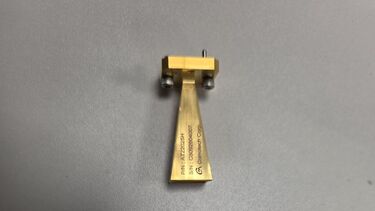
Another exciting upgrade at the National mmWave Measurement Facility!
We’ve now added two new 140 -220 GHz horn antennas, further extending our high-frequency measurement capabilities.
We are now able to support even more measurements in the mmWave and Sub-Terahertz range!
|
|---|
20/5/26
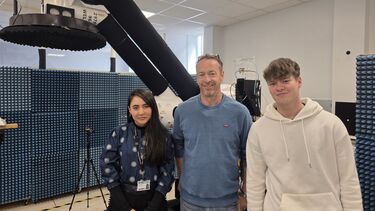
We had a great visit from Steve Clark and Sam Clark from Cambridge AirSeeker Ltd recently.
We spent time doing free-space scattering measurements, using S11 on the Keysight PNA-X with a WR10 VDI frequency extender, and transforming the data into the time domain (TDR-like response), working with our horn antennas.
Switching to the time domain really helped — you can separate reflections in range, and once you identify the target response, it becomes much easier to isolate and analyse.
It is always a pleasure work with Steve and it’s was really exciting to explore how much you can do with a PNA-X beyond standard S-parameters.
|
|---|
30/4/26
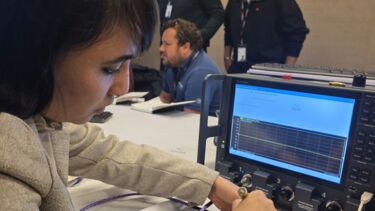
Our technician Sideqe attended a really good RF & microwave testing in Reading — there were some great discussions around improving measurement approaches and making testing workflows more efficient and reliable.
One of the key takeaways for me was how handheld OTA solutions are being used for more flexible field measurements. Being able to combine spectrum, network, and power measurements in real time across wide frequency ranges is quite powerful, especially for quicker interference checks and coverage validation outside the lab.
|
|---|
29/04/26
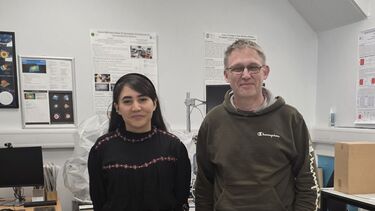
Recently we have had the pleasure to work with Johan Skatt from Cambridge Consultants, we measured 2 antenna arrays for him using our NSI-MI spherical measurement system.
The work focused on circular polarisation measurements across the 15–35 GHz range, supporting the characterisation of multiple antenna elements within a dual-fed antenna design.
We love using our facility to overcome mmWave measurement challenges and support high-frequency antenna and complex RF system developments.
It was a great session, and we look forward to working with Johan again soon.
|
|---|
13/04/26
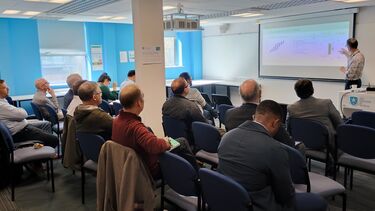
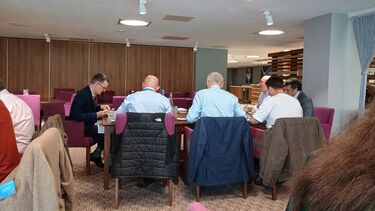
What an incredible day at our Research Update & Networking Event!
We were thrilled to welcome our valued industry partners to the National mmWave Measurement Facility for an inspiring day of research updates and technical discussions.
The event showcased exciting progress from Eddie Ball’s UKRI Future Leaders Fellowship, along with a look ahead at the next stages of development. Key highlights included:
⭐Time-Modulated Arrays for beamforming and direct antenna modulation
⭐Advances in Integrated Sensing and Communication (ISAC)
⭐Ongoing developments in mixers, VCO and RF ADC architectures
We also celebrated the recent extension to our capabilities, including the introduction of our new #220 GHz VDI units, opening up new opportunities for high-frequency measurement and research.
Aside from the technical updates, the event sparked valuable discussions around shared future directions in mmWave and RF design — including opportunities in heterogeneous integration and next-generation system architectures, inspired by Eddie's involvement with the CHIMES-IKC
We closed the day with a networking lunch, bringing together attendees for informal discussions and new collaboration opportunities.
A huge thank you to everyone who attended and contributed to making the event such a success 🙌 Your engagement and insights are what continue to drive innovation and partnership in this space.
We’re enthusiastic about what lies ahead and the new opportunities these discussions will open up!
|
|
|---|---|
| 
|
07/04/26
Exciting upgrade at the National mmWave Measurement Facility!
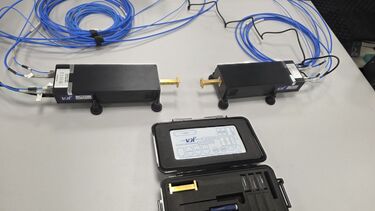
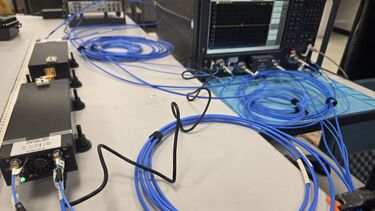
We’ve recently added two new VDI units, along with a calibration kit, significantly extending our measurement capabilities up to 220 GHz.
The image shows the setup in our lab, including the VDI extenders and precision calibration standards, ready for high-frequency waveguide measurements.
This enhancement enables more accurate and reliable measurements in the mmWave and Sub-Terahertz range, supporting advanced research in areas such as 6G, metamaterials, and electromagnetics.
A great step forward for pushing the boundaries of high-frequency measurement and research.
| 
|
|---|
31/03/26
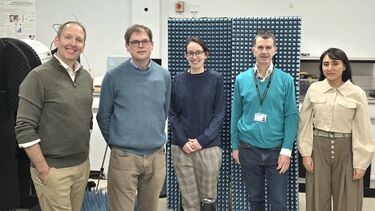
Last week we were visited by Nathan Meddings and Peter Williams from Bedrock Radio Systems Ltd and AGD Systems Limited to test their printed antennas and printed test circuits.
We carried out S-parameters and spherical measurements using our NSI spherical antenna mmWave system and network analyser. These measurements enabled detailed radiation pattern analysis and full 3D antenna charaterisation. This included measuring input return loss, coupling between sub-arrays, and V- and H-plane linearly polarised far-field beam patterns for the printed antenna, as well as fully calibrated 2-port S-parameter measurements on test circuit (up to 50 GHz) for the printed test circuits.
|
|---|
06/03/26
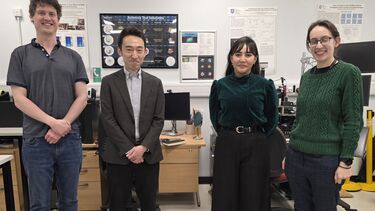
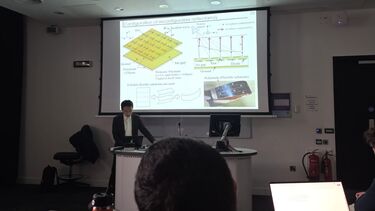
It was a pleasure to give Prof. Takashi Tomura from the Institute of Science Tokyo (Science Tokyo) a tour of the National mmWave Measurement Facility last week. We are always happy to showcase our work, and capabilities.
We enjoyed listening to his lecture on ‘Origami Deployable Reflectarray and Space Multiplexing Antennas for 6G and Space Systems’. He also shared valuable insights into mmWave antenna and metamaterial design, including waveguide slot arrays and deployable antennas for satellite communications.
We are keen to explore potential research partnerships during his time here. Many thanks to Prof. Tomura for an excellent talk and for sharing his expertise with us.
| 
|
|---|
02/03/26
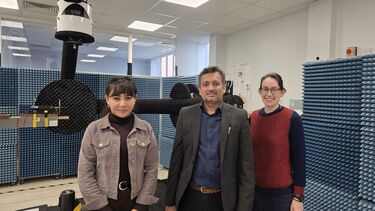
We had the privilege of giving a tour of the facility to Azeem Imtiaz from RFtronincs. An excellent opportunity to explore advanced research capabilities and cutting-edge work in millimetre-wave technologies.
|
|---|
16/02/26
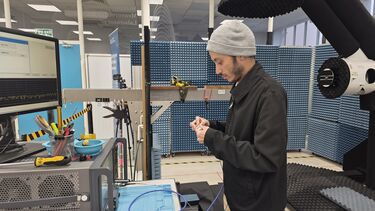
We are delighted to welcome our new PhD user Sami Almalki to the National mmWave Measurement Facility last week. We helped him measure the reflection coefficient of his 18-35 GHz antenna using our Keysight 4 port VNA.
|
|---|
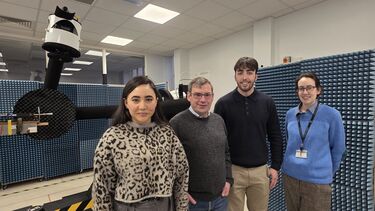
It was a pleasure to welcome John McGreevy and Matthew Taylor from Sylatech Limited to the National mmWave Measurement Facility In January.
We carried out S-parameter and spherical measurements using our NSI spherical antenna mmWave system, network analyser, and VDI units up to 110 GHz. These measurements enabled detailed radiation pattern analysis and full 3D antenna characterisation, supporting advanced mmWave research and development.
It was great to meet them and collaborate, we hope we work together again soon.
|
|---|
- 2025
Some good news to end the year our regular users Sumin David Joseph, Benedict Davies , Matthew Davies , Edward A. Ball and Jon. R. Willmot had their latest paper published in the IEEE Open Journal of Antennas and Propagation.
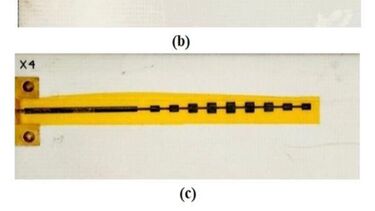
the paper investigates the potential of aerosol jet printing for rapid prototyping of millimeter-wave antennas. Traditionally, antenna design and production require extensive simulation and multiple prototyping stages to achieve the desired radiation pattern and bandwidth performance, with each iteration incurring material costs. In this work, a commercial aerosol jet printer, as a direct write additive manufacturing tool, was used to create antenna arrays on Rogers substrate and Kapton tape. A 9-element series-fed patch array with amplitude tapering based on the Dolph-Chebyshev method was designed.
you can read the paper here https://ieeexplore.ieee.org/document/11105427
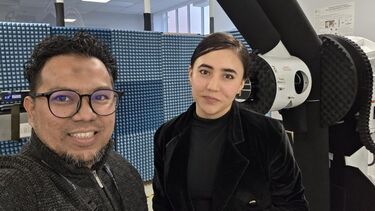
In December we gave a tour to our new colleague in the School of EEE at the university of Sheffield, Mohd Rashidi Che Beson. We also gave a tour to Prof. Hassan Osman a visiting Professor to the School of EEE.
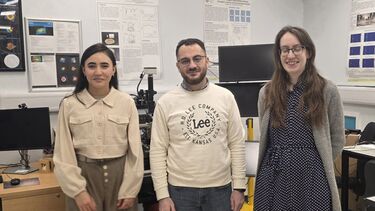
In November it was a pleasure giving a tour of our mmWave and antenna measurement facilities to our visitors from Malaysia yesterday.
Great to meet Professor Madya & DR RAFIDAH ROSMAN from the Faculty of Electrical Engineering at Universiti Teknologi MARA (UiTM).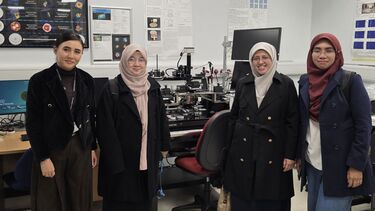
In October Rola Saad and her PhD student Hang Y. used the facility this last week, they ran some S-parameter tests using the horn antennas at 28 GHz on their material.
We really enjoy stretching the facilities' capabilities into material RF transition measurements!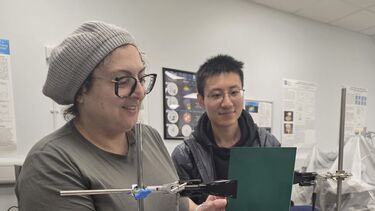
Also in October PhD student, Philippe Wang, has been using our Keysight 4-Port Network Analyzer (50 GHz) to carry out S-parameter measurements for his prototype, alongside a series of bending tests to assess performance under different conditions.
Philippe also made use of our NSI Spherical Scanner, running NSI2000 software together with the network analyzer, to perform spherical measurements and capture detailed radiation patterns for his new array prototypes.
It’s great to see our facilities supporting innovative research and next-generation design in high-frequency systems!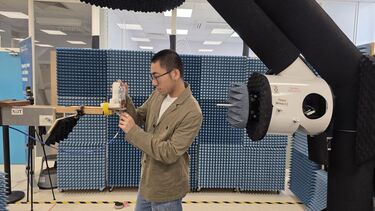
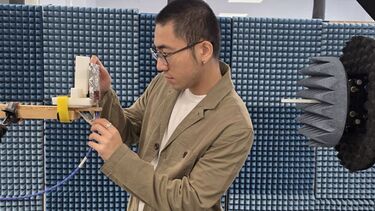
In September we were visited by our colleagues form the School of Electrical and Electronic Engineering at the University of Sheffield. We enjoyed explaining to them our equipment capabilities and the our latest experiments.
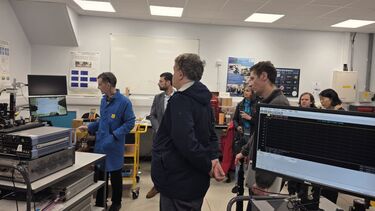
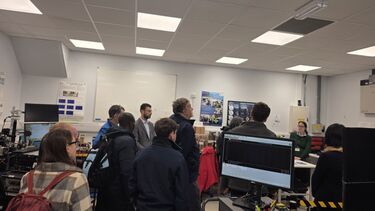
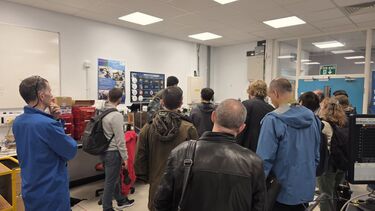
In August we had several researchers from the University of Sheffield conducting experiments some of which are shown below.
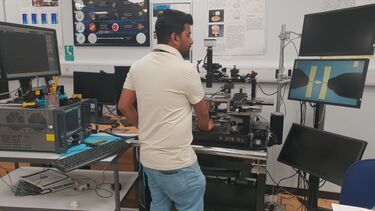
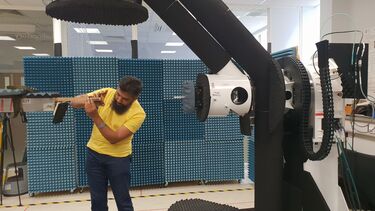
July 2025, Dr Rola Saad and her MEng student used the facility to test their mm Wave phased array and filter measurements on thin substances for Non Terrestrial applications.
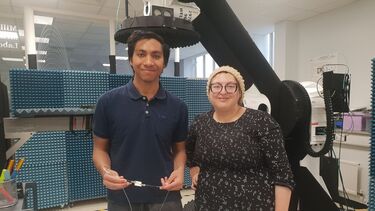
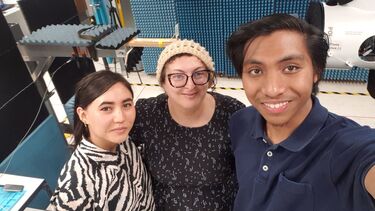
15/07/25 In July we had a visit from our colleagues from The Manchester Metropolitan University and SmOp Cleantech .
We had a fantastic visit and we are looking forward to the potential collaborations ahead.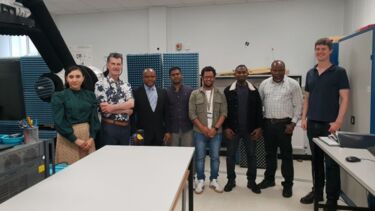
In February it was great to have the team from Cambridge Consultants using our UKRI National Millimetre Wave Facility (Keysight Technologies 4-Port PNA 10MHz-50GHz, NSI-MI Technologies Spherical Scanner and NSI2000 Antenna Measurement Software) to carry out S-parameter and spherical measurements to obtain radiation pattern on their antenna.
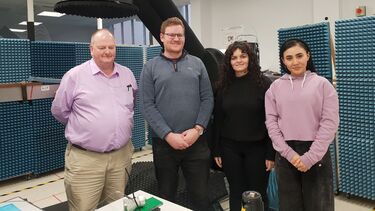
We were delighted to welcome Paul Holes and Leonardo Goncalves de Castro to our UKRI National Millimetre Wave Facility. It was a great opportunity to walk through our lab's unique capabilities etc at The University of Sheffield.
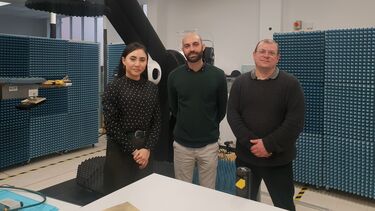
In January we had the pleasure of meeting Chris Needham from Innovate UK today.
It was a great opportunity to connect and discuss the exciting project we have underway at the UKRI National Millimetre Wave Facility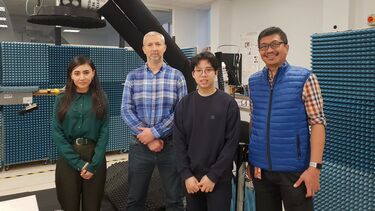
- 2023
Rawad Asfour a regular PhD student user of the national mmWave measurement facility, has published his research on chip antenna using data collected at our facility. Read the paper using the link below
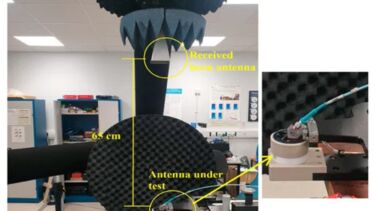
https://www.mdpi.com/1424-8220/24/2/321
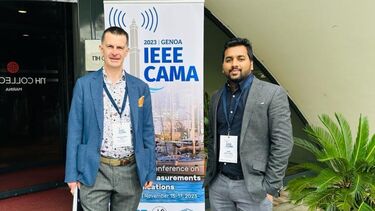
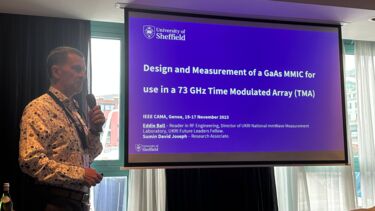
In November our academic Eddie Ball and his RA Sumin went to IEEE CAMA in Genoa, Italy.
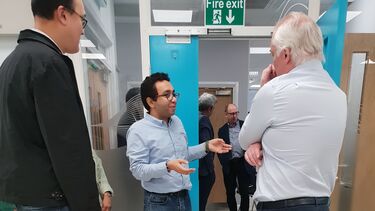
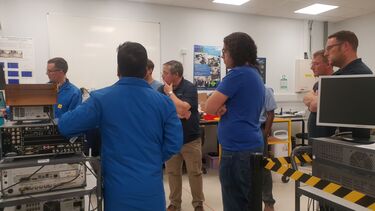
In September we had 30 visitors for the launch of the YORAN project that is being run in the Electronic and Electrical Engineering department with the AMRC. We had a great time explaining how our facility and equipment worked.
In August we did some more measurements for the University of Brest. We took near field and far field measurements on a 2 inch silicon carbide wafer. The photos show our setup which can probe the wafer to take measurements.
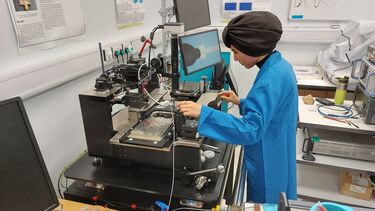
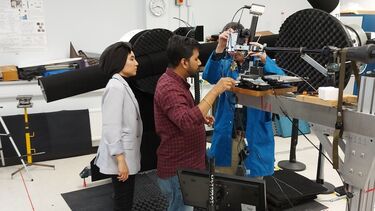
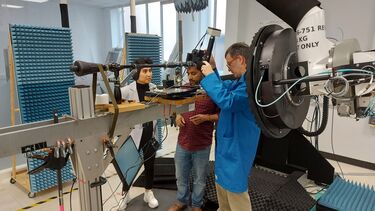
In June We had a visit from Dr Gavin Cox from Global Invacom to measure a new antenna.
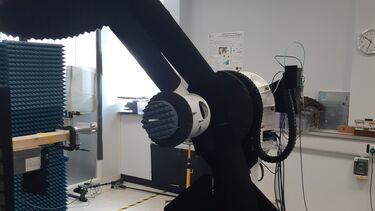
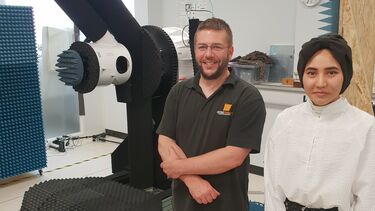
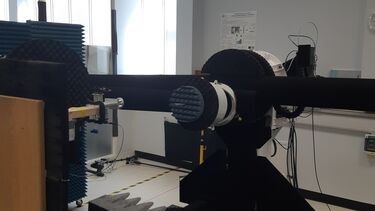
We had a successful visit from researchers at the University of Brest. They used the facility to measure their antennas on fabricated on the semiconductor 4H-SiC. The antennas were also fabricated in the cleanroom at the University of Sheffield.
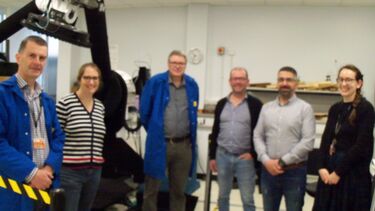
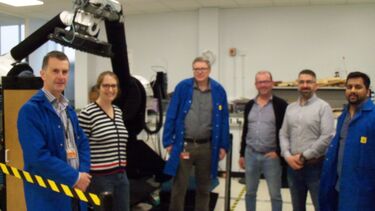
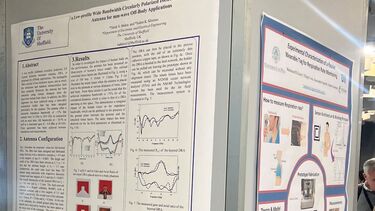
Recently one of the PhD students using the National mmWave Measurement Facility as presented a poster at EuCap 2023! Tarek’s poster explained his resent work on a Direct Resonator Antenna with two dielectric layers and a bandwidth of 14 GHz to 30.9 GHz. He designed a customized holder specifically for aligning the Direct Resonator Antenna, which further enhances its performance.
The measurement presented in his poster were taken at the National mmWave Measurement Facility.
The lab provided an ideal environment to conduct my research, and the support I received from the staff greatly contributed to my success. Thanks to the high-quality equipment and expert guidance of Steve Marsden, I was able to conduct precise measurements and collect valuable data.
Tarek Abdou PhD student
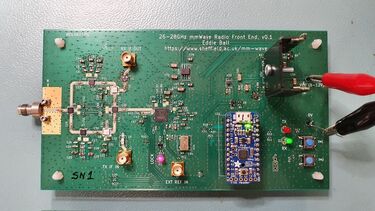
This month a paper by our academic lead, Eddie Ball, published a paper which references the facility. The article describes a bespoke and low-cost design of portable channel sounder for 28 GHz band portable propagation measurement system. The close to the ground system was tested for path loss both indoors and outdoors and showed very few strong reflections with delays exceeding 33 ns. This system could be very useful for mobile device-to-device communications.
You can read the paper in IEEE here.
In January the UKRI National mmWave Measurement Facility had its open day and Networking event. It was a great day and thank you to all the visitors who joined us. We had a total of 56 Guests from various companies and universities around the country, including Cambridge and Edinburgh.
We hope you had a good day, and we especially want to thank Prof. Jon Willmott and his research group for giving tours of their lab and explaining how they can print mmWave planar antennas on their Optimec printer. This attracted a lot of interest.
There was also exciting news from Prof. Tim O’Farrell as he announced he had just gained funding for a new 6G sub-THz SDR measurement facility in Sheffield.
I had a lot of interesting conversations with attendees and it is clear that the wider research and commercial community is becoming increasingly active in mmWave systems
Eddie Ball (Academic Lead for EPSRC National mmWave Measurement Facility)
Attendees were very interested in what they saw and several asked if we would be running the event again next year
Steve Marsden (Technician for EPSRC National mmWave Measurement Facility)
In January there has been some exciting news released about measurements take at the National mmWave Measurement Facility. Some printed antennas designed and printed at the University of Sheffield and measured in our facility, have shown performance that matches those produced using conventional manufacturing techniques. You can read more about this in the University of Sheffield's Department of Electronic and Electrical Engineering news page linked below.
- 2019-2022
In Novemeber the National mmWave measurement facility was used by Eddie Ball & Sumin David Joseph to perform some initial measurements of three different GaAs mmWave integrated circuits at 73 GHz they have designed. The circuits were made by United Monolithic Semiconductors as part of a GaAs multi-project wafer. Initial lab tests of RF performance have shown good results. Probing used two MPI DC probe cards and our VNA with VDI WR15+ frequency extenders and 150 micron GSG PicoProbes. Circuits for VCOs and antenna array beam steering have been prototyped, with more testing to follow. The circuits are part of Eddie’s UKRI Future Leaders Fellowship in mmWave Transceivers.
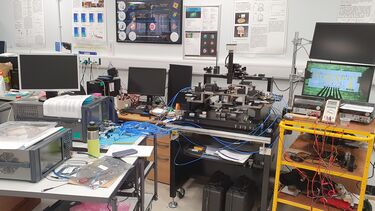
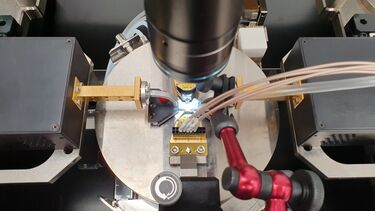
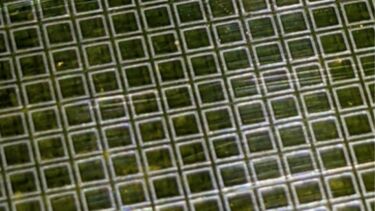
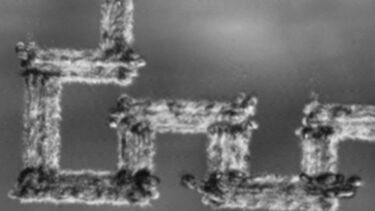
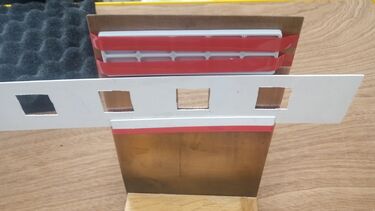
In October Dr Stephen Henthorn has been using the facility in his research into metasurfaces, below is a quote from him and some images of his research.
I've been using the mmWave facility to measure metasurfaces at frequencies from 30 GHz to 100 GHz. Metasurfaces allow us to control how electromagnetic energy reflects off and transmits through surfaces by designing their structure, rather than relying on their chemistry. We can choose patterns of metal on a surface to produce the magnitude and phase response required at different frequencies, and in advanced forms we can get exotic effects like bending microwaves in unexpected directions, or breaking symmetry by letting waves through in one direction, but not the other. It's expected that metasurfaces in the mmWave range will have applications in 6G mobile communications, such as improving antennas and radio transmitter efficiency, and producing intelligent surfaces which can direct beams of energy to our phones. The facility and technicians have been very helpful, using the PNA-X Vector Network Analyser with VDI frequency extenders to measure reflectivity and transmission through the metasurfaces, and constructing test rigs to ensure repeatable and reliable measurements.
Dr Stephen Henthorn
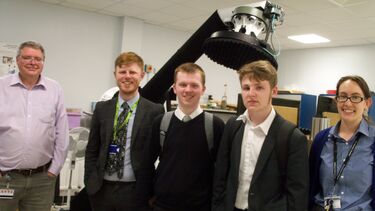
In July we had a visit from the UTC Sheffield Physics class, it was great to meet them and explain what we do here at the National mmWave Measurement Facility.
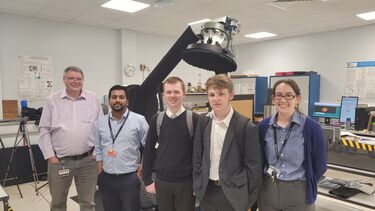
This month we have a new user of the National mmWave facility, Mr Meshari Alanazi, we look forward to working with you.
I am a PhD student working on the efficient design of mmWave dielectric resonator antennas. The designed antennas operate at the 28 GHz, 40 GHz and 60 GHz frequency bands with excellent agreement between simulations and measurements using the mmWave facility.
Mr Meshari Alanazi
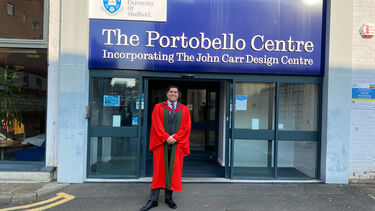
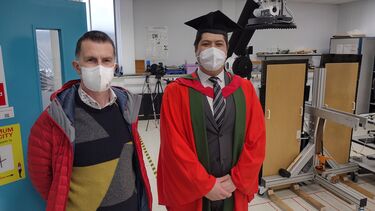
In June we had a visit from Dr Sergio Rodriguez-Albarran, the first ever user of the National mmWave Facility. It was great to see him on his graduation day.
I’m honoured to have been the first ever user of the cutting-edge National mmWave facilities in the University of Sheffield back in late 2019.
My project was about exploring tunable materials in dielectric resonant antennas (DRAs) at mm-Wave typical frequencies (24 -26 GHz) the resonators I studied were 3D-Printed in Polylactic Acid (PLA) and filled with graphene oxide gel, which, in presence of an incident biasing voltage achieved electronic tunability in the desired frequency range. The involvement of the innovative equipment was crucial in obtaining the frequency response, reflection coefficient and both 2D and 3D radiation patterns of all the antennas I designed constructed and characterised in my last chapters of the Thesis I presented to obtain my PhD degree in March 2020.
Dr. Sergio Rodriguez-Albarran
In February we had a visit from Ming Yang and Ryan Fairclough from Arralis to test their antenna design on our NSI spherical measurement system.