
Cripping the Concordat Event reflections
What does the Researcher Concordat mean to disabled colleagues? Do disabled colleagues feel supported by the Researcher Concordat? What creative methods can be deployed to crip the concordat? This page includes reflections on work by the WAARC team
Cripping the Researcher Concordat: Reflections by Dr Sophie Phillips and Dr Armineh Soorenian
On the 29th October 2025, researchers and professional services staff working in the field of Critical Disability Studies at The University of Sheffield came together to consider how the Researcher Concordat could be reimagined to centre Disabled researchers. To do this, we focused on crip theory and the practices of ‘cripping’. Cripping is generally viewed as a strategy in research and activism where participants are tasked with re-evaluating something with specific focus on disability (McRuer, 2006). Here, disabled people are the driving force of inquiry, championing their ways of being in the world and importantly, their experiences of being in the university. This therefore means that crip perspectives are a form of knowledge production that comes from people’s lived experiences of disability (Ellis et al., 2025). It is also important to remember that crip is a slippery and leaky category, that a person may come into, stay in or come out of once or multiple times in their life. It is a transient category that everybody who classes themselves as able remains permanently on the fringes of (Shildrick, 1997). Approximately 25 people attended, primarily made up of doctoral and early career researchers. We were also joined by those who support, lead and mentor doctoral and career researchers, with a number of professors and mid-career academics in attendance. All attendees were from the Faculty of Social Sciences.
Towards Anti-Ableist Research Cultures?
The Wellcome Anti-Ableist Research Cultures (WAARC) project is a 2 year research project funded by the Wellcome Trust. The project broadly sought to explore how the academy can be more inclusive to disabled researchers, educators, professional services and learners within the university. At present, there is a disconnect between commitments to researcher development, and the barriers faced by Disabled researchers. To address this, our project sought to interrogate how the Researcher Development Concordat could more effectively support the needs and research aspirations of Disabled researchers and developing academics (Phillips, 2024). In exploring how our university cultures might address this, we held our workshop entitled, ‘Cripping the Researcher Concordat’. We encouraged those attending and participating in the workshop activities to consider how the researcher concordat is currently framed for researcher development and importantly, how we might critique, consolidate and provocatively reimagine this through the lens of disability inclusion.
What is the Researcher Development Concordat?
The Researcher Development Concordat is a document that universities, funders and research institutions can commit to, to help them support the career development of researchers. The Researcher Development Concordat contains guidance about three areas: environment and culture, employment and, professional and career development.
Foregrounding Access
As well as the content of the event, it is important to reflect on the accessibility of the event. We tried to ensure the event was as accessible as possible. However, we acknowledge that over the course of the WAARC project as a whole, we have not yet been able to make an event truly accessible to everybody. This may be due to access frictions or other factors such as space restrictions. This is not to say that a truly accessible event should not be strived for, but that we acknowledge our own shortcomings whilst also celebrating how we challenge traditionally accepted forms of access. You can read more about ways of working towards more accessible university events via our resource links here.
The event was held in a hybrid format to enable participation by team members who primarily work online. This allowed more people to attend, however, it was difficult to allow meaningful participation in a hybrid format, due to group discussions in person (where there is only one group camera) being difficult to hear and join in online. We tried to balance this difficulty with each person being given the principles from the Research Concordat in writing, with the opportunity to respond in writing, drawing or verbally. This was to enable attendees to respond in a variety of ways and for opinions to be gathered not solely by voice, which tends to be the predominantly favoured method in research. This also meant that people who could not attend the event at all were able to participate asynchronously.
Our Event
Our event considered the three main principles of the Researcher Concordat (documented below): 1) environment and culture; 2) employment and; 3) professional and career development. Importantly, our methods and processes for facilitating such conversations and in attempting to ‘crip’ dominant frameworks and narratives, required a creative and somewhat playful approach focused on co-creation and making narratives together (White et al., 2025). We were also mindful that conversations on career development, precarity and working conditions in current higher education contexts are not always easy ones to have and so injecting light, hope and play was necessary here (see White et al., 2026 on joyful pedagogies in higher education). In our attempt to do this, our creative activities for participant engagement and dialogue were designed akin to the British game show ‘Blankety Blank’. Each attendee was given the three principles with some words missing to fill in themselves, with conversations and live illustrations by Nifty Fox to follow and accompany this.
We will now discuss each principle with our provocations in turn.
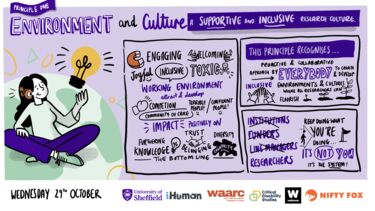
Principle One: Environment and Culture
Principle One of the Researcher Concordat states:
"Healthy working environments attract and develop a more diverse workforce, impact positively on individual and institutional performance, and enhance staff engagement. This Principle recognises that a proactive and collaborative approach is required between all stakeholders, to create and develop positive environments and cultures in which all researchers can flourish and achieve their full potential."
Participants were presented with the statement with these blank spaces:
__________ working environments attract and develop _________, impact positively on _________. This principle recognises that a proactive and collaborative approach is required between _________, to create and develop ________environments and cultures in which all researchers can flourish and _______.
Once everybody had considered the words they might add to the principle, we discussed what the environment and culture should and should not look like in academia. Discussions revolved around whether a university environment could ever be fully inclusive and joyful, and how at the moment it can be toxic to researchers. Examples of why academia was toxic included contract precarity, increasing workloads and lack of collegiality.
We discussed how the environment and culture of academia can vary depending on the behaviour of the people in it. This can mean it is either a toxic or welcoming environment. Attendees were also very keen to emphasise that it is the system and not individual academics who are the problem in promoting toxic behaviour or being unwelcoming.
Principle Two: Employment
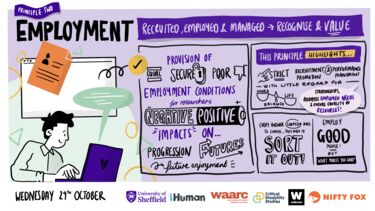
Principle Two of the Researcher Concordat states:
"Provision of good employment conditions for researchers has positive impacts on researcher wellbeing, the attractiveness of research careers, and research excellence. This Principle recognises the importance of fair, transparent and merit-based recruitment, progression and promotion, effective performance management, and a good work-life balance. All stakeholders need to address long-standing challenges around insecurity of employment and career progression, ensuring equality of experience and opportunity for all, irrespective of background, contract type and personal circumstances. "
Participants were presented with the statement with these blank spaces:
Provision of _______employment conditions for researchers has ________ impacts on researcher wellbeing, the ________ of research careers and ___________. This principle recognises the importance of ___________ recruitment, progression and promotion, ___________ performance management, and __________ work life balance. All stakeholders need to address _________, ensuring equality of ____________.
Principle two of the Researcher Concordat allowed us to consider how broken the academic system is, summarised in a simple statement: ‘sort it out’. Employment conditions are not beneficial for researchers or indeed line managers who have to manage within strict boundaries. We discussed how the joy of a research job can be reduced when work/life balance is not prioritised.
Principle Three: Professional and Career Development
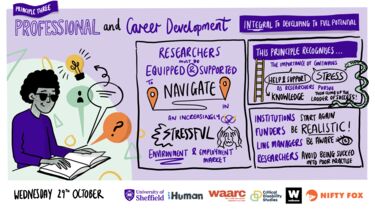
Principle Three of the Researcher Concordat states:
"Researchers must be equipped and supported to be adaptable and flexible in an increasingly diverse global research environment and employment market. This Principle recognises the importance of continuous professional and career development, particularly as researchers pursue a wide range of careers. "
Participants were presented with the statement with these blank spaces:
Principle Three: Professional and Career Development. Researchers must be equipped and supported to ____ in an increasing ____ research environment and employment market. This Principle recognises the importance of continuous _____, particularly as researchers pursue ____.
Principle three allowed us to consider how researchers could navigate career development and how line managers and institutions as a whole could support this. Our discussions around this area of the Researcher Concordat were predominantly based around how stressful academia can be and that the wider employment market is very difficult to infiltrate, particularly when lots of contracts are short term and researchers spend a lot of time being uncertain about their futures.
Who must do what?
With each of the principles, we also took time to think about who must do what. By who, we thought about: 1) institutions as a whole; 2) researcher funders; 3) academic line managers and; 4) disabled researchers themselves.
What must institutions do? ___________________________.
What must funders do? ______________________________.
What must researcher line managers do?________________.
What must researchers do?___________________________.
These questions provoked rich discussion about where/who responsibilities for enacting values associated with the Researcher Concordat lay. Although discussions were nuanced, they broadly revolved around a key theme that researchers themselves needed to keep on researching and should not feel any pressure that they are not doing enough. On the other hand, it was broached that institutions and funders needed to prioritise accessibility in order to change ‘the system’ to be more inclusive. Examples of this were ensuring access is written into research proposals and that institutions support managers and researchers to carry out inclusive research.
Discussions surrounding line managers centred around increasing awareness of the ways in which their employees may feel and the pressures academia creates. It was also discussed that line managers need to recognise that they are stuck in a system that may not enable them to change working conditions on their own. Overall, we concluded as a collective that funders and institutions were key to changing the researcher experience in academia.
Creating a Crip Concordat?
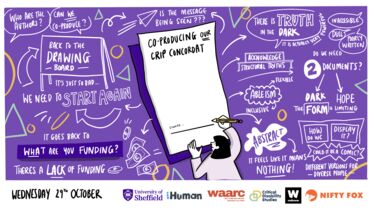
We concluded the event by considering how we could create a co-produced cripped Researcher Concordat that better supported the needs of researchers, leaning on the principles of Critical Disability Studies (to challenge disablism and ableism through intersectional frameworks), . Below is the image that the visual illustrator captured of our thoughts. The messiness of the image as a whole resonates with discussions that took place - that overall, we could not come to a decision on what a single resource, whether to replace or to sit alongside the current Researcher Concordat. This may tell us that it is difficult to formulate a defined set of principles, particularly when embracing Critical Disability Studies’ ideas due to the wide range of needs that disability covers. In addition, this lack of consensus may reflect the variety of lived experiences of the researchers present at the event. The circle and triangle on the image nod to the gameshow 'Blankety Blank' that the event was based on.
A strong theme of these discussions that ran through the entire event was the notion of dark humour, which was captured by the visual illustrator. The current Researcher Concordat felt abstract to the attendees and so it felt that to manage the unsupportive nature of it using dark humour was the only way to survive academia that can be a difficult place to be, particularly at the moment when there are many cuts being made across the country.
Overall, we entertained the idea of how the Researcher Concordat could be cripped. It meant that we could explore the difficulties in putting together a resource that is inclusive of everybody. Ultimately, we considered the ways in which the Researcher Concordat could be more supportive of researchers, such as by championing them and assuming they are doing a good enough job, but also of employers. In addition, conducting this event loosely based on the British television game show Blankety Blank brought an element of joy and fun to what were difficult and sometimes heavy conversations.
References
Ellis, J. et al. (2025). Cripping inquiry: breathing life into co-produced disability methodologies. Frontiers in Sociology, 10. https://doi.org/10.3389/fsoc.2025.1600693
McRuer, R. (2006). Crip Theory: Cultural Signs of Queerness and Disability. New York University Press.
Phillips, S. (2024). The autistic postgraduate woman: Navigating the neurotypical university. Pavilion Publishing and Media Ltd.
Shildrick, M. (1997). Leaky Bodies and Boundaries: Feminism, Postmodernism and (Bio)ethics. Routledge.
White, L., Mason, W., Grant, V., Romaine, A., Cleary, G & Tulloch, S. (2026) Towards a Pedagogy of Joy. British Journal of the Sociology of Education. DOI: 10.1080/01425692.2026.2652344
White, L., Buxton, A. Liddiard, K., Goodley, D., Qarni, S., Jansen, E., Gordon, H. & Gillard, S.(2025) Disabled young people as researchers, designers and makers: aligning makerspaces, co-production and critical disability studies. Journal of Disability Studies in Education. https://doi.org/10.1163/25888803-bja10039
Related information

iHuman
How we understand being ‘human’ differs between disciplines and has changed radically over time. We are living in an age marked by rapid growth in knowledge about the human body and brain, and new technologies with the potential to change them.