
The Professors: challenging dominant ideas about co-production through disability arts practice
Dr Cassie Kill reflects on working with The Professors, a learning disability artist collective whose creative, non-linear and embodied ways of working disrupt the ableist assumptions underpinning dominant models of participatory research.

Origins of the partnership
In late 2024, I was matched with The Professors, a learning disability artist collective, after applying to the Participatory Research Network (PRN@TUoS) and Wellcome Anti-Ableist Research Culture (WAARC) project collaborative research stream. After a series of initial meetings with the group, we developed a shared research idea, and WAARC generously funded us to work together.
The Professors were to be paid as expert collaborators in the research, which would explore how their long-established arts practice acted as a form of inclusive and participatory knowledge production. I planned to attend the group’s weekly meetings over an extended period, using ethnographic and participatory methods in a flexible way to learn from their work. After gaining ethical approval in Summer 2025, the research proper began.
Rethinking participation and co-production
As a researcher with a focus on the complexities and contradictions of participation in both the arts and research methods, I was really interested in the way The Professors and the paid artists who work with them had developed methodologies for creative collaboration which were accessible for disabled people, using both individual and collaborative elements.
Previously, I have critiqued the way that co-produced research too-often relies on idealised fantasies about such methods as a route to the resolution of power, which can ultimately conceal and maintain the underlying dynamics (Kill, 2022). Assumptions that participatory research involves “training up” participants in academically-defined knowledge production techniques can be assimilative, quite at odds with the espoused ethos of this approach (Gallacher & Gallagher, 2008; Kill, 2023). Furthermore, dominant modes of participatory research can overlook the fact that many participant groups are already engaged in existing modes of producing knowledge about their lives. As Marcus (2000) suggested, research “participants” might, in some circumstances, better be positioned as ‘epistemic counterparts’, if we hope to realise goals of more equal research relations. Whilst it is not easy to transcend the default hierarchies involved in doing research (indeed, this may well be impossible), following Bell and Pahl (2018), I consciously attend to such complexities in my research practice, to resist uncritically reproducing dominant dynamics.
I set out on the research with The Professors wanting to learn more about how these complexities were navigated in this disabled artist collective, as my early experiences of the group suggested some complex practices were at play.
Unsettling the norms of participatory research
“It became clear very quickly that [The Professors] did not work in the linear, unified ways that are often assumed to constitute ‘good practice’ in literatures and discourses about collaboration and co-production”
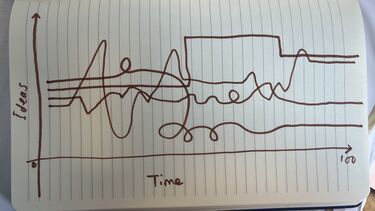
As I attended The Professors’ meetings, observing and participating in their work, I learnt about how they made knowledge in participatory and inclusive ways, through disability arts practice. It became clear very quickly that the collective did not work in the linear, unified ways that are often assumed to constitute “good practice” in literatures and discourses about collaboration and co-production.In their paper about participatory research with children and young people, Gallacher and Gallagher argue that the commonplace assumption that participatory research is a linear and unified process is an ‘adult norm’. I would argue that it is also an ableist one, and conflicts with the creative ways in which contemporary artists often work.
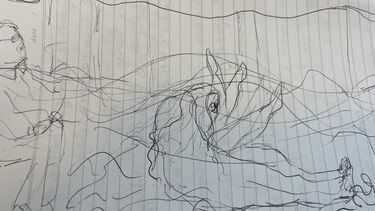
The Professors often began devising from a shared workshop exercise, developed by the paid artists, who each had their own practice and approach to working with people. From these group exercises, each collective member then followed their own trajectory in the creative development process. Many members continued doing their own research at home, and they often returned in subsequent sessions with divergent approaches and ideas. For instance, early in the research, Lee Sass, a paid artist and Director of the group, led a ‘pocketbook’ exercise in which we gathered and categorised memories of past workshops and projects. Gabrielle – a group member – decided to start making a pocketbook apron from fabric, planning for a performance in which she wanted to pull out memories about the group from the pockets and share them with an audience. However, one week, Gabrielle arrived at a meeting and explained that her piece was now about mermaids. She sewed a fishtail onto her pocketbook apron, before going on to create a performance and a film, which explored complex issues around identity and transformation, through the idea of what it would be like to become a mermaid.
This example illustrates how collective members often pursued artistic inquiries that suddenly seemed to change, referred back to past workshops, or were part of sustained or iterative long-term inquiries underlying their practice. These multiple temporalities within the collective enacted forms of crip time which were fragmented, time-bending and thoroughly at odds with the notion of a singular collaborative inquiry moving forwards in a neat and tidy fashion.
Towards participatory research otherwise
Whilst participatory and co-produced research is often imagined to be based on linear, unified inquiry, in which verbal deliberation and intellectual consensus are often believed to be central, working with The Professors powerfully demonstrated that it does not have to be so. In fact, working in non-linear and fragmented ways via crip time, embodiment, abstraction and affect was central to how knowledge was co-produced in inclusive ways in this context.
Framing The Professors' artistic practice as a research methodology offered another image of what collaborative and research with disabled people (and, indeed, anyone) can be and become. When deliberative speech and linear, rational thought are not centred, artistic and embodied ways of knowing together can provide a powerful challenge to the ableist roots of academic inquiry.
There is much more to be said about this work, as Cassie and The Professors develop a forthcoming publication. More resources and outputs from the project will be shared on the WAARC webpage soon.
Related information

iHuman
How we understand being ‘human’ differs between disciplines and has changed radically over time. We are living in an age marked by rapid growth in knowledge about the human body and brain, and new technologies with the potential to change them.