Disability Arts Practice as Methodology: a research visit to London
Dr Cassie Kill

On Thursday 26 March I caught an early train down to London to take part in three exciting disability arts and research events. Firstly, I logged into an online workshop as part of the Disability Matters project. The event was about creative inclusive knowledge exchange and included presentations by Dr Daniel P Jones, Dr Elaina Gauthier-Marmaril and Khairani Barokka, a practicing artist and filmmaker.
The presenters each shared insights into their own experiences of knowledge production through the arts, and how this intersects with their ethical framework and disability politics. The workshop was attended by a wide range of researchers and artists with an interest in disability politics, and we had some great discussions after the presentations, including some reflections on the ethical limits of “capturing” or exchanging knowledge. In this discussion, I reflected on my current work with The Professors – a learning disability artist collective – and how Glissant’s (1997) notions of the ‘right to opacity’ can help us understand the nuances of artistic and participatory research. Turana Abdullayeva has also shared some reflections on the event here and a recording of the presentations is online here.
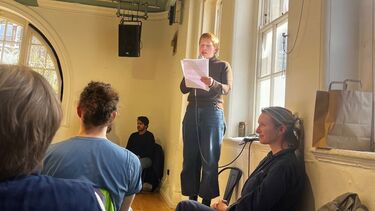
Image: Dr Grace Josephs stands on a chair to deliver a monologue at Battersea Arts Centre, as part of her ‘Open Scholar’ work-in-progress performance with Extant.
After a short lunch break, I joined some colleagues to attend a showing of work-in-progress at Battersea Arts Centre, developed by Dr Grace Joseph and Extant as part of their WAARC and PRN project, Open Scholar. I was really excited to see how the work had developed, as the project explores some important questions around disability and artistic research. In particular, the project’s third research question resonates with my current research interests: ‘How might performance capture and accessibly convey complex academic research?’. Extant had carried out a round table event with visually impaired artists and academics, to explore some of the access barriers they faced, including in universities. The results of these discussions had been used to inform 2.5 days of rehearsals, immediately preceding the event. The performers used games, movement, song and speech to illustrate the exhausting experiences often faced by visually impaired people encountering never-ending institutional chains of bureaucracy, patronising support workers, inaccessible buildings, seemingly impenetrable library services, and hostile ‘Access to Work’ processes. It was a powerful piece, and it was wonderful to see the issues around university contracts for doing collaborative research with artists highlighted, as this has also arisen in my project with The Professors.
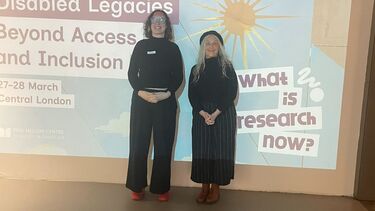
Image: Cassie Kill with her collaborator, Lena Sass, from the disability arts collective The Professors, at the Paul Mellon Centre event, ‘Disabled Legacies: Beyond Access and Inclusion’.
The next day, I attended a day of the Paul Mellon Centre’s event, ‘Disabled Legacies: Beyond Access and Inclusion’. I was attending the event with Lena Sass, one of my collaborators from The Professors. The day started with introductions from the Paul Mellon Centre staff, and the event’s co-convenors, Kenny Fries, Khairani Barokka and Sria Chatterjee. The convenors explicitly rejected the idea of “inclusion” as the goal of disability arts, with Fries arguing in the accompanying handbook that:
‘“Inclusion” connotes that there are people who hold the power to include. Most often these gatekeepers are nondisabled. Inclusion seems like charity. The very idea of “inclusion” seems excluding’.
The rejection of ‘inclusion’ as a dominating relation of philanthropy and assimilation was a powerful starting point for the day. This provocation aligned strongly with my research, reminding me of the critiques of institutional hospitality as a paradoxical relation presented by Ahmed (2012) and Derrida and Dufourmantelle (2000).
Next, Tony Heaton gave a talk on the history of the UK Disability Arts Movement. It was a formidable challenge to give an overview of such a complex and rich area of practice in just 30 minutes, but Tony successfully highlighted some landmark moments in the field, whilst critiquing the enduring barriers encountered by disabled artists and curators. I was also excited to hear Lena - who has worked in disability arts in South Yorkshire for over 40 years - talk to Tony afterwards about the significant histories from our region, which are not yet well represented in the national archives.
The rest of the day included several brilliant presentations from disabled artists and scholars, including Sandie Yi talking about her work on Crip Couture as a research method, Saleem Hue Penny presenting work about Black and Crip space times, and Syrus Marcus Ware sharing some of his artistic research on Black Mad and Disabled world building. I was particularly interested in Ware’s work ‘Black Bunker’ which resisted dominant imaginaries of post-apocalyptic worlds centred on white cultural ephemera. Instead, Ware created a durational performance in which Black actors and dancers lived in a bunker, pursuing somatic movements from Black culture, including hair braiding and dance moves, before emerging to teach the audience some of these embodied repertoires. Ware also discussed a series of radio plays he curated called ‘No Future, No Cry’ , in which different artists, activists and thinkers were invited to create radical speculative imaginaries of the coming century that are ‘that are at once apocalyptic, beautiful, hopeful, and sacred’ (No Future No Cry). The day was a provocative resource, which will further inform my work about the affordances and contradictions of institutional inclusion as an approach to social justice. Overall, the three events I attended were testament to the epistemic power of disability arts practices to cultivate radical imaginaries and desires for the world otherwise, which are perhaps needed now more than ever.
References
Ahmed, S. (2012). On Being Included: Racism and Diversity in Institutional Life. Durham and London: Duke Univeristy Press.
Derrida, J., & Dufourmantelle, A. (2000). Of Hospitality: Anne Dufourmantelle invites Jacques Derrida to respond (R. Bowlby, Trans.). Stanford, California: Stanford University Press.
Glissant, É. (with Wing, B.). (1997). Poetics of relation. University of Michigan Press.
Dr Cassie Kill is a Research Associate in the School of Education. Her work focuses on institutional practices of inclusion and participation, with specialisms in higher education, disability, the cultural industries, youth, and grassroots collectives. She is also interested in critically engaging with participatory research methods. She has previously blogged about the complex hospitality of conferencing and attending ECQI 2026 in Athens.

iHuman
How we understand being ‘human’ differs between disciplines and has changed radically over time. We are living in an age marked by rapid growth in knowledge about the human body and brain, and new technologies with the potential to change them.