
Folklore, Disability and the Indian Psyche: Reading the Dadhkai Photograph By Maghya
Student submission from the Introducing Critical Disability Studies: Indian Contexts, Global Perspectives online course.
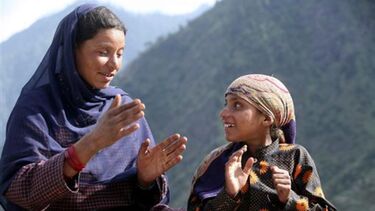
Retrieved from https://www.reuters.com/news/picture/kashmirs-silent-village-idINRTR25722
“If a baby cries loudly and doesn’t open eyes in the first two days, that means he or she is deaf,” says Muhammad Haneef, the village chief of Dadhkai, in a report documented by The Telegraph.
The photograph of Dadhkai, a remote village in Jammu and Kashmir often described as “India’s Deaf village,” is deceptively simple yet profoundly layered. At first glance, it captures an ordinary exchange: two villagers, hands mid-air, faces lit with recognition, framed against the undulating vastness of the mountains. But beneath this ordinariness lies something extraordinary- a visual testimony to an entire community’s reconfiguration of language, embodiment, and belonging. Ethnographic studies note that nearly 70% of Dadhkai’s population is Deaf, with around a quarter of households including more than one Deaf member (Kushwaha et al., 2021; Singh & Raina, 2020). Out of this statistical fact emerges a lived reality: the village’s lifeworld is not dominated by silence, it breathes through gesture, movement, and a shared understanding.
It is striking to note what is absent here: wheelchairs, prosthetics, and the medical paraphernalia that often dominate mainstream images of disability; which probes us also to note what is present: the routine familiarity of a shared linguistic culture. Here, sign language is not an accommodation, but the natural medium of everyday social life. The photograph captures this reality: communication unravels not through spoken word, but through hands becoming voices, gestures becoming syntax, and expressions becoming poetry.
Disability is often viewed through pathologizing frames- as deficit, tragedy or misfortune, and in resisting these views, the image of Dadhkai community reorients our gaze. It demands for disability to be viewed not as an individual burden, but as a cultural ecology, sustained through adaptation, kinship, and collective resilience. The mountains in the background seem almost symbolic of this endurance: vast, immovable, and quietly sheltering a community whose way of life has carved out its own grammar of survival.
Thus, Dadhkai emerges as more than a village- it becomes a case study in the psychology of disability as a cultural practice, where folklore, caste, gender, class, and language converge to craft unique meanings of difference. In the quiet intimacy between the two figures, we glimpse something profoundly radical: the normalization of diversity, the transformation of silence into dialogue, and the reimagining of disability as a shared human condition rather than an isolating limitation.
An indisputable aspect of disability within the Indian context is illustrated by the ambivalent role of folklore as a force of social and cultural influence. In the case of the Dadhkai community, while on one hand, myths of divine curse and ancestral fault circulate in the village, thus framing Deafness as the outcome of cosmic displeasure; on the other, these same conditions have prompted the community to invent and adopt an indigenous sign language, thereby transforming a potentially exclusionary and isolationist circumstance into a sense of shared social and cultural identity of the villagers. The dhakhai community stands as a remarkable example demonstrating how folklore simultaneously constrains and enables lived experience in a rural Indian setting, highlighting the psychological significance of community-wide sign language as a culturally embedded adaptation not adequately addressed by Western models (Patel & Mehra, 2018; Singh & Raina, 2020).
Folklore and Disability: The Case of Dadhkai
In attempting to understand the multifaceted aspects that influence and shape the Dadhkai community, adopting a culturally informed lens becomes essential. Cultural psychology emphasizes meaning systems, identity, and collective narratives as central to psychological life (Shweder, 1990), thereby aiding an understanding of the layered realities that exist in the Dadhkai community.
Cultural psychology highlights the significance of meaning systems, identity, and collective narratives as fundamental components of psychological existence (Shweder, 1990), thereby facilitating a comprehension of the complex realities present within the Dadhkai community. Within Dadhkai, sign language serves not only as an effective means of communication but also as a cultural emblem of belonging, defining community membership and providing a sense of shared identity that reduces feelings of isolation.
In Dadhkai, folklore explains Deafness as divine displeasure or ancestral transgression, reflecting local cosmologies that link disability with fate, sin, or karmic retribution (Miles, 2000). Language sustains these frameworks: idioms, ritual chants, and whispered proverbs often reinforce stigma by framing disability as deficit. Yet folklore also exhibits flexibility and can facilitate acceptance. Shared narratives of collective experiences provide a platform for adaptation, in which village-wide sign language forms an everyday norm. Viewed through this lens, the Dadhkai photograph constitutes a site where folklore and psychology intersect.
Folklore provides frameworks through which communities interpret differences, acting as agents of socialization. Kakar (1982) argues that Indian individuals experience their identity as deeply relational, shaped by myths, cultural narratives, and intimate family ties- suggesting that the self is “a system of reverberating representational worlds”. Across Indian languages and regions, proverbs, ritual practices, and oral myths remain central to shaping cultural understandings of disability, often characterizing disabled persons as deficient or cursed. Expressions such as “andhon mein kana raja” (“among the blind, the one-eyed is king”) exemplify how disability is metaphorically associated with deficiency, sustaining cultural stereotypes that frame disability as inadequacy. Rituals similarly link disability to sin and karma, while idioms frequently construct disabled women as unmarriageable, burdened, or cursed.
These traditions function as interpretive schemas that structure cognition, affect, and social behavior (Kakar, 1982; Ghai, 2015). In his book: The Intimate Enemy, Ashis Nandy (1983) shows how the Indian psyche is influenced by layered traditions and moral cosmologies. Sudhir Kakar (1996) likewise emphasizes the centrality of myth and narrative in Indian psychological life, illustrating how beliefs in karma, fate, and cosmic order mediate responses to difference. These broader cultural frameworks operate in Dadhkai as well, offering a paradox of simultaneously stigmatizing Deafness as a consequence of ancestral fault while enabling adaptation through the institutionalization of a village-wide sign language (Kushwaha et al., 2021; Singh & Raina, 2020).
Layered Social Realities
Embedded with cultural beliefs stemming from folklore are intersectional realities of gender, caste, and socio-economic status. Intersectional perspectives complement the understanding of factors, such as caste, socio-economic conditions, and sex, that deeply impact the daily lives of disabled individuals. Dadhkai is an isolated locality with low socio-economic conditions and with limited access to biomedical interventions, education, and therapeutic resources. Even so, the availability of caste solidarity and kinship-mediated social structures provides an atmosphere favorable for collective adjustment. Disability seems to bear less stigma when it is commonplace among the people. In the said situation, Deafness becomes the norm, and local mythology functions less as an agent of segregation but rather as an explanatory narrative fortifying the whole community's sense of self as an integral socio-cultural group.
Gendered experiences are pronounced: Deaf women in Dadhkai often assume caregiving roles within the family while simultaneously facing exclusion from marriage markets, whereas men more frequently occupy visible economic or social positions. Caste disparities further intersect with lower-caste families experiencing compounded marginalization, with limited access to educational and economic resources, intensifying the psychosocial impact of disability (Chakraborty & Das, 2019; Kushwaha et al., 2021). Within Dalit communities, disability is sometimes coded as a marker of ritual pollution, exacerbating stigma. In upper-caste contexts, disability is often interpreted through a karmic lens, as repayment for past misdeeds. These frameworks materially influence opportunities and psychological well-being, including access to education, inheritance, and marriage (Ghai, 2015).
Socio-economic status also mediates folklore’s role. Families with limited resources often rely on ritual or myth to explain disability, to which additional cases beyond Dadhkai are instructive. Healing shrines such as the Tirupati Balaji Temple in Tamil Nadu and Rajasthan’s Mehandipur Balaji Temple attract families of disabled children seeking divine cures through ritual healing and exorcism. Disability is framed as a divine test, and ritual interventions provide psychological relief while simultaneously reinforcing stigma by implying that disability is abnormal.
Folklore as a Double-Edged Sword
As observed through previously noted cases and contexts of disability, folklore operates as a double-edged sword in the psychology of disability. On its oppressive edge, it reinforces stigma and self-surveillance. Narratives of divine wrath, idioms of deficiency, and caste-based exclusions produce psycho-emotional disablism (Reeve, 2012), wherein internalized shame may be as debilitating as structural barriers. Disabled individuals may internalize beliefs of curse or unworthiness, perpetuating cycles of exclusion.
Conversely, folklore provides enabling resources, including coping mechanisms, solidarity, and alternative explanatory frameworks. Rituals such as healing shrines, while stigmatizing, offer structured hope and social belonging. In Dadhkai, folklore frames Deafness as a shared destiny, which alleviates individual stigma and facilitates collective adaptation through sign language.
This ambivalence can be analyzed through multiple theoretical perspectives. Goffman’s (1963) concept of stigma elucidates how enacted stigma diminishes not through absence of disability but through normalization in community life. Reeve’s (2012) psycho-emotional disablism highlights the persistence of internalized shame, which is mitigated by solidarity and shared meaning-making. With such all encompassing conceptions propagating negatively toned prejudices leading to the othering and subsequent ostracism towards people with disabilities, gender and caste based beliefs emanating largely from folklore adds another layer of complexity. In her influential book (Dis)Embodied Formations: Disability, Women and Theory, Anita Ghai (2003) notes, “disabled women are perceived as asexual, dependent, and incapable of performing traditional gender roles. Disabled women are constructed as unmarriageable, their bodies interpreted as cursed or unsuitable for reproduction (Mehrotra, 2013). These beliefs intersect with patriarchal structures, restricting access to social and emotional resources.
Against this backdrop, Dadhkai represents a counter-case. While the folklore of ancestral curse circulates, the community’s practical adaptations transform potential stigma into solidarity. Socio-economic constraints and remoteness enable creative solutions: the development and transmission of sign language. Kinship networks further facilitate inclusion. When multiple families share the condition, stigma that is pronounced in other settings is reduced. Deafness is reframed as a collective destiny, illustrating folklore’s ambivalent function.
The Dadhkai photograph, while seemingly a simple village scene, reveals itself as a psychological portrait of folklore in action. The psychology of disability in India cannot be grasped through Western categories alone; it must account for cultural grammars: sign languages, myths, rituals, and idioms, which shape lived experience. Dadhkai unsettles binaries of deficit versus adaptation and stigma versus acceptance, showing disability as simultaneously constrained and enabled by folklore.
References
Bose, N., & Kumar, S. (2017). Cultural narratives and disability: Indian ethnographic insights. Disability & Rehabilitation, 39(10), 1023–1031.
Chakraborty, S., & Das, A. (2019). Folklore, stigma, and resilience: Perspectives from rural Indian deaf communities. Asian Journal of Social Psychology, 22(3), 175–190.
District Doda. (2021, December 17). DDC Doda tours along with medical team to Dadhkai village of specially abled: Takes stock of local issues, constituted committee of officers for the welfare of specially abled children. District Doda. https://doda.nic.in/2021/12/ddc-doda-tours-along-with-medical-team-to-dadhkai-village-of-specially-abled-_takes-stock-of-local-issues-constituted-committee-of-officers-for-the-welfare-of-specially-abled-children-_/
Ellis-Petersen, H. (2021, August 18). Born deaf and mute: Kashmir’s “silent village” where a disease has bruised every family. The Telegraph. https://www.telegraph.co.uk/global-health/climate-and-people/born-deaf-mute-kashmirs-silent-village-disease-has-bruised-every/
Ghai, A. (2003). (Dis) embodied form: Issues of disabled women. Har-Anand Publications.
Ghai, A. (2018). Women and disability: Issues of care. In Discourse on Rights in India (pp. 297-316). Routledge India.
Goffman, E. (1963). Stigma: Notes on the management of spoiled identity.
Gupta, A. (2009). Folklore, disability and the Indian psyche. Reuters.
Kakar, S. (1982). The Indian mind: Fundamentals of a western psychology.
Kushwaha, A., Sharma, R., & Raina, P. (2021). Village sign languages and collective adaptation in Northern India. Disability & Society, 36(4), 567–583.
Kushwaha, S., Singh, P., & Raina, N. (2021). Intersectional realities of disability, caste, and gender in rural India.
Nandy, A. (1983). The intimate enemy: Loss and recovery of self under colonialism.
Patel, R., & Mehra, K. (2018). Sign language and social cohesion in Indian villages. Journal of Applied Developmental Psychology, 56, 89–100.
Reeve, R. (2012). Psycho‑emotional disablism: Internalised shame and its mitigation through solidarity.
Singh, P., & Raina, N. (2020). Caste‑based marginalisation and psychosocial impact of disability.
Singh, V., & Raina, P. (2020). Deaf communities in rural India: Ethnography, folklore, and inclusion. International Journal of Disability Studies, 12(2), 101–118.
Shweder, R. A. (1990). Cultural psychology: Meaning systems, identity, and collective narratives.

iHuman
How we understand being ‘human’ differs between disciplines and has changed radically over time. We are living in an age marked by rapid growth in knowledge about the human body and brain, and new technologies with the potential to change them.