
What is considered to be an Ethical Representation of the Marginalised?
Student submission from the Introducing Critical Disability Studies: Indian Contexts, Global Perspectives online course.
On March 27, 2026, Priyam Sinha’s lecture at the University of Sheffield, titled From Script to Screen: The Rise of Disability-Centered Storytelling made me pause and think about how representation, politics and essentialism works. It focused heavily on Bollywood, that diverse land which somehow manages to influence global cinema and individual lives while remaining stuck in a perpetual state of ethical stagnation.
We discussed how bollywood is currently suffocating under a massive content crisis, yet shockingly, it refuses to account for marginalized narratives unless they can be sanitized for a suburban multiplex that they can earn money off. During the inauguration of the National Museum of Indian Cinema, a minister famously claimed that India is Bollywood, and Bollywood is India. and while that was meant to be a positive thing?? (I think..) It feels more like a warning because if the nation is mirrored by its cinema, then the reflection we see of disability is one that revolves around the politics of profit and the ‘gaze’ of the non-disabled elite rather than actually authentic storytelling.
I do agree with how the New Bollywood is coming around because filmmakers are finally emerging from diverse social and class backgrounds but even then we have the hereditary filmmakers, those who treat movie studios like ancestral jaghir and the non-hereditary upstarts that do not get the recognition they deserve. Even the outsiders admit that the big production houses are still just funneling money into the same old mainstream narrative with exotic foreign locations and dance numbers with budgets larger than the GDP of a small island.
In such a condition, where already marginalised spaces are considered as a taboo, the thing that frustrates me, and also what is a major takeaway from Sinha’s work, is that disability is treated as a trope, and never a lived reality that NEEDS authenticity. In the mainstream, marginalized spaces are wrapped up in this ‘essential’ form as if one narrative can account for the human experience of all such unique individuals. This is a violent form of essentialism, I believe. It boils down a wildly diverse subsection of humanity into a single, digestible, and ultimately homogenous group which kind of beats the whole point, doesn’t it??
I believe that there is far more homogeneity among the Indian mainstream classes, thanks to their participation in a standardized, bland and globalized capitalist culture than there is among the disabled or the disadvantaged given how the marginalized are forced to navigate their existence in radically unique ways, and yet seeing cinema insisting on a one size fits all narrative makes me tired. This strategic essentialism is almost used as a lazy filmmaker's tool to capitalize on a narrative that they do not understand or even wish to. It allows them to fit a human being into a troop neatly and perfectly but that is the thing, you cannot put individuals into boxes? Can you?
And why to, even?.. Because I think that nowadays, the aim of all storytelling in this hellscape is profit generation. The masses do not appreciate what makes them uncomfortable. They don’t want to be forced to change their perspective; and thus the narratives that aren’t the most comforting, are silenced.
We ALSO have to talk about disability performativity, given how Ms. Sinha also brought up Vishal Bhardwaj’s Omkara, set in the grit of Meerut. It’s a film that supposedly challenges the usual stuff that Bollywood offers by embracing intersectionality and an affirmative approach but we have to look at the casting of Saif Ali Khan as Langda Tyagi more closely.
Here, we have an actor from an educated, privileged and literally ‘royal’ able-bodied background playing a poor character with polio and the excuse is always that they need a famous star to draw in the masses. I mean, why do fair-skinned actors get cast for brown-skinned characters only to be tanned intentionally later? And why, in the name of all that is ethical, do we not cast an actual individual with disability for a role that represents disability?
I think that this is because, at the heart of all mass-produced art is inauthenticity. Production cultures are inherently predatory and they view disability as a costume to be donned by the elite to prove their ‘acting range’????
While I see why they think they need to be this way to reach the masses, it’s high time we demand better. These platforms have the power to change an entire subcontinent’s perceptions about disability forever. They have a responsibility to be more ethical, but instead, they choose the path of least resistance (and most profit)and if we keep allowing the disabled body to be used as a mere tool for an able-bodied actor’s vanity project, are we really creating art? Or is this a white-washed, expensive and fancy-Shamcy form of exploitation that we call, Cinema?
Again, this brings me back to the question, WHAT is representation. Is it a token that the silenced get to find solace in the fact that at least, they appeared in art and media? Is it an able-bodied Royal playing the part of a poor individual with disability because the director cannot find another actor that is fit for the role in an entire subcontinent??
Or, is it when Art is made and distributed in a way that captures not the essence but the actual lived reality of people that are different from what everybody is used to seeing?. The least the world can do for the marginalized is to tell their stories in a way that isn’t disrespectful, and inauthentic and that alas, is not something even NEW bollywood has been able to do, yet.
(Heavy emphasis on the YET)
Research that stands for, with and against something
Research, in its most traditional, sterile form, is often an act of intellectual gentrification. Researchers normally enter marginalized spaces, harvest the trauma of others, and package it into neat, peer-reviewed PDF whereas, the realities of the said participants remain diabolically, unchanged and, often, unheard.
After a year of navigating the lanes of Delhi’s Lalbagh slums for my dissertation, I’ve realized that ‘research’ is often used as just a polite word for intellectual colonization unless it is rooted in transformative praxis.
The lectures by Dr. Sophie Phillips on collaborating with Disabled People’s Organizations (DPOs) and the session by Dr. Ankita Mishra and Dr. Nikita Hayden on sensitive topics acted as a mirror, forcing me to confront the power I carry as a researcher and the said positionality that I inherently carry with myself. My year-long project, A Solution-Oriented Study on Infrastructural Violence Among Women Living in Slum Areas of Delhi-NCR, was a relevant parallel in my life. Even the title, infrastructural violence implies how neglect and apathy by the system goes a long way, so long that it becomes violent. When I sat down with my participants, I realized the sensitivity of the topic was about the political threat and stigmatization mentioned in the McCosker (2001) typology from slides that we also discussed. Talking about why a woman doesn’t feel safe going to a community toilet at 2:00 AM isn't just data collection at some point, right?
Sophie Phillips’ lecture on WAARC (Wellcome Anti-Ableist Research Cultures) also hit home when she discussed the nothing about us without us philosophy. While her focus was on DPOs like Sheffield Voices and NADSN, I think that the basic principle is fairly universal. If we aren't sharing intellectual property and simplifying contracts with the communities we study, then the question is, are we adding to the good or just capitalizing off the bad?
It is almost embarrassing to admit that me and my two co-authors went into the slums with pre-conceived notions about how the life there would be but admitting to it only makes it feel farther from my reality now. The most interesting finding that we came back with in the field work was how they were actually happy?
We had genuinely anticipated fatigued women that were tired of the battles of daily life but the closer we went, the more we realized that we had attributed this structural vulnerability to people, and when their human-ness slapped us across our imperialised thinking faces, we realised how it's only the system that puts them in positions of such unfortunate scarcity while they are gossiping, laughing and living even in adversity.
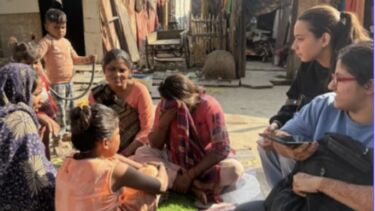
Source - Original pictures from dissertation fieldwork (November 26, 2026)
We went in to interview women from this slum about how infrastructural deficits shape their perceptions about life, curtail their daily movements, influence their social and familial relationships and opinions about how much the world cares about them and we did find out how neglect has led to issues, yes, but they do not identify as victims of this marginalisation. We realised how we had taken away their agency even before entering the space by assuming that they would be obviously unhappy.
This realisation and the subsequent reflexivity made us realise that even their problems are not something we could assume from a distance for they exist in diversity, let alone ‘lead the research’ for them. After our first visit, we had realised how wrong it was to be a researcher and not a collaborator who's just there to aid their self-expression and not decide what questions they answer and how. The next time we went, we went with an even more flexible questionnaire that lets them lead where the research goes next.
We got to know so much about how their community functions, how they hate people who come to help and then leave with the data, and how even amongst themselves, they have groups and biases that decide who gets what resources.
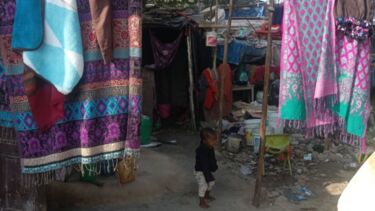
Source - Original pictures from dissertation fieldwork (November 26, 2026)
After this to and fro process, the next obvious step was to come up with a do-able ‘intervention?’, (using the term - intervention in somebody’s reality to make it better, somehow feels wrong??) and so we did. We come up the idea of an internship program that the MCD (Municipal Corporation of Delhi) rolls out in collaboration with NSS (National Service Scheme) to employ third-fourth years students from all domains to act as a POC (Point-of-contact) between the government and the slums that covers the biggest gap that we have i.e. the implementation of policy gap, wherein weekly reports from said students interning under the government report back to the stakeholders about how the implementation of governmental policies can roll out to make the lives of the residents easier and lets them that somebody cares.
This lecture about transformative research only helped in getting a clearer understanding of why is research done in the first place and how structures, systems and acute political threats zone in to put humans in vulnerable spaces only to then ignore their hardships and move on, with a care in the world.
This lecture, my research and everything that my college and life has taught me in the last few months have made me a better collaborator, a more critical thinker and a sensitive human being at the same time.
I am grateful for everything and I hope that this course aids in somehow, making this world a better place for all.

iHuman
How we understand being ‘human’ differs between disciplines and has changed radically over time. We are living in an age marked by rapid growth in knowledge about the human body and brain, and new technologies with the potential to change them.