
Access intimacy
Student submission from the Introducing Critical Disability Studies: Indian Contexts, Global Perspectives online course.
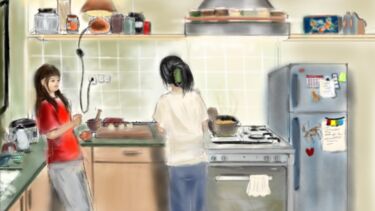
Image description:
The digital art depicts two friends cooking together in a warm and cozy kitchen. One person in a red shirt stands by the counter communicating in sign language with her friend, with partially washed dishes beside her. The hand sign shown represents the word “neighbour” The other person, seen from behind with her head turned toward her friend, cooks at the stove beside a steaming pot. The kitchen is filled with comforting details such as shelves of jars and dishes, a tiled backsplash, a refrigerator decorated with notes and magnets, and soft ambient lighting.
Concept note:
This digital art explores the idea of access intimacy within an everyday domestic space. It portrays two close friends and roommates sharing a quiet moment in their kitchen while cooking together. One of them pauses midway in between doing the dishes, animatedly gossiping about their neighbour in sign language, while the other continues cooking but
turns toward her friend, fully engaged in the conversation. Their interaction reflects a relationship shaped by familiarity, intimacy and mutual understanding, where communication and connection flow naturally. The kitchen itself is intentionally designed as a lived-in and accessible space, with details such as visible light switches that support non-auditory communication and help gain attention. Rather than centering disability as a barrier, the artwork highlights how intimacy, friendship, and accessibility are woven seamlessly into everyday life.

iHuman
How we understand being ‘human’ differs between disciplines and has changed radically over time. We are living in an age marked by rapid growth in knowledge about the human body and brain, and new technologies with the potential to change them.