
Disability Representation and Narratives By Sandra Haridas
Student submission from the Introducing Critical Disability Studies: Indian Contexts, Global Perspectives online course.
Disability has always been considered as a tragedy and something to be hidden or been sad about.Ancient works often shows Disability as cursed or unique.For a long period of time disability history or narratives was written about disabled people rather by them or with them which makes it difficult to cover the issues that they faced.
I have a personal experience with my uncle who is almost 60 yrs. He has an intellectual disability of 60% .Even though he is capable of doing his chores on his own with support, people often sympathize with the whole family for his disability.Growing up I watched how society treats him as a joke or sometimes as a fearing character. I have heard people labelling it as a “family curse” and the children in the neighborhood used to mock him.
I think the gap between who he is and who the world decides they are is a main central tension of representation of disabled people.
Dr. Priyam Sinha began her lecture with the research questions: What have been the most prominent tropes of disability representation in Bollywood?.Prime minister Narendra Modi recently mentioned that the Bollywood was considered as an influential form of story telling and understanding India with a language of diversities.The entire cultural and diversity of India was portrayed in a bollywood manner and people who try to understand the culture and diversity of India just through the bollywood lens is missing out on the real image of Indian villages and states.
Priyam Sinha in her work,Margarita with a Straw: Female Sexuality, Same Sex Love, and Disability in India mentions that bollywood usually served as reinforcing the normative ideals like the heterosexuals and able bodied people.
She gives the example of the movie ‘Omkara’ where the Able bodied Saif ali Khan as a character with Polio.
It made me think about another example of a Tamil short film, Paava Kadhaigal, one short film from a four short film series, the main character who is a transgender is played by Kalidas Jayaram who is a well known Malayalam actor.
Margarita with a Straw is analyzed for its portrayal of a disabled protagonist, Laila, who demands to be seen as a sexual being with her own desires, thereby challenging the "male gaze" that typically disregards disabled women as unattractive,She quotes the works of Mulvey and Blumer.Sinha talks about “Crips theory” to show how homosexuals and disabled people are often denied privacy and bodily integrity.
Ammons A R in his work mention the resemblance of a “poem” and a “walk” and he mentions that it needs a “total person”.To walk one need legs, circulatory system and the desire, similarly a poem has to have body, rhythm, feeling, sound, and mind, which reflects the “physiology” of the poet. (A R 1997, 16)
The work Narrative Prosthesis Disability and the Dependencies of Discourse, edited by David T. Mitchell and Sharon L. Snyder gives a different view on the literature, While movie Industry and society consider Disability as marginalized, literature portrays it as a “problem in need of a solution”.He discusses the core concepts in his work like Narrative Prosthesis, which describes the two fold dependence of literary discourse on disability.Firstly he says disability serves as a stock feature of characterization, differentiating a character from the "anonymous background of the ‘norm’ and Second, it acts as an opportunistic metaphorical device, serving as a signifier for social or individual collapse (Mitchell and Snyder 2000, 47)
Authors provide a four step narrative structure to showcase how narrative engage with disability to limit or control them.Exposure: A deviance or marked difference is presented to the reader
Justification: The narrative establishes its own necessity by calling for an explanation of the deviance’s origins.Centralization: The deviance is moved from the periphery of the story to the very center of the plot Rehabilitation: The story attempts to resolve the deviance, often through a “cure”, the: “extermination of the object”, or the “revaluation of an alternative mode of being” (Mitchell and Snyder 2000, 53-54)
Even though literature focuses on narrative Prosthesis, Auto biographies and first person accounts have allowed disabled people to reclaim their representation.
As someone from Kerala, I find that Malayalam cinema provides meaningful examples that parallel these discussions. Malayalam movies used Disability as a narrative connected to punishment and pity similar to bollywood .The modern Malayalam movies we can see that all these existing movie concepts has been questioned or challenged for eg; Bangalore days(2014) In this movie a wheel chair using radio jockey is portrayed as independent, professional, and romantically pursued, without making disability the sole source of her identity but the actress is still a well known, able bodied individual. Thanmathra, a 2005 Malayalam movie is a story of a Kerala government secretariat official who is happily living in his village later diagnosed with Early onset Alzheimer’s disease, the movie clearly shows the stages of his changes. The first sign appears when he misplaces a government file in the refrigerator.The movie shows external repercussions of the family dynamics too.
It is interesting to see that society reflects an evolving shift from tragic representations to more inclusive rights based and human centered perspectives.Representation and Narratives matters as it portrays social reality and public imagination Life writing, fiction, and media all have the power to alter how disability is understood, and if used well the power could actually support for creating an inclusive space.
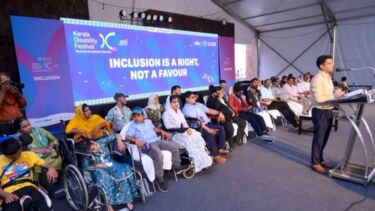
Source: Kerala Disability Festival, Kerala Disability Festival - Truecopy Think
Kerala Disability Festival | Towards An Inclusive Society
Kerala Disability Festival is a premier four-day event organized by the Thanal Daya Rehabilitation Trust, a renowned social welfare organization with a pan-India presence. This initiative is a collaborative effort involving more than 30 prominent disability organizations and institutions across Kerala.
References
A R, Ammons. 1997. “A Poem is a Walk.” In et In Motion: Essays, Interviews, and Dialogues, edited by Zofia Burr, 11-19. N.p.: University of Michigan press.
Mitchell, David T., and Sharon L. Snyder. 2000. Narrative Prosthesis: Disability and the Dependencies of Discourse. Edited by David T. Mitchell and Sharon L. Snyder. N.p.: University of Michigan Press.
S, Anjana K., and Dr.Sarbani Banerjee. 2024. “EXAMINING ABLEIST NARRATIVES: MEDIA PORTRAYALS OF DISABILITY AND CONTROVERSIES IN MALAYALAM CINEMA.” ShodhKosh: Journal of Visual and Performing Arts 5, no. 6 (June): 260-270.
Sinha, Priyam. 2020. “Margarita with a Straw: Female Sexuality, Same Sex Love, and Disability in India.” Economic & Political Weekly 55, no. 14 (April).

iHuman
How we understand being ‘human’ differs between disciplines and has changed radically over time. We are living in an age marked by rapid growth in knowledge about the human body and brain, and new technologies with the potential to change them.