
Thinking Affect within Critical Disability Studies
An online symposia from Spain on 2nd Oct , 2025
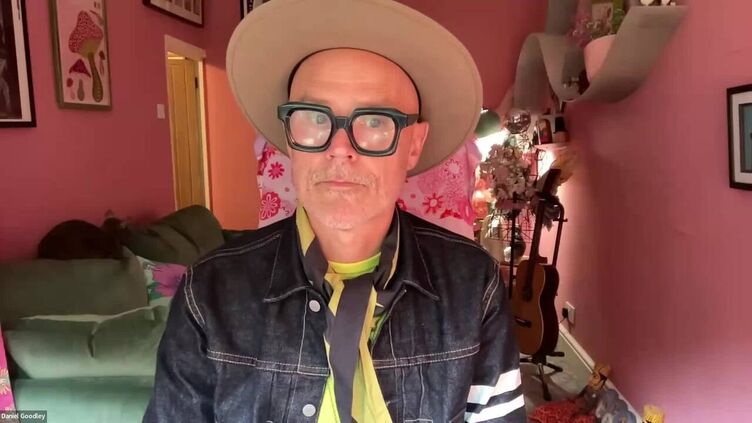
In this symposia, three critical disability scholars from Spain (Madrid, Barcelona, and Valencia) will address matters of affect that shape the lives of disabled people.
Andrea Garcia-Santesmases will analyse the sexuality and intimate lives of disabled people. Her presentation is entitled "The Intersection of Gender, Disability, and Sexuality: Challenging Ableist and Normative Codes".
Laura Sanmiquel-Molinero will explore how affect and Critical Disability Studies have shaped her work on adjustment to disability. The title of her presentation is "Adjustment to dis/ableism, affect and agency in clinical settings: a provocation?"
Finally, Javier Monforte will present a catchy typology to approach the intersection of disability and happiness. His work is entitled "Introducing DisHappiness: a typology on the intersection between disability and happiness"
Speakers and their contact emails
Andrea Garcia-Santesmases is an Associate Professor at the Department of Social Work at National Distance Education University (UNED, Spain). Her main lines or research are the intersections between gender and sexuality studies and critical disability studies. She has several publications in this field, last one the book “El cuerpo deseado: la conversación pendiente entre feminismo y anticapacitismo” (The desired body: the urgent conversation between feminism and anti-ableism).
Link to paper
Laura Sanmiquel-Molinero is a Juan de la Cierva post-doctoral research fellow at the Department of Social Psychology of Universitat Autònoma de Barcelona (Spain). Her research focuses on the dialogue between Critical Disability Studies and traditional approaches to disability in Psychology, Sociology and Anthropology from an intersectional perspective. She has also participated in a research project on disability and sexual and reproductive rights funded by the Spanish Ministry of Science. She has authored several journal articles regarding dis/ableism and its intersections.
Link to paper
Javier Monforte is an assistant professor in the Department of Physical Education and Sport at the University of València, Spain. His research takes a qualitative approach and focuses on the meanings and experiences of physical activity in disabled people. He received the ECR award by the International Society of Qualitative Research in Sport and Exercise and the Young Investigator award by the European Federation of Adapted Physical Activity. he has authored several book chapters and journal articles on critical and posthuman disability studies.
Our speakers are happy to be emailed about their work - Laura.Sanmiquel@uab.cat, andrea.gsantesmases@der.uned.es; Javier.Monforte@uv.es.
The Intersection of Gender, Disability, and Sexuality: Challenging Ableist and Normative Codes
Andrea Garcia-Santesmases
This paper explores the interrelation between gender, disability, and sexuality, highlighting how ableist norms shape the construction of identities and desires. The category of disability often obscures gender, placing individuals in a space of liminality. This position generates responses of hyper-femininity—linked to physical appearance, caregiving roles, or professional achievement—and hyper-masculinity—presenting oneself as hypersexual or hyper-competent—but it also opens fissures that allow us to understand gender as a learned and repeated performance, destabilized through interference or dissidence. Disability, in this sense, reveals how gender technologies rely on bodily control that is not available to everyone, exposing the artificial nature of norms of femininity and masculinity.
In a complementary way, the paper examines social imaginaries surrounding the sexuality of people with disabilities, often represented as different from the “normative” and marked by lack. The most common institutional responses have oscillated between therapeutic approaches and rights-based discourses, but both present limitations, particularly for those who cannot express or materialize their desire. Against these representations, it is proposed to understand such experiences as a sexual minority capable of questioning established codes of intimacy, roles of passivity and activity, and the exclusion of prostheses or non-normative bodies from sexual practices.
Nevertheless, the fact that a sexuality is stigmatized does not necessarily imply that it is transgressive. For this reason, the paper emphasizes the need for a feminist perspective that highlights how many claims tend to legitimize male desire more easily, often positioning women in the role of service providers. Furthermore, it problematizes the myth of asexuality, which functions as a mechanism of oppression by denying the possibility of living asexuality as a legitimate identity and experience. Overall, it is argued that gender and sexuality in disability should not be understood solely as fields of exclusion, but also as spaces from which to make visible the fissures of normativity and to rethink the diverse ways in which bodies are embodied and lived.
Adjustment to dis/ableism, affect and agency in clinical settings: a provocation?
Laura Sanmiquel-Molinero
As a disabled woman and a psychologist, I had always been obsessed with the mantra: “you have to adjust to your disability”, repeated both within psychology and in my everyday environment. What did it actually mean? How was a subject supposed to speak, act and feel in order to be considered well-adjusted to their disability? Since discovering Critical Disability Studies, I was able to give a new meaning to the question: what role did ableism and disablism play in this “good adjustment”? Could it be that a well-adjusted disabled person was in fact a person well-adjusted to dis/ableism? In what ways did this process of adjustment take place through affect? What affects did ableism and disablism prescribe and proscribe for disabled (and non-disabled) body-subjects?
In order to try to answer some of these questions, some years ago I decided to carry out a narrative-ethnographic study (Sanmiquel-Molinero, 2023) in what struck me as a production line of “well-adjusted disabled people”: a neurorehabilitation hospital. To take on this task, I found invaluable support in the work of academics such as Dan Goodley, Kirsty Liddiard, Katherine Runswick-Cole, Rebecca Lawthom, Donna Reeve and Carol Thomas. Over the past twenty-five years, all of them have worked to reclaim affect as an indispensable analytical (and political) category for Critical Disability Studies.
I will now outline how their concepts of ‘affective disablism, emotional labour and ‘agency as affect’ have influenced my work. The notion of ‘affective disablism’ helps us account for all those emotional impacts that disabled people experience on a daily basis, insofar as we are constantly told that ‘we are out of place in the world’. This can take multiple forms: a supposedly ‘well-meaning’ comment on how inspiring we are for not having committed suicide despite ‘our situation’, or the architectural barrier at the train station that, according to the authorities, there are ‘still no resources to remove’… What was expected of a body newly inducted into the disability club in the face of such situations? Early on in my ethnography it became clear that the answer was none other than emotional work.
The concept of emotional work allows us to name all those emotional performances that the ‘demanding non-disabled public’, as Goodley (2017) would put it, requires us to enact in response to affective disablism. Forget about telling off lovers of inspiration porn, forget about proclaiming that we have a right to travel on public transport without constantly putting ourselves at risk. As became clear in the hospital’s psychology sessions I participated in, the best response to such grievances seemed to be to ‘look the other way’. There began to emerge what it meant to be well-adjusted to a disability in affective terms: nothing other than appearing unaffected by dis/ableism. But it was not enough simply to declare, chest out, ‘that kind of thing doesn’t affect me’. The true good adjustment lay in claiming ‘those things don’t affect you’ while allowing them to affect you in ways that reproduce dis/ableism.
And this brings us to the third concept from Critical Disability Studies that has most influenced my work: thinking of affect not as mere emotion, but in relation to agency. From the Spinozist conception proposed by Goodley et al. (2017), agency is the ability to affect and be affected by one’s human and non-human environment. If being well-adjusted to disability means appearing unaffected by dis/ableism while acting according to its normative demands, then good adjustment to disability leaves us ill-equipped to affect these systems of oppression.
When I first communicated these results to the neurorehabilitation hospital some years ago, the response was not what I expected: while some psychologists there supported me, others were negatively affected by my explanations, which they considered biased — surely the product of my own traumas with disability — and hurtful, insofar as they implied an attack on their daily practice. At the same time as my work as a researcher had affected them, my own ability to affect ‘the field’ was also altered. As Liddiard (2013) explains, I was forced to undertake significant emotional work to keep myself afloat during fieldwork: I had been hurtful, but I was also hurt. The doors of the observation spaces I had worked so hard to open began to close, literally or symbolically. Fortunately, I was supported by colleagues such as Andrea García-Santesmases, who helped me navigate the situation, and my virtual research stay at iHuman with Kirsty Liddiard and Dan Goodley also helped me
All of this led me to connect two concepts often understood as opposites: agency — as the ability to affect and be affected — and vulnerability — as the susceptibility to be wounded by the environment. In what ways could the lens provided by Critical Disability Studies, which had been so healing for me as a disabled woman, also leave deep wounds in professional spaces? Had that wounding been counterproductive, insofar as it not only affected me emotionally but also prevented me from significantly affecting the hospital’s dynamics in ways that counter dis/ableism?
A few months after completing my doctoral research, one of the professionals at that hospital put me in contact with Javier Monforte, who is the one who invited me to be here today, as he felt that ‘we spoke a similar language’. Together, we are beginning to reflect on these questions, since we are concerned with the challenge of bringing Critical Disability Studies into clinical settings, which are increasingly keen to incorporate a social perspective but still reluctant to address dis/ableism and affect. We do not yet have definitive answers. We are confident, however, that sharing this presentation with you today will stimulate us in building one.
References:
Goodley, D. (2017). Disability studies: An interdisciplinary introduction. SAGE.
Goodley, D., Liddiard, K., & Runswick-Cole, K. (2017). Feeling disability: Theories of affect and critical disability studies. Disability & Society, 33(2), 197–217. https://doi.org/10.1080/09687599.2017.1402752
Liddiard, K. (2013). Reflections on the Process of Researching Disabled People’s Sexual Lives. Sociological Research Online, 18(3), 10.
Sanmiquel Molinero, L. (2023). El ajuste a la discapacidad como espacio-tiempo liminal: Un análisis desde los estudios críticos de la discapacidad [PhD Thesis, Universidad Autònoma de Barcelona]. Department of Social Psychology.
Introducing DisHappiness: a typology on the intersection between disability and happiness
Javier Monforte
Over the last months, I have been designing a research project that will bond critical happiness studies and critical disability studies. In this paper, I will not describe such project. Instead, I will share A typology to approach the intersection of disability and happiness. It is not evidence based. It is not the outcome of a deep process of theorisation. It is an approximation, a foot in the door of the topic. The typology is moulded around 4 modal verbs that express permission (can’t), ability (can), obligation (must), and opposition (shouldn’t). Each type will be illustrated with a representative archetype. We have the sadcrip, the possibilist, the happycrip, and the crip killjoy.
- Disabled people can’t be happy: the sadcrip
In relation to happiness, the presence of impairment is regarded and represented as an impediment for first and third parties alike (Bolt, 2015)
Historically, disability has been seen as a tragedy, and disabled people - people who fail to meet up to the ableist zeitgeist- have been stereotyped as sadcrips. Many still assume that disabled people cannot be truly happy and are better off dead (Shakespeare, 2014). As Dahl and Monrad (2025, p. 3) suggested, “the disabled body is constructed as an unhappy object that needs to be transformed into a less disabled body to approach happiness”. The idea that disability is essentially miserable and hinders happiness is used to validate oppression and inequality towards disabled people. Peter Singer, considered by many the most famous philosopher alive, argued that disabled lives have limited happiness potential and therefore can justifiably be replaced by non-disabled ones with supposedly greater capacity for happiness.
- Disabled people can be happy: the possibilist
In a society that greets disability with low expectations or outright prejudice, it is entirely possible to be happy and fulfilled and disabled (Ryan, 2025).
Disabled people are happier than nondisabled people think. Evidence of that causes a cognitive dissoanance in non-disabled people who frame being disabled in pessimism (Albrecht & Devlieger, 1999; McBryde Johnson, 2003). Often, disabled people’s happiness is downplayed: they are happy “because they do not know any better. Perhaps these cheerful people with disabilities are deluding themselves. Or, perhaps they are fooling others (...) these folk must be in some kind of denial” (Shakespeare, 2014, no page). For many people with lived experience of serious and persistent impairment, however, living is not a tragedy, but rather a possibility; an affirmation. One key goal of the affirmation model of disability is to dispel “the erroneous idea that disabled people cannot be happy” (Swain & French, 2000, p. 573). Exercising positive virtues such as optimism is key. Still, possibilists reject the positivity myth and acknowledge that happiness emerges not from the absence of hardship, limitation, and failure, but from the journey through these (Clifton, Llewellyn & Shakespeare, 2019).
- Disabled people must be happy: The happycrip
It is often a requirement upon oppressed people that we smile and be cheerful. If we comply, we signify our docility and our acquiescence in our situation (Frye, 1983, p. 2).
Since the development of positive psychology and the happiness industry, the possibility of happiness has mutated into a commandment. As Du Toit & Verhoef (2025, p. 412) said, “happiness and our efforts to obtain it became an obsessive new goal and an all-encompassing, nearly new religion”. This means that failing to be happy is failing altogether. The happiness imperative augments the cruelty of the claim that disabled people can’t be happy. However, the happiness discourse has interests in replacing the sadcrip with the happycrip. These two archetypes are “two sides of the same coin” (Cameron, 2024, p. 1891). I define the happycrip as the supercrip after ‘the happiness turn’ (Ahmed, 2019). Happycrips show resilience and overcome their situation. They are “tragic but brave.” (French & Swain, 2008, p. 73). As such, they are the quintessential object of ‘inspiration porn’ (Grue, 2016). This means they are objectified to inspire nondisabled people, to motivate but also shame them, so that they think: If they can be happy, what is my excuse?
- Disabled people shouldn’t be happy
There might be joy, but this might take place against a dehumanising backdrop (Goodley, 2021)
If happiness is co-opted, equated with self-sufficiency, and used to justify oppression, it is logical to ponder If disabled people and their allies should rebel against it. The question is: should we become crip killjoys? The crip Killjoy is a “refusing figure” (Sheppard, 2025, p. 7) that embraces “attempts to think and act that… dispense with, the propensity to affirm” (Dekeyser & Jellis, 2021, p. 318). This does not mean crip killjoys are against happiness itself. Rather, they reject the neoliberal-ableist fantasy of happiness, turn down imposed happiness scripts, and refuse to perform happiness for others. Although this is not an easy position to occupy, it is not necessarily bitter. As Bolt (2015, p. 1105) suggested, “those of us who identify as disabled may find happiness by transcending the very norms to which we are meant to aspire”.
Conclusion
The aim of introducing the modest typology above was to raise awareness about a complex phenomenon asking for further attention. Thus far, happiness has been an absent presence in critical disability studies. To borrow from Shuster and Westbrook (2022), there is a ‘happiness deficit’ in the field. Meanwhile, those who have set the agenda for a critical examination of the ‘happiness turn’ and its consequences have utterly ignored disability, both as an axis of oppression and a critical thinking category. There is a ‘disability deficit’ in critical happiness studies. I firmly believe that rethinking happiness is a key step towards disability justice, and that disability opens up possibilities for rethinking happiness. It is the time for DisHappiness Studies. Watch this space!
References
Ahmed, S. (2019). La promesa de la felicidad. Barcelona: Caja Negra.
Albrecht, G. L., & Devlieger, P. J. (1999). The disability paradox: high quality of life against all odds. Social science & medicine, 48(8), 977-988.
Bolt, D. (2015). Not forgetting happiness: The tripartite model of disability and its application in literary criticism. Disability & Society, 30(7), 1103-1117.
Cameron, C. (2024). Some things never seem to change: further towards an affirmation model. Disability & society, 39(7), 1890-1895.
Clifton, S., Llewellyn, G., & Shakespeare, T. (2018). Quadriplegia, virtue theory, and flourishing: A qualitative study drawing on self-narratives. Disability & Society, 33(1), 20-38.
Dahl, O., & Monrad, M. (2025). The tragedy of promising happiness through overcoming disability. Social Science & Medicine, 367, 117769.
Dekeyser, T., & Jellis, T. (2021). Besides affirmationism? On geography and negativity. Area, 53(2), 318-325.
du Toit, J., & Verhoef, A. (2025). Happiness, circumstance, and the environment: Philosophy’s crucial voice in times of environmental crisis. South African Journal of Philosophy, 44(2), 210-222.
Frye, M. (1983). The systemic birdcage of sexism. The Politics of Reality: essays in feminist theory, 2-7.
Goodley, D. (2021). Disability and other human questions. Bingley: Emerald.
Grue, J. (2016). The problem with inspiration porn: A tentative definition and a provisional critique. Disability & society, 31(6), 838-849.
McBryde Johnson, H. (2003). Unspeakable conversations. https://www.nytimes.com/2003/02/16/magazine/unspeakable-conversations.html
Ryan, F. (2025). Who wants normal? London: Penguin.
Shakespeare, T. (2014). A Point of View: Happiness and disability. https://www.bbc.com/news/magazine-27554754
Shuster, S. M., & Westbrook, L. (2024). Reducing the joy deficit in sociology: A study of transgender joy. Social Problems, 71(3), 791-809.
Swain, J., & French, S. (2000). Towards an affirmation model of disability. Disability & society, 15(4), 569-582.

iHuman
How we understand being ‘human’ differs between disciplines and has changed radically over time. We are living in an age marked by rapid growth in knowledge about the human body and brain, and new technologies with the potential to change them.