
Monitoring volcanoes with accessible tech
Taking the pulse of the world’s most dangerous peaks. A conversation with Tom Pering, VolcanoTech CEO/Co-founder.

Mission: Providing cutting edge, accessible UV imaging and monitoring tools to the remote sensing community worldwide.
Industry: Technology
Headquarters: Sheffield
Founded: Jan 2026
Milestones:
Secured £40k in investment
Two new staff hires
- Equipment installed in 6 countries
Challenge
Existing volcano monitoring tools are prohibitively expensive for the communities at the greatest risk from eruptions.
Solution
By tracking sulphur dioxide levels (a critical early warning sign of an eruption) with low-cost tech, VolcanoTech delivers affordable, reliable monitoring options to those who need it most.
VolcanoTech's story
There are over 1.5k volcanoes worldwide considered to be potentially active, and over 500 million people live close enough to be at risk from eruptions.
Roughly 75% of Earth's active volcanoes are concentrated along the ‘Pacific Ring of Fire.’ In developing regions like Indonesia, the Philippines, and Central America, the risk is compounded: populations are dense, yet state-of-the-art monitoring networks used elsewhere remain financially out of reach.
Enter VolcanoTech, a fledgling spinout company from the University of Sheffield’s School of Geography and Planning - the University’s first spinout from the Faculty of Social Sciences. VolcanoTech are harnessing low-cost technology from mobile phones and Raspberry Pi computers to open up the market, and bring volcano monitoring to those who need it most.
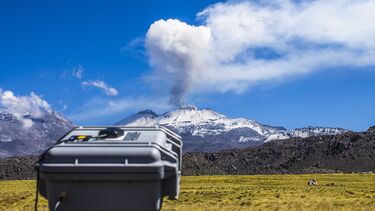
Using modified phone cameras, VolcanoTech’s kit can measure sulphur dioxide (SO2). Monitoring its levels can be the difference between timely evacuation and disaster.
"What really excites me about this project is that we're not a traditional tech company” says Tom Pering, Co-Founder and CEO.
“We're not purely driven by profits and income. So, while under the hood we may look like a tech company who's developed some exciting kit, we're doing this with a purpose, it's motivated by helping people."
With six cameras already in position at volcano sites around the world, the company are proving that low-cost tech can deliver high-stakes data.
“I always tell my students that every volcano has its own personality, and you need to understand that personality to know what kit you need.”
It’s this boots-on-the-ground perspective that Pering, a self-described career academic, is now bringing to the business world.
And no one is better suited to design and build these systems than a team who’ve spent years pitting their lab tools against the reality of challenging field logistics.
“To reach some volcanoes, like Masaya in Nicaragua, you can just drive all the way up and park at the crater rim, and look straight down at a lava lake. For others, you have to stay at a local hostel and it's a six hour hike through thick jungle to get there.”
Getting the monitoring gear up to the crater is just the beginning. For VolcanoTech, the real measure of success is what happens after they leave.
“It's a really big thing for us that we're not going in and putting the kit in and then just taking it away again. We work really closely with local people, teaching them how to use it, monitor it, and maintain it so they can be largely independent, and just get our support if they need it.”
Taking it to market
Tom and his team had already been selling their kits for over three years with some steady traction, but the next natural step was to create their own company. In January of 2026, VolcanoTech took the leap and incorporated.
"We thought - we're doing this work, we're selling the kit, people are interested in it, and the emails keep coming in. As an independent company we can start buying things in bulk, reducing costs further.”
A seismic shift in sales turnaround
Commercialisation has completely transformed VolcanoTech’s sales process, turning what was often a complicated back-and-forth into a much quicker completion.
“With our old process, the sales turnaround could take up to twelve months," Tom explains. "Now, that process is down to less than a week. It’s a bit of a no-brainer.”
Facing fears about commercialisation
Though starting a company looked like a shrewd move for VolcanoTech on paper, the team weren’t entirely without their doubts.
“I worried it’d take up a lot of my time, that I'd be spending too much time managing everything, and that I would fall out of love with what we were doing and why we’re doing it.”
“I feared it would become too much about the money, and the running of the business.”
But just four months in, VolcanoTech were able to hire their first member of staff - Technical Product Lead Dr. Hannah Calleja.
“Hannah's come onboard and she's just absolutely flying from the start. So I've taken a bit of a step back and it's been more managing everything behind the scenes, finances, legal elements, and general operations.”
“And so actually if you've got someone helping with the heavy lifting and on board with the vision, maybe that's how you stay in love with it."
Mission over scale
Wary of the aggressive fundraising and commercial targets that typically drive traditional startups, VolcanoTech have decided to pursue a different path. To protect their mission, the team favours a more sustainable, bootstrapped model that puts the communities they serve first.
“It’s a bit frustrating when we’re constantly asked what our exit plan is, because we don’t have one. The idea is that we create this company, run it for the long term, and grow organically.”
“If we can run this company and make a difference, but we’re not generating gigantic turnovers, that’s still fine, right?”
Tom Pering
In this way, VolcanoTech provides a blueprint for researchers who want to see their work making a real impact in the world, without losing control of its purpose.
Navigating the learning curve
But as bold as the decision was to take their research to market, they didn’t have to do it alone. They found an ally in the University’s Commercialisation Team.
“They’ve really understood what we’re doing and why we’re doing it—and I think that’s why they’ve supported a non-traditional business like ours.”
That partnership has helped them demystify the business landscape through tailored seminars, discussion sessions, and 1:1 mentorship.
“I was mentored by someone who runs a business in Sheffield and they were brilliant—really getting insight into how the business world works.”
Winning the mindshare
Going forward, VolcanoTech intend to keep forging their own path, growing organically and gradually expanding their range of monitoring technology when the moment feels right.
“To my knowledge, we’re still the only company worldwide who only deal with the volcanic market and make bespoke volcanic kit.
So my hope is that within three to five years, if you were to ask around the world who to go to for volcano technology, it’ll be us.”
With monitoring systems already active across Ecuador, Chile, Mexico, the US, and Indonesia, the team is set to take their life saving tech to sites in Costa Rica and Argentina in the next 12 months.
Keep up with what Tom and VolcanoTech are doing on Instagram and LinkedIn.


Written by Tommy Wilson (Marketing and Communications Officer, Research)
For further information contact: mediateam@sheffield.ac.uk