

Part 3: Design and practical utilisation of ERW-D’s social science research engagements
We have chosen to use different but complementary modalities of qualitative research: deliberative, participatory, and visual, all of which can adeptly enact research that is engaging (relatable, enjoyable, empathic etc) for participants.
Our combination of research modalities and methods relies on using talk and text-based methods extensively and intensively to generate rich experiential knowledge (Henwood and Shirani, 2022). Group discussions, conducted over the course of a day workshop, were facilitated and moderated by researchers who jointly deployed interactive group activities. These activities were augmented by two bespoke research tools (the adaptive landscape model (ALM) and ERW deployment image timeline (DPIT).
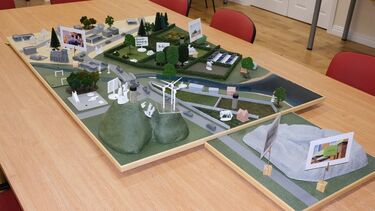
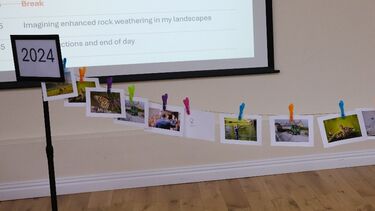
A key characteristic of the tools-augmented group interactions was how they successfully promoted personally meaningful experiential talk. Group discussion can highlight culturally sensitive forms of meaning making. Shifts in social perception in place occurred when moving a model object (i.e. a plastic figure of buildings, wind turbines, people or animals) or image object (photographs) to different places on the 3-D architectural model. Activating discussions, in ways that were important for the research, meant that group participants could find ways to attend to spatial and temporal changes pertinent to how science development and technologies had potential to affect people and the places that they live in.
Certain research ideas feeding into the day workshop drew principally from deliberative research. Here the established practice is for researchers to offer balanced, relevant expert and technological information on substantive and scientific matters, and to provide a context for discussion of a focal inquiry topic (ERW and as a novel CDR technology). Without this the session discussions would remain too unfamiliar and challenging to discuss (Pidgeon et al, 2014).
Participatory methods tend to interactive, free form activities, guided by participant interests. They are means of augmenting qualitative forms of engagement so that they are relatable (enjoyable, empathic etc). In our study they were purposively designed to create spaces and places where research activities could help make otherwise invisible or intangible phenomena more tangible and real.
Using this metaphor of making visible is widespread within social science methodology and practice. It counteracts over-reliance on using single methods (interviews, observation), and it seeks out ways of filling in their blind spots. Use of visual imagery is a particularly good example. It harnesses potentials that come with acknowledging the role of mental imagery and other imaginative engagements: this involves symbolisation as a more creative form of representation, while extending lived experiences in thought and talk (Henwood, Shirani and Groves, 2018; Henwood and Finn, 2010; Henwood and Colthart, 2012). Ways of making abstract ideas and phenomena that are at first only dimly perceived (basalt rock dust, carbonate deposition, gasification) visible to people in the spaces and places where people live and work was a key research task, and it involved finding lively ways for participants to engage with the presented topics and materials.
References
- Henwood, K., and Shirani, F. (2022). Qualitative longitudinal design: Time, change, interpretive practice. Chapter 25 in Uwe Flick (Ed) Sage Handbook of Qualitative Research Design pp 414-429
- Henwood, K., Shirani, F. and Groves, C. (2018). Using photographs in interviews: When we lack the words to say what practice means. Chapter 38 in U. Flick (ed) The Sage Handbook of Qualitative Data Collection London: Sage, pp599-614
- Henwood, K. and Coltart, K. (2012) Researching lives through time: Analytics, narrative and the psychosocial, A Timescapes Methods Guide (No10). In B. Neale and K. Henwood (eds) ISSN 2049-9248 (online) Timescapes Methods Guide Series - (2012) Publications and Outputs | Timescapes Archive
- Henwood, K. and Finn, M. (2010). Researching masculine and paternal subjects in times of change: Insights from a Qualitative Longitudinal (QLL) and psychosocial case study -ORCA. In Thomson, R. (ed) Timescapes Working Paper Series 3. Intensity and Insight: Qualitative Longitudinal Methods as a Route to the Psychosocial. http://www.timescapes.leeds.ac.uk/assets/files/WP3_final_Jan%202010.pdf
- Pidgeon, N.F., Demski, C.C, Butler, C., Parkhill, K.A. and Spence, A. (2014) Creating a national citizen engagement process for energy policy. Proceedings of the National Academy of Sciences of the USA, 111 (Sup 4), 13606-13613. DOI: 10.1073/pnas.1317512111.